Editor’s note: Please note that this topic is intended for readers aged 14 and over.
Arnaud Pontin (Image : Getty/PALMIHELP)
A misunderstood organ
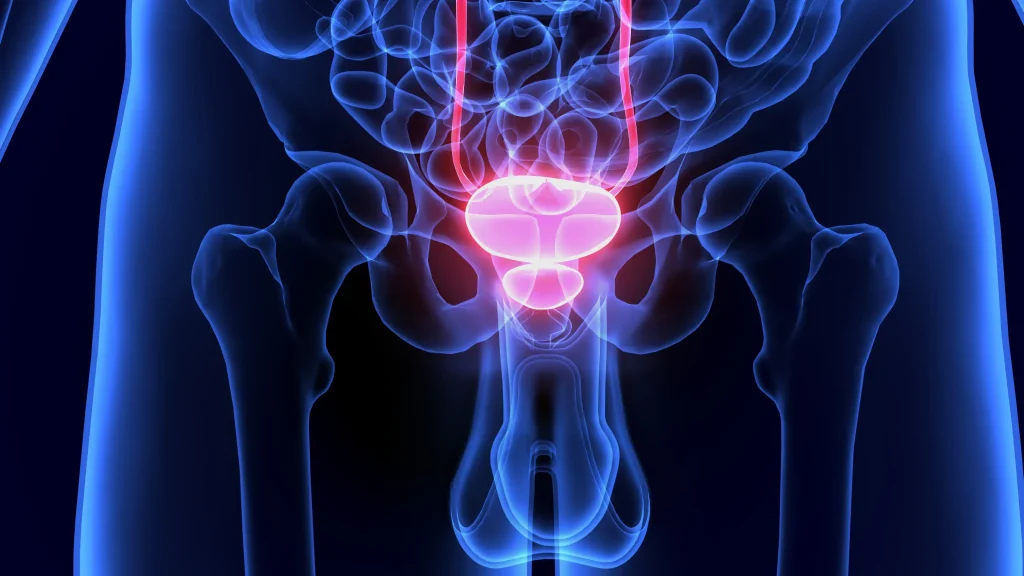
The prostate is a rather mysterious organ for many, and its function and usefulness are sometimes difficult to understand. We have often discussed prostate health on Gay Globe, an organ found only in men, but we have rarely addressed its role in sexuality. So let us take a closer look at this organ, which can prove to be as pleasurable as the genital organs.
An essential gland of the reproductive system
The prostate is a small gland located beneath the bladder in men, surrounding part of the urethra. Its main role is to produce part of the seminal fluid, meaning the fluid that transports sperm during ejaculation.
This prostatic fluid is not just a simple “support”: it helps protect sperm, improves their mobility, and extends their survival within the female genital tract thanks to its slightly alkaline composition, which partially neutralizes acidity.
On a mechanical level, the prostate also plays a role during ejaculation itself. Its muscles contract to expel prostatic fluid and semen into the urethra, contributing to the orgasmic process.
Prostate and pleasure: a complex neural role
What makes it unique is its neural environment. The prostate is located very close to several structures rich in nerve endings involved in sexual pleasure. When stimulated indirectly or internally, it can activate nerve areas associated with orgasm, which explains why some men report different sensations, sometimes more diffuse or deeper than penile stimulation alone.
An anatomical dimension must also be added: the prostate is close to the rectum, making it accessible through internal stimulation, without being visible or directly exposed like external genital organs. This accessibility has contributed to its exploration in sexual practices, even though its primary role remains reproductive.
Finally, this shift toward a sexual function mainly comes from human experience: it is not that the prostate was designed as a pleasure organ, but rather that the male nervous system can interpret its stimulation as pleasurable due to its connections with orgasm circuits.
A neural crossroads of male pleasure
The prostate is surrounded by a very dense nerve network called the pelvic plexus, which communicates with nerves involved in sexual sensitivity, particularly the pudendal nerve. Even though the prostate itself is not an external erogenous zone, it sits at the heart of a neural crossroads that contributes to the overall sexual response.
When it is stimulated, usually through the rectal wall which is in close contact with it, pressure or movement can activate these nerve endings. This stimulation is then transmitted to the central nervous system, which integrates it into pleasure circuits. What is distinctive is that this pathway is not exactly the same as penile stimulation, which can produce different sensations, often described as deeper, internal, and more diffuse.
There is also a central component: the brain. As with any sexual experience, the perception of pleasure depends on the brain’s integration of nerve signals, particularly in reward-related areas. Prostatic stimulation can therefore activate these circuits in a way similar to other forms of sexual stimulation, but with a different sensory signature.
Testimonial: Michel, 42
Michel, 42, says he had never considered the prostate as anything other than a medical subject reserved for routine examinations. Heterosexual, not very informed on the topic and rather reserved about intimate sexuality, he explains that everything changed following a relationship of trust with his partner.
“At first, I was very closed off to the idea. For me, it had no connection to pleasure, even less to my sexuality,” he explains. It was his partner who, gradually, brought up the subject, not from a performance angle, but from bodily discovery and mutual curiosity.
According to his testimony, the first experiences were mainly marked by discomfort and a phase of psychological adjustment. “It didn’t feel natural in my mind at the beginning. I had to understand that it wasn’t a questioning of who I am,” he specifies.
With the time, Michel says he discovered sensations he had never experienced before. He describes internal perceptions different from usual stimulation. “It’s not the same thing, it’s not better or worse, it’s simply something else,” he says cautiously.
He emphasizes above all that this discovery was made possible thanks to a climate of trust and communication within his relationship. For him, the experience is less about technique than psychological comfort and mutual consent.
“I think the most important thing is not what you do, but the state of mind you do it in,” he concludes.
Testimonial: Ziggy, 23
Ziggy, 23, explains that his discovery of prostatic stimulation profoundly changed the way he perceives his sexuality with male partners. He describes a new bodily experience that broadened his relationship to sensations and intimacy.
According to him, this internal dimension of pleasure has become an important part of his sexual life, to the point of influencing his expectations and preferences in relationships. However, he insists that it is above all a personal and evolving exploration, built gradually within a framework of trust and consent.
“It changed the way I understand my body,” he summarizes.
A modern rediscovery of the male body
One could say that the prostate, long confined to the vocabulary of doctors and health check-ups, has ultimately managed quite an unexpected parallel career… that of an object of intimate curiosity. As if some organs spend their lives doing biological accounting by day and sensory reinvention by night.
ADVERTISING

READ ALSO