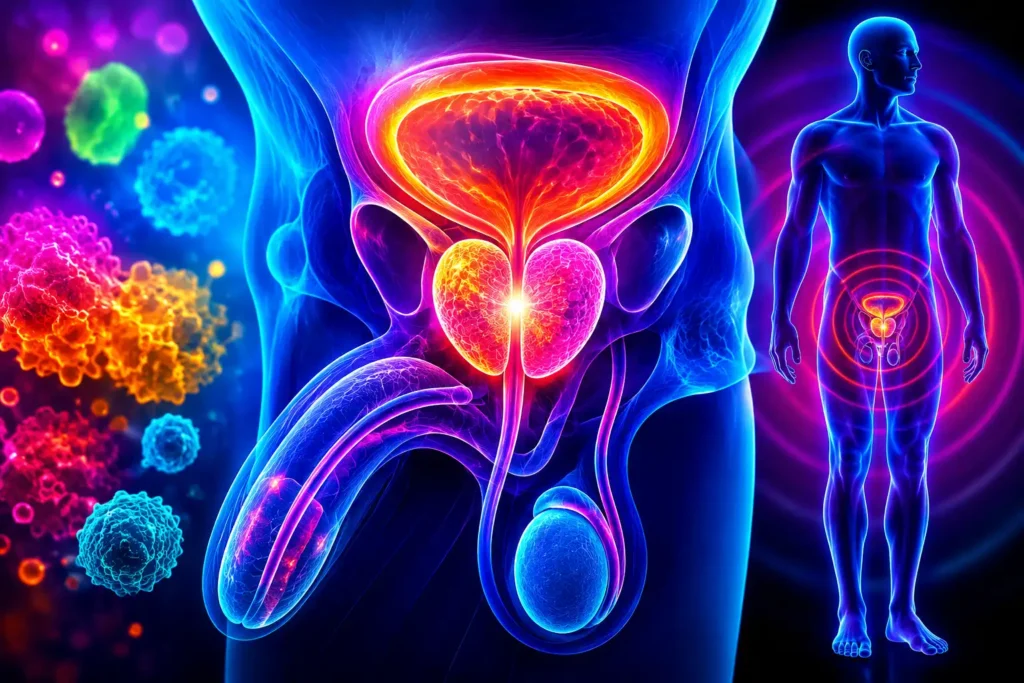
Arnaud Pontin (Image : AI / Gay Globe)
One of the cancers that affects only men and whose number of diagnosed cases continues to rise, largely due to early screening and improved detection methods, is prostate cancer.
Prostate cancer remains one of the most significant public health challenges affecting men worldwide. According to the latest estimates from the International Agency for Research on Cancer (IARC) and GLOBOCAN, nearly 1.5 million new cases were diagnosed globally in 2024. During the same year, approximately 420,000 men died from the disease.
Today, prostate cancer is the second most commonly diagnosed cancer in men, after lung cancer. It is also the fourth leading cause of cancer-related death among men worldwide. Experts note, however, that these figures vary considerably from one region to another. Countries with well-established screening programs, greater access to cancer treatments, and advanced healthcare systems generally report significantly higher survival rates.
Despite its high incidence, prostate cancer often has a favorable prognosis when detected at an early stage. In developed countries, the five-year survival rate typically exceeds 95%, reaching nearly 99% when the tumor is confined to the prostate at the time of diagnosis. By contrast, metastatic prostate cancer, which has spread to other parts of the body, remains much more difficult to treat and accounts for the majority of deaths associated with the disease.
Good News for Prostate Cancer Research
An experimental combination therapy could transform the treatment of men diagnosed with high-risk prostate cancer. Results from an international Phase III clinical trial show that adding an intensive hormone therapy to radiation therapy reduces the risk of disease progression by nearly 50%, helping prevent the cancer from developing into a more aggressive form.
The study, led by researchers at the Huntsman Cancer Institute at the University of Utah, involved men with localized prostate cancer considered to be at high risk of recurrence. Participants received radiation therapy combined with standard androgen deprivation therapy, while a second group also received a next-generation hormonal therapy.
Researchers found that patients receiving the combined treatment were significantly less likely to develop castration-resistant prostate cancer, an advanced stage of the disease that is much more difficult to treat. The benefits also included a reduction in metastases, improved progression-free survival, and better overall disease control.
According to the study authors, these findings could reshape clinical practice for patients with the most aggressive forms of prostate cancer. They believe that intensifying treatment immediately after diagnosis may help control the disease before it becomes resistant to conventional hormone therapies.
Although most cases detected through early screening can be treated successfully, high-risk prostate cancer remains associated with an increased likelihood of recurrence, metastatic disease, and other serious complications.
The results of this clinical trial reinforce the growing belief that personalized treatments, introduced earlier in the course of prostate cancer, can significantly improve prognosis, quality of life, and overall survival for thousands of patients every year. These advances also reflect the rapid progress being made in oncology, precision medicine, and the development of innovative therapeutic strategies against prostate cancer.
ADVERTISING

READ ALSO
HPV Vaccine: Near-Complete Protection Against Several Cancers Confirmed in Europe and North America
https://gayglobe.net/en/hpv-vaccine-protection-cancers/
Hepatitis A and Hepatitis B Vaccination in Gay Men: From the 1990s Public Health Campaigns to Bepirovirsen Innovation
https://gayglobe.net/en/hepatitis-a-b-vaccination-gay-men-1990s-bepirovirsen/
21 Ejaculations per Month: What Does the Harvard Study Really Say About Prostate Cancer?
https://gayglobe.net/21-ejaculations-per-month-what-does-the-harvard-study-really-say-about-prostate-cancer/
Testicles and the Cremasteric Reflex: How This Natural Protection Works
https://gayglobe.net/sexual-health-testicular-health-cremasteric-reflex/
Discreet Organ, Intense Sensations: The Surprising Role of the Prostate
https://gayglobe.net/en/prostate-male-pleasure/