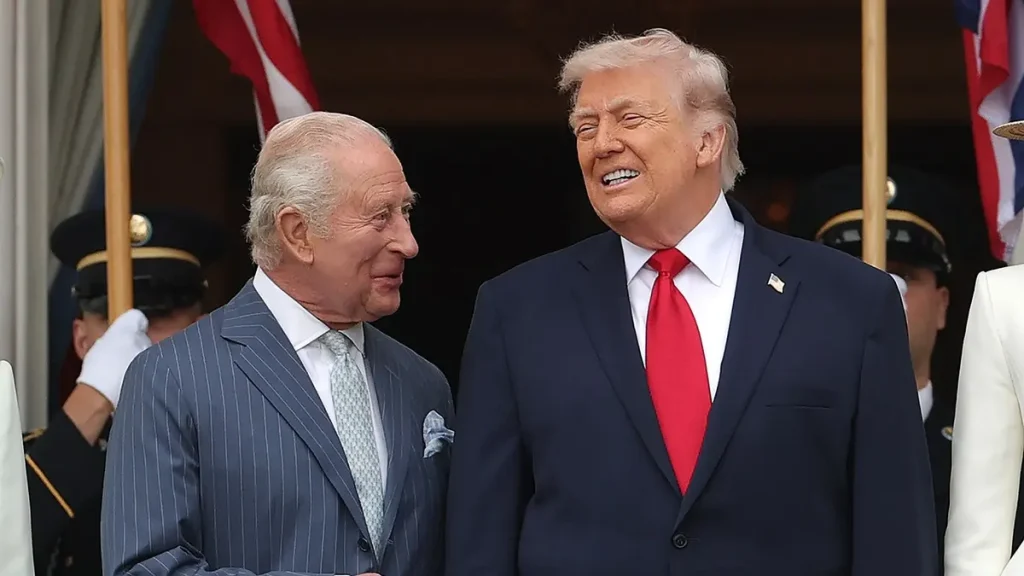
Carle Jasmin (Photo : Kevin Dietsch / Getty Images)
We must admit it, King Charles III demonstrated a remarkable sense of humor during his meeting with President Trump as part of his official visit currently taking place in the United States alongside Queen Camilla.
A joke about FIFA and state roles
The first joke, subtle yet highly meaningful, came when he referred to the upcoming arrival of international teams for the FIFA World Cup. He is said to have told President Trump: « As Canada and the United States will soon receive the teams for the FIFA, and since we are both heads of state, we might as well say that we are co-organizers », he said laughing, implying that he was also the King of Canada.
A historical remark on the Second World War
During the state reception held in his honor, when he referred to Trump’s statement that without the United States during the Second World War, Europe would today be speaking German, the King said: « Dare I say that, without us, you would be speaking French », he said laughing, referring to the historical role of the United Kingdom in North America in relation to the French presence.
French, a language of prestige at the British court
And on this point, although the general public knows it little, it should be noted that French has long been a language of prestige at the British court, particularly in diplomatic and aristocratic usage. This explains why Queen Elizabeth II, Prince Philip, and their children, including King Charles III, speak fluent French.
The history of the French at the British court is ancient, prestigious, and sometimes counterintuitive if one imagines English as the “natural” language of power in England.
It all begins after 1066, with the Norman Conquest led by William the Conqueror. From that moment on, the nobility ruling England spoke essentially an early form of French, Norman French. For several centuries, French became the language of the elite, of law, and of the court, while the common people spoke English. This linguistic separation was so strong that some fundamental English words come directly from the French of that period, particularly in law, cuisine, and politics.
The gradual shift toward English began in the 14th century, notably after the Hundred Years’ War, when tensions between France and England made the use of French less central. English then gained ground in administration and literature, eventually becoming the dominant language of the state.
But French never completely disappeared from the court. It remained for a long time the language of European diplomacy and aristocratic exchanges. Even after its decline as an administrative language, it retained a status as a language of cultural prestige. At the British court, French remained a language taught to elites, used in certain formal and diplomatic contexts.
During the 19th and 20th centuries, speaking French was still part of the classical education of members of the British royal family and aristocracy. It is within this tradition that figures such as Queen Elizabeth II, Prince Philip, and King Charles III were educated, all trained in foreign languages, including French, considered essential for international relations.
Even today, French still retains a symbolic presence in certain official uses of the British monarchy. During Royal Assent, the formal approval of laws by the sovereign, a traditional Norman French phrase is used: « La Reyne le veult » or « Le Roy le veult », depending on the monarch. Furthermore, the motto on the royal coat of arms of the United Kingdom is also in French: « Dieu et mon droit », a medieval legacy that reflects the lasting influence of the French language in British institutional history and its former role as a language of prestige and power.
But, of all this, Mr. Trump knows nothing!
ADVERTISING

READ ALSO