Arnaud Pontin (Image : AI / Gay Globe)
An alarming rise in online hate
An alarming rise in online hate
Hate against gay and lesbian communities has never been as intense on social networks, and it is time to be concerned about it, not only because of the ease with which it spreads, but above all due to the inertia of law enforcement authorities, who are nonetheless responsible for enforcing laws against hate speech on the web.
Champion: Facebook
Originally, Facebook was created in 2004 by Mark Zuckerberg and a few students from Harvard University with a very simple goal: allowing students to connect with each other online.
The concept was inspired by “face books,” paper directories used on campuses to identify students. The first version of the site, called TheFacebook, was essentially used to consult profiles, view photos, and see who was enrolled at the university. It was therefore an internal social tool, initially limited to Harvard, then gradually extended to other universities.
The initial ambition was not yet to create a global social media giant, but rather to reproduce online the social interactions of a campus: introducing oneself, expanding one’s circle, and staying in touch. It was only through its rapid expansion that the platform evolved into a global social network, with much broader features such as content sharing, messaging, and later targeted advertising.
Unfortunately, the monster Facebook has become, and especially its financial appeal—generating billions of US dollars per year—has transformed a completely innocent concept into a tool for spreading all forms of online hate, without any real moderation seeming to take place, whether by moderators or by algorithms that are claimed to exist but are rarely seen in action.
Why hateful content keeps circulating
The situation is less simple than voluntary “hands-off” moderation, even if the result may give that impression. Facebook (now part of Meta) combines several factors that explain why anti-LGBT hate content continues to circulate.
First, there is an issue of scale. Billions of posts are published every day. Even with automated systems and moderation teams, everything cannot be processed immediately, and much content slips through the cracks.
Then, algorithms play an ambiguous role. They are designed to maximize engagement—reactions, shares, comments—and polarizing or shocking content often generates more interaction. Without being explicitly programmed to promote hate, they can indirectly increase its visibility.
There is also a gray area surrounding freedom of expression. The platform tries to distinguish between opinion, offensive speech, and truly illegal hate speech. This boundary varies from country to country and according to different laws, making uniform enforcement extremely difficult.
Moderation itself is imperfect. Automated tools struggle to understand context, irony, or coded language used to bypass rules. Human moderators, meanwhile, are limited in number and must handle massive volumes, often under difficult conditions.
There is also an economic and strategic dimension. Stricter moderation can reduce engagement and expose the platform to accusations of censorship, placing it in a delicate balance between regulation, public image, and profitability.
Hate speech laws: three visions of the world
In major Western democracies, the issue of hate speech targeting LGBT people is shaped by a clear dividing line: protecting minorities without abolishing freedom of expression. But from one continent to another, the balance is very different.
Canada
In Canada, the legal framework is relatively strict, although often considered insufficient in practice. The Criminal Code of Canada explicitly prohibits “hate propaganda” targeting identifiable groups, including sexual orientation and gender identity.
These restrictions are nonetheless framed by the Canadian Charter of Rights and Freedoms, which protects freedom of expression while allowing “reasonable limits.”
In practice, several experts denounce a legal gap and limited enforcement, particularly online, which allows a significant amount of online hate content to circulate.
United States
In the United States, there is no general law banning hate speech, including against LGBT people. The dominant principle is based on the First Amendment, which protects freedom of expression very broadly.
Hateful speech remains legal unless it constitutes direct incitement to imminent violence or a real threat.
As a result, anti-LGBT discourse can circulate freely, although it may be indirectly sanctioned in specific contexts (harassment, discrimination, hate crimes).
Europe
In Europe, the approach is more interventionist, often shaped by the history of fascism and propaganda. Most countries strictly regulate hate speech, including that targeting sexual minorities.
The general framework is based on the European Convention on Human Rights, which guarantees freedom of expression but allows restrictions to protect dignity and public order.
In countries such as France or Germany, statements inciting hatred or discrimination against LGBT people can lead to criminal prosecution, and platforms are sometimes legally required to quickly remove illegal content.
Influencers and the radicalization of discourse
The role of certain conservative Christian influencers fits into a dynamic that is simultaneously ideological, media-driven, and political.
These actors use social media codes to amplify their messages. Short videos, punchy phrases, emotional storytelling: they translate religious or moral positions into viral content, often centered on themes such as “defending the family,” “protecting children,” or criticizing what they call a gender ideology.
Not all religious actors are involved, but a more activist fringe does instrumentalize these platforms to construct an antagonistic narrative toward LGBT rights.
The goals vary: cultural influence, political mobilization, or electoral impact. In some cases, polarization itself becomes a strategy, since divisive content generates more engagement.
There is also an economic dimension: outrage increases visibility, audience growth, and sometimes revenue.
Maggy, victim of a crushing machine
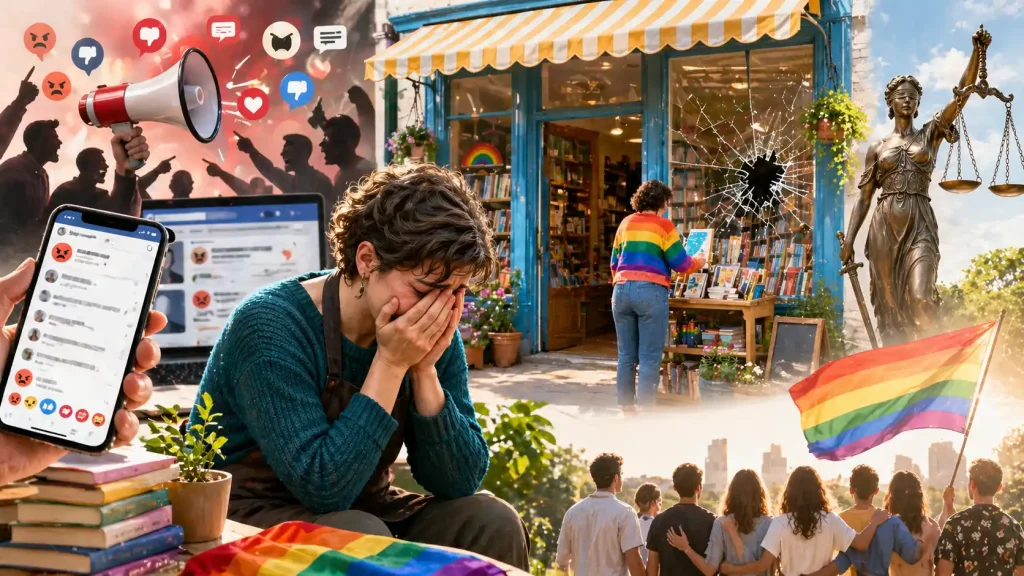
Maggy ran a small independent bookstore in Chicago. A space filled with queer literature, activist novels, and poetry. For many, it was a refuge.
Everything collapsed after a viral video. A misleading montage accused her bookstore of “indoctrinating children.” It spread rapidly across social networks.
Other accounts amplified the narrative. Maggy was targeted, her identity exposed, her store described as dangerous. Online harassment escalated: insults, threats, and calls for action.
Then it moved offline. People gathered outside. Her storefront was photographed, monitored, and vandalized. One night, the façade was attacked.
Maggy tried to respond, but misinformation spread faster than truth. Customers disappeared. Fear replaced trust.
Eventually, she closed the bookstore.
Inside, everything remained intact, but the space had lost its meaning. It had become a symbol of how online hate can destroy real lives.
A radical solution?
Laws alone are often insufficient given the volume of hate speech online. One possible lever is the accountability of social media platforms themselves.
A handful of companies control most of the ecosystem. Stronger sanctions—financial penalties, operational restrictions, or personal liability for executives—could fundamentally change incentives.
Freedom of expression exists to protect lawful expression, not to justify hate against protected groups.
Food for thought.
ADVERTISING

READ ALSO