Roger-Luc Chayer (Photo : Roger-Luc Chayer / Gay Globe)
Thursday, 1 p.m. At the corner of Dandurand Street and 5th Avenue, in the Rosemont borough of Montreal, a sad incident unfolded that could have turned into a tragedy, all because of those damn potholes that no one repairs despite the obligation to do so.
On my way to the post office on Masson Street, I stopped at the corner of 5th Avenue and Dandurand when I heard a metallic sound and, out of the corner of my eye, I saw, like in a slow-motion film, a lady on a tricycle being thrown into the air and landing on the asphalt right in the middle of the intersection. A teenage boy was watching her from the sidewalk, not knowing what to do.
The lady lay face down in the middle of the street. She was no longer moving.
Without thinking, I turned off my vehicle in the middle of the lane and, leaving my door wide open, rushed toward the lady to ask if I could help. Another man then came to join me. The lady said she had very severe pain in her hip. She was clearly a person suffering either from cerebral palsy or a neurodegenerative disease; she could not move on her own.
So, with great care, the man and I lifted the lady to get her back on her feet to see if she might have a fracture. She said she would certainly have a bruise, but that she could return home. We asked whether it would not be safer to call an ambulance to have her examined, but she refused, probably hurt in her pride and in her heart for having ended up in such a situation.
Once placed back on her tricycle, she headed back to her residence.
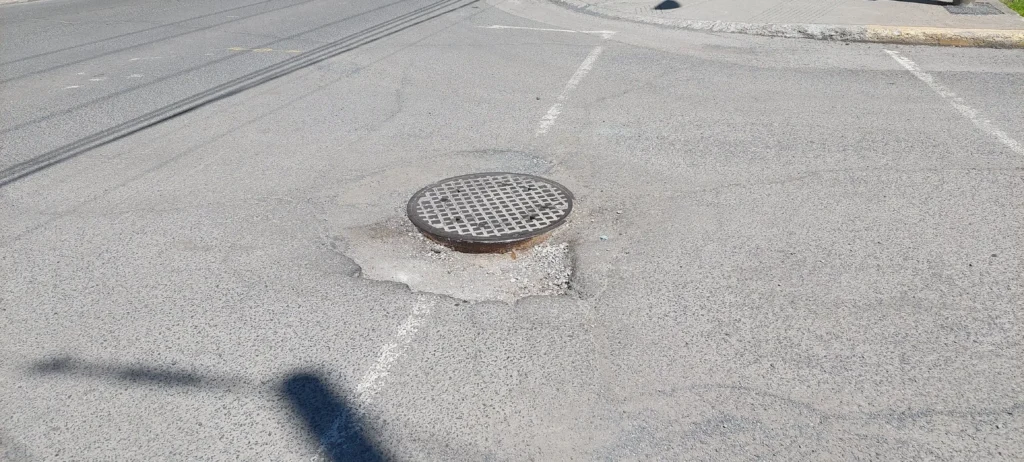
The culprit: a deep pothole in Montreal strategically placed beside a storm drain that she could not see. It was located directly in the passage between the two sidewalks. That pothole could have killed her.
Since last autumn, Dandurand Street has become a real battlefield, completely destroyed by potholes forcing motorists, cyclists, and pedestrians to slalom their way through. This street is the very emblem of what the city of Montreal has become as a whole: a metropolis in ruins where circulation routes, although essential in such a city, no longer allow normal movement and cause damage at every level.
Responsibility of Montreal boroughs regarding potholes
And yet, in Rosemont, we have a borough mayor, François Limoges, who does absolutely nothing. But we are used to that, we Rosemont residents, because for years, all the commitments he made to me, at least, he has never respected. Mayor Limoges shows blatant irresponsibility and, despite the state of our streets, alleyways, and the traffic he constantly tries to block, he does nothing of what he says he will do.
In Montreal, responsibility for potholes generally falls to the borough for local streets. Borough public works departments are responsible for maintaining the road network, which includes repairing road surfaces, sidewalks, and potholes.
In the case of Rosemont–La Petite-Patrie, the borough therefore has the obligation to ensure reasonable maintenance of local streets such as Dandurand Street. The City of Montreal also states that potholes must be patched year-round, not only when it suits the mayor.
According to the Montreal ombudsman, in a situation involving bodily injury, such as a fall caused by a pothole, the issue can become legally more serious if it can be demonstrated that the dangerous condition of the street was known, reported, or clearly neglected over a long period of time. The duration is clearly evident here. Potholes are scattered holes that appear unpredictably in front of drivers and cyclists and cause thousands of dollars in damage to any vehicle unlucky enough to hit them. Ask Mayor Valérie Plante, who lost two tires on Notre-Dame Street this spring.
That said, this situation is not only dangerous for motorists but also for cyclists, who must constantly avoid them and sometimes end up cutting into traffic to avoid damaging their bikes. There are also people with disabilities, who do not have the dexterity required to constantly deal with uneven terrain, whether in wheelchairs, with crutches, or a cane.
Even worse, we live in a society that values the autonomy of people with disabilities. Imagine for a moment how visually impaired people feel when they must go out to shop, attend medical appointments, or simply go out for dinner or attend a concert. These people absolutely need properly maintained roads in order to move on foot. White canes cannot detect all the holes in the street, and when a visually impaired person detects one in front of them, they must decide whether to go left or right, whether to pass alongside moving vehicles they cannot see, or whether to move forward into the unknown, since in their routine they never take alternative routes.
A situation denounced in the media regarding potholes in Montreal
The situation can no longer continue and is being discussed in all media, even in the United States and Europe, as Montreal’s situation has become increasingly concerning.
This weekend, we will welcome more than 350,000 tourists who will come for the Montreal Formula 1 Grand Prix or for the hockey finals at the Bell Centre. We will show the world how a third-world city can exist in North America.
If you have a solution, feel free to comment at the bottom of this article.
ADVERTISING