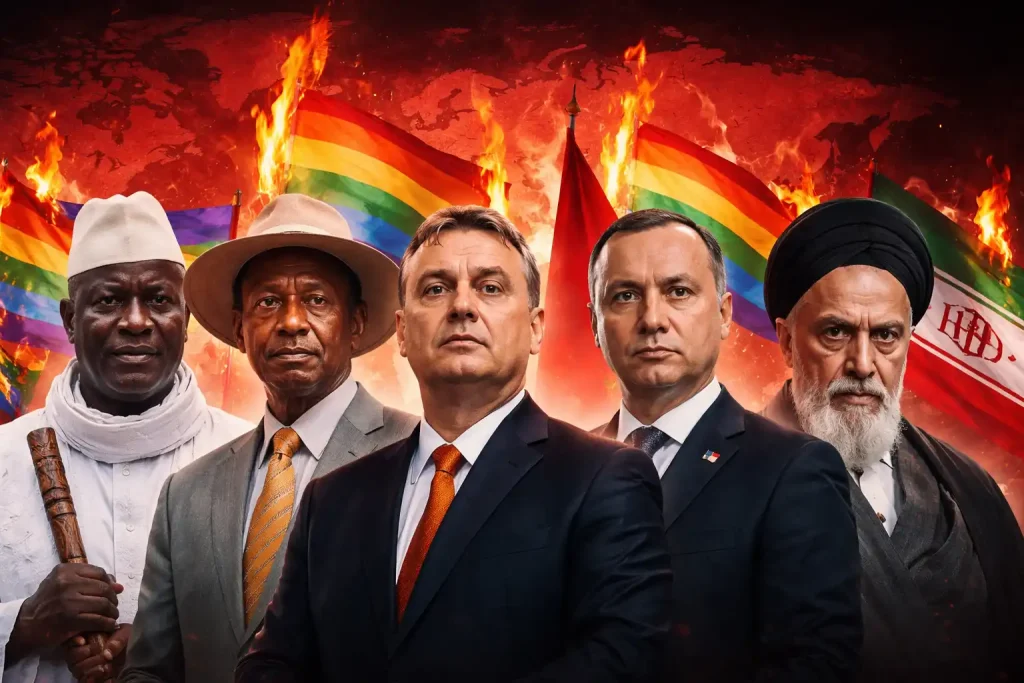
Arnaud Pontin (Image : AI / Gay Globe)
State Homophobia: The Most Repressive Heads of State Around the World
I have always been interested in geography and the global socio-political situation, and it was after proposing to Gay Globe to address the issue of extreme homophobia worldwide that I discovered some particularly striking facts.
We often hear about countries where extremely restrictive and punitive laws are adopted against LGB people, but we rarely know the names of the heads of state responsible — therefore culpable — since these policies sometimes involve penalties up to execution. Here are the main leaders of some of the most violently homophobic countries, about whom very little is actually known. Let me introduce them to you.
Yahya Jammeh, former president of The Gambia
The champion above all and frequently mentioned in the media is Yahya Jammeh, former president of The Gambia.
Yahya Jammeh, born May 25, 1965, in Kanilai, remains one of Africa’s most notoriously infamous leaders for having turned homophobia into a true instrument of power. Rising to power in 1994 following a military coup when he was only 29, he ruled the country for more than twenty-two years until his fall in 2016. Throughout his reign, the repression of homosexual people became one of the most visible and shocking hallmarks of his authoritarianism.
Very quickly, Jammeh understood that homophobia could serve as a political lever. By publicly targeting LGB people, he appealed to the most conservative currents in society while diverting attention from widespread criticism of his governance, corruption, and systematic human rights abuses. In his speeches, he regularly described homosexuality as “unnatural,” “anti-African,” or incompatible with Islam. At times, he went much further, making extremely violent statements, promising to eradicate homosexuals or inflict cruel punishments on them, declarations that sparked outrage far beyond Gambian borders.
Under his regime, the legal arsenal against homosexual people was significantly hardened. In 2014, Jammeh enacted a law introducing the concept of “aggravated homosexuality,” a deliberately vague qualification that could cover many situations. This offense was punishable by life imprisonment, placing The Gambia among the most repressive countries in the world concerning the rights of LGB people. This legislation created a constant climate of fear, forcing many to live in hiding, remain silent, or flee the country.
But violence was not limited to laws alone. Under Jammeh’s authority, arbitrary arrests, illegal detentions, and mistreatment were regularly reported by human rights organizations. Simple rumors or denunciations sometimes shattered lives. In a country where social stigma was already strong, this policy deepened the isolation and vulnerability of the people affected.
Since Yahya Jammeh’s electoral defeat and exile to Equatorial Guinea, The Gambia has begun a slow transition process. While the general climate has slightly eased, the legacy Jammeh left remains heavy, particularly for sexual minorities. The laws he strengthened have not all been abolished, and the wounds caused by years of state-sponsored homophobia are still very present. His reign remains a striking example of how hatred can be used as a political tool at the highest levels of government.
Yoweri Museveni, president of Uganda
Yoweri Museveni, born September 15, 1944, has been president of Uganda since 1986, making him one of Africa’s longest-serving heads of state. Coming to power after a guerrilla war, he long portrayed himself as a pragmatic and stabilizing leader. However, his international reputation is deeply tarnished by his extremely hostile policies toward homosexual people. Under his presidency, homophobia became a recurring political tool, often used to rally conservative and religious groups. Museveni supported or validated several laws heavily criminalizing homosexuality, including texts providing for very long prison sentences. By promoting a discourse that equates homosexuality with a moral and cultural threat, he helped establish a climate of fear, stigmatization, and violence against LGB people in Uganda.
Viktor Orbán, Prime Minister of Hungary
Viktor Orbán, born May 31, 1963, has been Hungary’s Prime Minister since 2010, after a first term between 1998 and 2002. A central figure of European conservative nationalism, he has gradually made institutional homophobia a cornerstone of his political strategy. Under his government, the rights of LGBT people have been severely restricted, notably by banning legal recognition of transgender people and through laws equating LGBT visibility to “propaganda” aimed at minors. Orbán regularly portrays homosexuality as a threat to the “traditional” family and Hungarian national identity. This discourse, widely disseminated by the state, has helped normalize stigmatization and further isolate sexual minorities, while drawing sharp criticism from the European Union and human rights organizations.
Andrzej Duda, former president of Poland
Andrzej Duda, born May 16, 1972, was president of Poland from 2015 to 2025 and remains a prominent figure in the country’s conservative shift. Close to the Law and Justice party (PiS), he framed his mandate around a firm defense of so-called “traditional” values, often to the detriment of LGBT rights. During his presidency, Duda regularly portrayed homosexuality and LGBT demands as a foreign ideology threatening the nation, the family, and childhood. He supported hostile political and symbolic initiatives, including so-called “LGBT-free zones,” which sparked serious concern across Europe. This presidential rhetoric helped legitimize stigmatization, heighten social tensions, and normalize discrimination against sexual minorities in Poland.
Recep Tayyip Erdoğan, president of Turkey
Recep Tayyip Erdoğan, born February 26, 1954, has been president of Turkey since 2014, after serving as Prime Minister for over a decade. Initially seen as a reformer, he gradually imposed authoritarian rule marked by pronounced religious conservatism. Under his presidency, the situation of LGBT people has significantly deteriorated. Erdoğan and his entourage regularly associate homosexuality with a Western-imported “moral decadence,” incompatible with Turkish and Islamic values. Pride marches have been banned, LGBT associations harassed, and hate speech has become commonplace at the highest levels of the state. This institutional hostility has deepened social stigmatization and exposed sexual minorities to increased violence and discrimination in Turkey.
Special mention for Ruhollah Khomeini
Ruhollah Khomeini, a key figure of the 1979 Iranian revolution, left a profound mark by turning Iran into a theocracy where anything deviating even slightly from strict religious norms is harshly punished. Regarding homosexuality, Khomeini was uncompromising: for him, it was clearly a “crime” deserving the harshest punishments, including the death penalty without hesitation. With a dramatic flair and puritanism to match, he established a regime where even the slightest expression of LGBT identity was not only taboo but extremely dangerous. No wonder that under his rule, being oneself was almost an extreme sport. To put it plainly, his policies gave a strong boost to repression, recycling fear as a tool of social control.
Under the regime established by Ruhollah Khomeini following the 1979 Islamic revolution, executions of homosexuals did occur in Iran. The Islamic legislation put in place by Khomeini severely criminalized homosexuality, often punishing it with the death penalty, particularly for relations between men. Numerous reports from human rights organizations documented arrests, torture, and executions of homosexuals in the years following Khomeini’s rise to power. This repressive climate has unfortunately persisted under the regime, making Iran one of the countries in the world where homosexuality is most harshly punished.