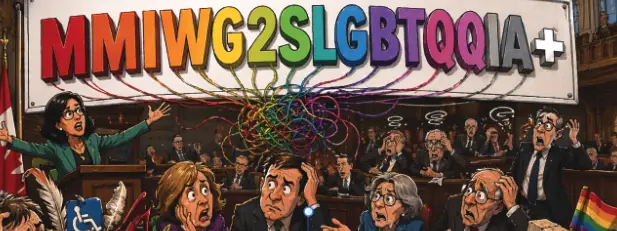
Opinion by Carle Jasmin (Image : AI / Gay Globe)
Forget the terms “gay and lesbian,” forget even the now-classic LGBTQ+. From now on, according to Leah Gazan, we should use the gigantic acronym MMIWG2SLGBTQQIA+ to describe the realities concerned. A proposal that on its own illustrates the excesses of an inclusion pushed to caricature and that is sparking strong reactions across the country.
MMIWG refers to Missing and Murdered Indigenous Women and Girls, a tragic national crisis widely documented by the National Inquiry. The 2S refers to Two-Spirit people, a specific Indigenous cultural concept. Then comes the long LGBTQQIA+ list: lesbian, gay, bisexual, transgender, queer, questioning, intersex, asexual, and the “+” which encompasses all other possible identities.
The issue is not recognizing the legitimacy of each of these realities, but merging them into a single acronym as if they formed a homogeneous and inseparable block. On one side, a specific social and historical crisis affecting Indigenous communities; on the other, questions of sexual orientation, gender identity, and sex characteristics. Juxtaposing them within a single acronym is more a matter of political alliance strategy than of logical or factual equivalence.
This approach deeply divides public opinion. On social media, the acronym has gone viral and is often mocked under the name “alphabet soup.” Many see it as an unnecessary complexity that makes the message inaccessible to the general public and dilutes concrete issues. Even within some progressive circles, voices are being raised to criticize this fusion, which risks turning precise struggles into one catch-all category.
Daniel Godbout, an openly gay Montrealer, expresses a frustration shared by many members of the community: “At some point, we have to keep a minimum of common sense. We are adding completely different realities with no direct link and claiming they form a coherent whole. It is not serious. People are speaking in our name without consulting us.”
This inflation of acronyms raises an essential question: how far can inclusive language be stretched before it becomes counterproductive? In Canada, inclusion should not mean confusion.
Clear, precise, and accessible language remains the best way to advance legitimate causes while maintaining public support. Excessive symbolism and complexity risk today weakening the very struggles they claim to defend, generating mockery, misunderstanding, and disengagement. It is becoming necessary to return to the essentials: the right words for distinct realities.
ADVERTISING