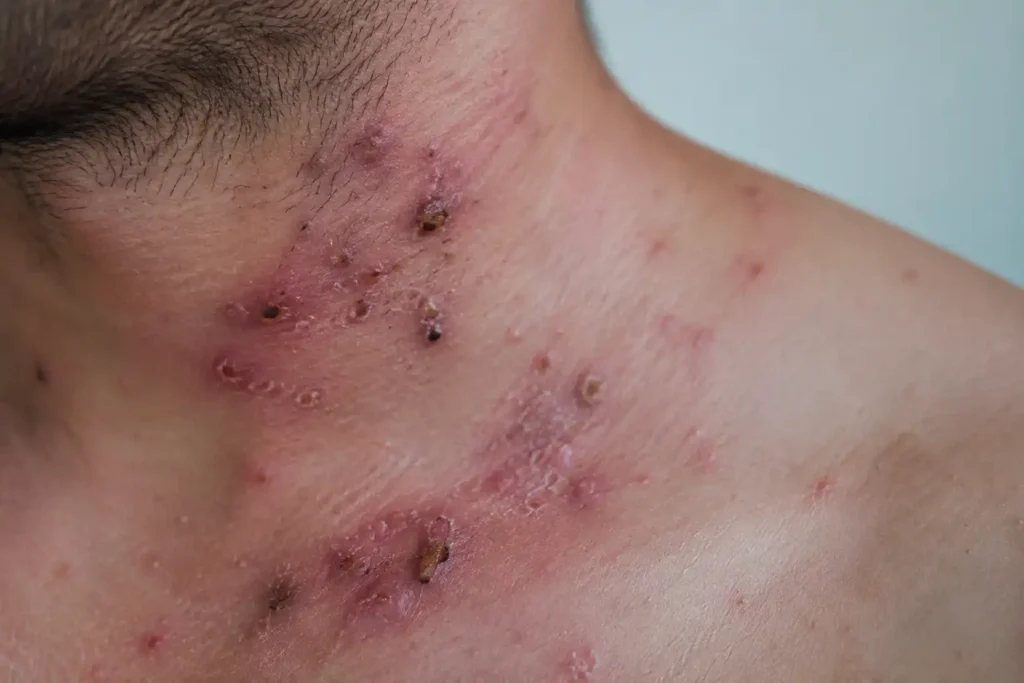
Roger-Luc Chayer (Image : AI / Gay Globe)
A new sexually transmitted disease appears to be emerging in humans. Until recently, this bacterium was known almost exclusively in animals. When humans became infected, it was generally following contact with livestock or other infected animals. However, recent outbreaks identified in Europe involve only human-to-human transmission, with no animal exposure reported.
The disease in question is dermatophilosis. More concerning still, current cases appear to be occurring exclusively among gay men.
What Is Dermatophilosis?
Originally, dermatophilosis is a skin infection caused by the bacterium Dermatophilus congolensis. The disease is well known in veterinary medicine, where it primarily affects cattle, horses, sheep, goats, and other domestic or wild animals living in humid environments.
In animals, the infection typically causes skin lesions characterized by thick crusts, hair or wool loss, and skin inflammation. The bacterium often takes advantage of small wounds or skin weakened by prolonged moisture to penetrate the body.
For decades, dermatophilosis was considered a rare zoonotic disease in humans. The few documented human cases mainly involved farmers, livestock workers, veterinarians, or individuals in close contact with infected animals. Lesions were generally limited to the skin and appeared following occupational or environmental exposure to the bacterium.
In recent years, however, European researchers have reported unusual cases of human-to-human transmission, particularly within sexual networks. This has led some specialists to question whether dermatophilosis could represent an emerging sexually transmitted infection (STI). Data remain limited, and dermatophilosis is not currently classified as an official STI by most public health authorities.
Nevertheless, several physicians already consider it an emerging STI.
Recent Cases Reported in Europe
Since late 2025, clusters have been identified in Spain, particularly in Barcelona, and in France, especially in Lyon, Paris, and several other cities. Approximately forty cases have been reported in France.
These infections have primarily affected men who have sex with men (MSM), with no reported contact with animals.
Several factors support the hypothesis of sexual transmission:
- Skin lesions (papules, pustules, crusts) frequently located on the genital area, perineum, buttocks, or beard region.
- Common participation in sexual networks.
- Strong genomic similarity between bacterial strains isolated from different patients.
- Absence of animal exposure.
- Probable transmission through prolonged skin-to-skin contact during intimate encounters rather than through bodily fluids, as seen with many traditional STIs.
Specialists publishing in medical journals and investigators in France and Spain describe dermatophilosis as a potential new STI or, at minimum, a disease with suspected sexual transmission. It is not yet classified as a “classic” STI such as chlamydia or syphilis because transmission does not appear to be exclusively sexual and research remains recent.
However, the available evidence is strong enough for medical authorities to monitor the disease closely. Humidity and close physical contact appear to facilitate transmission.
Among gay men, the term “promiscuity” is often used to describe having sexual relations with multiple partners over a given period. However, the concept remains subjective and varies across cultures, communities, historical periods, and personal perceptions. Public health researchers increasingly prefer neutral expressions such as “multiple sexual partners” or “high number of sexual partners” to avoid the moral judgments often associated with the word “promiscuity.”
Symptoms, Treatment, and Prognosis of Dermatophilosis in Humans
The symptoms observed in recent human-to-human cases are primarily cutaneous and generally mild. They often appear within a few days following intimate contact, with a median incubation period of approximately six days.
Common Symptoms
- Folliculitis-like lesions involving inflammation of hair follicles.
- Small papules (bumps), red pustules, or vesicles.
- Thick crusts that may ooze or become scaly.
- Inflamed plaques or skin redness (erythema).
- Itching (pruritus), often significant but usually not painful.
The most common locations include areas exposed during sexual activity:
- Genitals
- Pubic region
- Groin
- Thighs
- Buttocks
- Anal area (less common)
- Beard and facial regions, especially around the mouth
Lesions may be multiple and affect several body areas simultaneously. While often visually striking, particularly because of the thick crusts, they generally remain superficial and do not involve deeper mucosal tissues.
Most patients do not experience fever, significant fatigue, or systemic symptoms, although rare exceptions have been reported.
Treatment Options
Treatment primarily involves oral antibiotics administered for approximately seven to ten days.
The most commonly prescribed medications include beta-lactam antibiotics such as:
- Amoxicillin
- Cefadroxil
- Cloxacillin
- Penicillin
Doxycycline, administered at 100 mg twice daily, is also considered an effective and frequently used treatment option.
In France, pristinamycin may also be prescribed depending on the clinical situation.
Available evidence indicates that Dermatophilus congolensis remains susceptible to several antibiotic classes, including beta-lactams, tetracyclines, and certain macrolides, making treatment generally straightforward.
Supportive Care
In addition to antibiotic therapy, local wound care is often recommended. This may include:
- Antiseptic solutions such as chlorhexidine or povidone-iodine.
- Gentle cleansing of lesions to promote healing.
- Careful removal of crusts when medically appropriate.
Topical antibiotic creams such as mupirocin have also been used, although their effectiveness appears limited when used alone.
Recovery and Outlook
Clinical observations reported in recent years indicate rapid symptom improvement, often within just a few days of starting treatment.
Complete recovery typically occurs within seven to fourteen days.
To date, reported cases have been considered mild and have not required hospitalization.
Medical specialists emphasize that professional diagnosis remains essential. Diagnosis generally relies on laboratory testing through lesion swabs or bacterial cultures to confirm the presence of Dermatophilus congolensis.
Self-medication with antibiotics is strongly discouraged. Inappropriate treatment may complicate diagnosis and contribute to antibiotic resistance.
Although some historical cases of dermatophilosis occasionally resolved spontaneously, experts currently recommend antibiotic treatment to accelerate healing and reduce the risk of transmission.
Available evidence suggests that new exposure to the bacterium may result in reinfection. However, no true relapses have been reported among patients who completed appropriate treatment successfully.
ADVERTISING

READ ALSO
Alcohol and Health: The Type of Drink Changes Everything, According to a Major Study
https://gayglobe.net/category/spot/
HIV: Anti-PD-1 Immunotherapy, a Promising Path Toward Durable Remission
https://gayglobe.net/category/spot/
What if Immunotherapy Could Finally Defeat HIV? The Breakthrough Approach That Is Shaking Up Science
https://gayglobe.net/en/
COVID-19 and mRNA: The Medical Revolution Born from a Pandemic
https://gayglobe.net/en/
Hepatitis A and Hepatitis B Vaccination in Gay Men: From the 1990s Public Health Campaigns to Bepirovirsen Innovation
https://gayglobe.net/en/
Fibromyalgia and Magnesium Deficiency: Symptoms, Diagnosis and Supplementation
https://gayglobe.net/en/fibromyalgia-and-magnesium-deficiency-symptoms-diagnosis-and-supplementation/
Discreet Organ, Intense Sensations: The Surprising Role of the Prostate
https://gayglobe.net/en/
Tooth Loss Among Street Drug Users: A Little-Known Phenomenon
https://gayglobe.net/category/local-and-international-english-news/
Urgent Health Emergency in Manitoba: HIV Is Spreading Rapidly
https://gayglobe.net/urgence-sanitaire-au-manitoba-le-vih-progresse-rapidement/
New HIV Treatment: Early Therapy May Lead to Long-Term Remission
https://gayglobe.net/magazine-gay-globe-161/