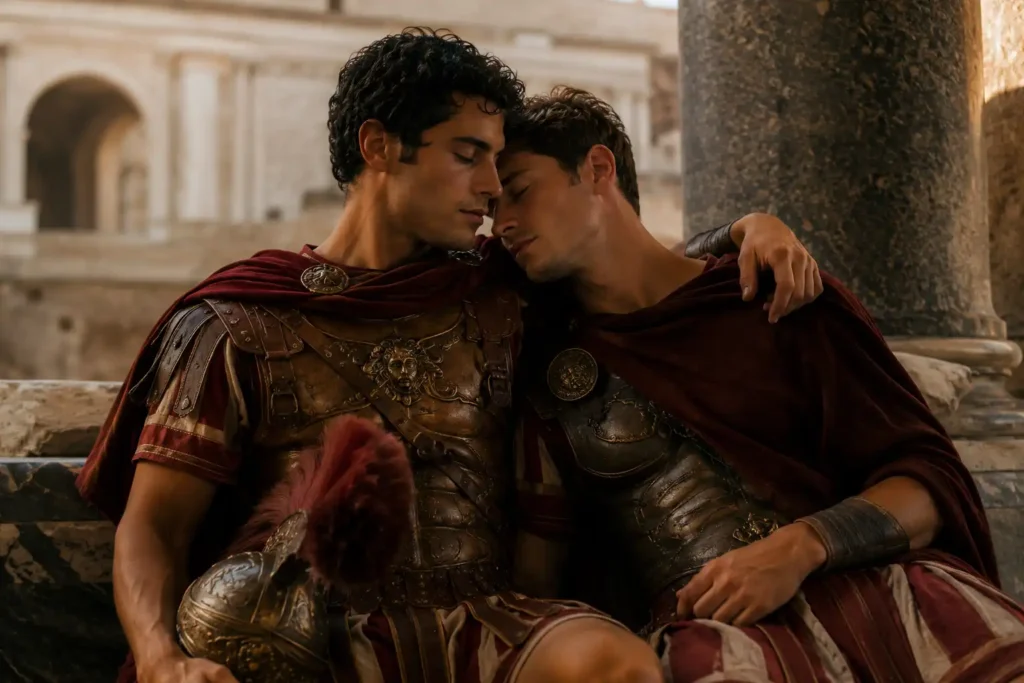
Arnaud Pontin (Image : AI 1 Gay Globe)
There are many remarkable stories of love, loyalty, and sacrifice from Antiquity that continue to inspire us today, especially when they involve figures with whom many members of the LGBTQ+ community identify.
Today, I would like to share the moving story of Sergius and Bacchus, two Roman soldiers who were martyred—not because of their alleged homosexuality, but because they refused to renounce their Christian faith.
Among the most compelling stories from the Roman Empire is that of Sergius and Bacchus, two high-ranking Roman officers whose lives continue to fascinate historians, Christians, and many people within the LGBTQ+ community.
The story unfolds in the early fourth century, during a time when the Roman Empire was marked by widespread persecution of Christians. Sergius and Bacchus held prestigious positions in the Roman army and enjoyed the respect of their superiors. Ancient accounts describe them as inseparable companions, united by profound affection, unwavering trust, and deep mutual loyalty.
Their lives changed dramatically when their Christian faith became known. Imperial authorities ordered them to abandon their beliefs and participate in ceremonies honoring the Roman gods. Calmly and resolutely, both men refused, choosing to remain faithful to their convictions despite the consequences.
Their decision cost them their military careers. Stripped of their rank and publicly humiliated, they nevertheless remained devoted to one another. According to tradition, Bacchus died first after enduring harsh treatment. Sergius continued alone, strengthened by the memory of his companion, before eventually being executed himself.
Ancient tradition also recounts that Sergius experienced a vision of Bacchus, encouraging him to persevere with courage until the very end. Whether understood as a historical event or a symbolic narrative, this episode has become one of the most memorable moments in their legend.
Over the centuries, Saints Sergius and Bacchus became highly revered in the Eastern Christian Church, with numerous churches and shrines dedicated to them throughout the Byzantine world.
Since the 1990s, their story has also attracted renewed scholarly attention. Some researchers have suggested that Sergius and Bacchus may have shared a romantic relationship, while most historians argue that the historical evidence points instead to an extraordinary spiritual friendship and brotherhood-in-arms. The surviving documents, however, do not provide enough evidence to settle the question definitively.
One fact remains beyond dispute: whether they were simply fellow soldiers, devoted friends, or a loving couple, Sergius and Bacchus have become enduring symbols of love, loyalty, courage, and unwavering commitment in the face of adversity. More than sixteen centuries after their deaths, their story continues to inspire those who believe that remaining faithful to one’s convictions—and to the people one loves—is one of life’s greatest acts of courage.
ADVERTISING

READ ALSO
Plato and Same-Sex Love: What His Writings Really Reveal
https://gayglobe.net/en/plato-same-sex-love/
Jean-Jacques-Régis de Cambacérès: The LGBTQ+ Architect Behind the Napoleonic Code
https://gayglobe.net/en/the-man-behind-the-civil-code/
INTERVIEW WITH VICTORIA PRICE
https://gayglobe.net/interview-with-victoria-price/
George Michael
https://gayglobe.net/george-michael/
Why do gay men love the TV series The Golden Girls so much?
https://gayglobe.net/why-do-gay-men-love-the-tv-series-the-golden-girls-so-much/