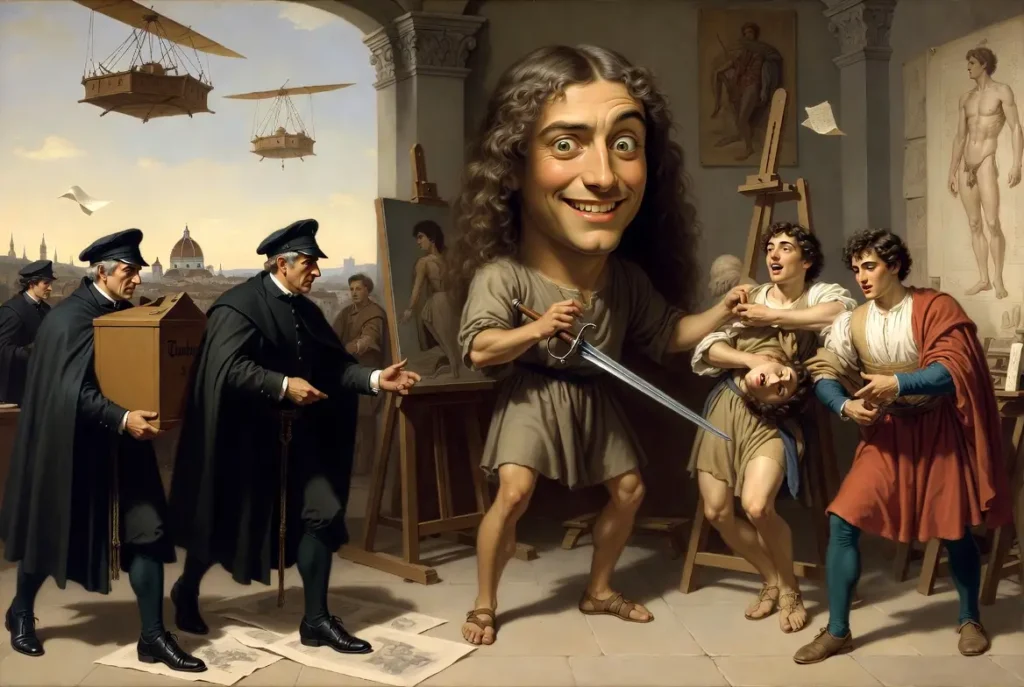
Carle Jasmin (Image : AI / Gay Globe)
Leonardo da Vinci Arrested for Homosexuality in 1476: The Forgotten Scandal That Still Intrigues Historians
Scandal! It has been revealed that Leonardo da Vinci was arrested for homosexuality. I know, this story is centuries old… but I had never heard about it until today!
According to historians, the arrest of Leonardo da Vinci is a well-documented episode from his youth.
In 1476, when he was about 24 years old and living in Florence, Leonardo was anonymously accused, along with three other young men, of having sexual relations with a young male prostitute named Jacopo Saltarelli. At the time, homosexual acts were considered a crime in the Florentine Republic and were prosecuted by authorities responsible for enforcing laws against “sodomy.”
The accusation was submitted through a public mailbox known as the Tamburo, where citizens could anonymously report alleged offenses. The charges were reviewed by the Officers of the Night (Ufficiali di Notte), a tribunal specialized in this type of case.
However, the case was quickly dismissed due to a lack of evidence. Because the accusation was anonymous and there were no witnesses or material proof to support it, authorities dropped the proceedings. A second attempt to reopen the case was also rejected a few weeks later for the same reasons.
Among those accused was also a young man from an influential Florentine family, leading some historians to suggest that political protection may have contributed to the dismissal of the case. However, there is no definitive evidence confirming this theory.
More than five centuries after his death, Leonardo da Vinci’s sexual orientation continues to attract the attention of historians. While several scholars believe he was probably homosexual, no direct evidence allows this to be stated with absolute certainty.
Beyond this arrest, several elements have attracted the attention of researchers. Leonardo da Vinci never married, no romantic relationship with a woman has been documented, and he maintained particularly close relationships with some of his students, including Salaì and Francesco Melzi, who shared an important part of his life. Some art historians also see in several of his works an idealized representation of male beauty.
These clues, however, remain circumstantial. Specialists point out that there are no letters, personal journals, or contemporary testimonies in which Leonardo discusses his sexual orientation. Relationships between masters and apprentices were also very different from those of today and cannot be interpreted solely according to modern standards.
The current historical consensus is therefore cautious. Many historians consider that Leonardo da Vinci was probably homosexual, but acknowledge that, without irrefutable evidence, it cannot be presented as an established historical fact. This distinction between historical probability and documentary certainty remains essential to understanding the private life of one of the greatest geniuses of the Italian Renaissance.
ADVERTISING