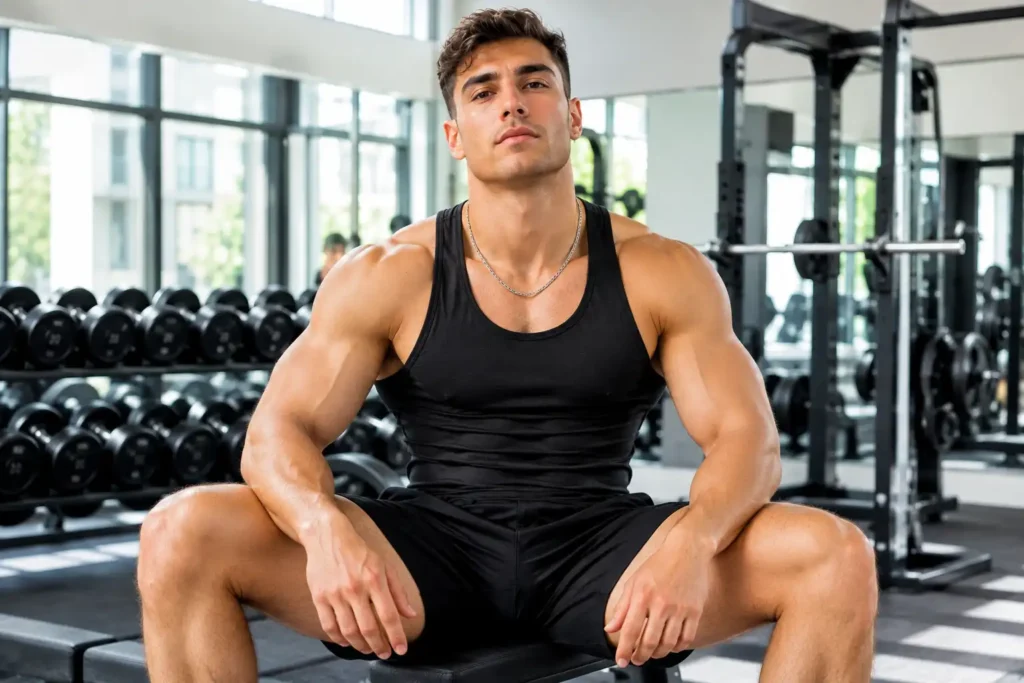
Carle Jasmin ( Image : AI / Gay Globe)
Key Takeaways
This investigation examines research on masculinity, social media, and certain trends observed among gay content creators. It does not support the existence of an organized “gay masculinism” movement—a notion that lacks consensus in the scientific literature.
When people talk about masculinism, attention almost automatically turns to heterosexual influencers who denounce feminism, discuss a “crisis of masculinity,” or advocate a return to traditional gender roles between men and women. Yet as social media reshapes social relationships, some observers are asking: do comparable phenomena also exist among gay men?
The answer is more nuanced than it first appears. Researchers consulted on the issue generally agree that, to date, there is no organized gay masculinist movement comparable to the heterosexual “manosphere.” However, several academic studies show that a portion of gay men participate in a culture in which masculinity, physical performance, virility, and certain traditional norms occupy a central place. These phenomena, sometimes amplified by the algorithms of digital platforms, should be distinguished from masculinism proper.
A History Older Than Social Media
To understand the origins of this valorization of masculinity, we must go back well before TikTok, Instagram, or YouTube.
At the beginning of the 20th century, representations of gay men in North America were largely shaped by medical and psychiatric discourses. Homosexuality was often associated with a reversal of sexual roles: a gay man was presumed to adopt behaviors considered feminine. This perception influenced both institutions and popular culture.
American historian George Chauncey, in his book Gay New York, shows that the reality was far more complex. Until the 1940s, identity categories were based not only on sexual orientation but also on gender expression. A man could have sexual relations with other men while still being perceived as fully masculine, provided he maintained the social codes associated with virility.
The social upheavals of the 1960s profoundly changed this dynamic. The Stonewall riots in New York in June 1969 marked the beginning of the modern gay liberation movement. Activists demanded an end to discrimination, but they also sought to redefine the image of gay men in the public sphere.
The Birth of the “Castro Clone”
It was in this context that an emblematic figure emerged in the early 1970s: the “Castro clone.”
The Castro neighborhood in San Francisco became one of the main centers of North American gay life. A new masculine aesthetic rapidly developed there. Plaid shirts, tight Levi’s, work boots, leather jackets, thick mustaches, and muscular bodies gradually replaced the more effeminate representations often associated with gay men in previous decades. This evolution was not merely a fashion trend.
For many historians, it was also an identity strategy. After decades in which homosexuality had been equated with a lack of virility, many gay men instead claimed an assertive masculinity. They wanted to demonstrate that it was possible to be gay without renouncing the attributes traditionally associated with the masculine. This transformation quickly influenced bars, magazines, advertising, and even cinema aimed at gay audiences.
The Body as Identity
During the 1980s, this culture of masculinity intensified. Gyms became important sites of socialization. Specialized magazines multiplied covers featuring highly muscular men. Leather, military, biker, and later “bear” subcultures gained visibility. The HIV/AIDS epidemic also played a complex role.
While the disease caused significant weight loss in many patients, some researchers believe the muscular body gradually became a symbol of health, vitality, and survival. Without fully explaining the phenomenon on its own, this context contributed to reinforcing the importance placed on physical appearance in part of the gay community.
At the same time, mainstream media disseminated an increasingly uniform image of the gay man: young, slim, white, athletic, and financially comfortable. Several academics already denounced a reductive representation that rendered older men, racialized people, effeminate men, or those who did not conform to dominant aesthetic standards invisible.
Masculinities in the Plural
It was also during this period that researchers began to challenge the idea that there was only one way of being a man.
Australian sociologist Raewyn Connell developed the concept of “hegemonic masculinity,” now widely used in the social sciences. According to this approach, certain forms of masculinity are more highly valued than others because they correspond to the dominant norms of a given society: physical strength, autonomy, economic success, emotional control, or the ability to exercise a form of leadership.
Connell emphasizes that this hierarchy does not apply solely to relations between men and women. It also exists among men themselves, including within gay communities. This idea was taken up by several researchers, including Michael Kimmel, Eric Anderson, and C.J. Pascoe, who demonstrate that masculine norms continue to influence behavior well beyond heterosexuality.
The Internet Changes the Rules
The arrival of the Internet profoundly transformed these dynamics. In the early 2000s, the first dating sites allowed users to specify their preferences. Expressions such as “masculine only,” “straight acting,” or “no fem” appeared. With the widespread adoption of mobile apps like Grindr, Scruff, or Romeo, these formulations became even more visible.
Several studies published in The Journal of Homosexuality, Psychology of Men & Masculinities, and Sex Roles show that these expressions are not merely individual preferences. They also contribute to the construction of a symbolic hierarchy in which certain forms of masculinity are more highly valued than others.
This evolution does not mean that all gay men adhere to these norms. On the contrary, many voices have for years denounced the effects of these criteria on self-esteem, mental health, and inclusion within the community.
The arrival of social media marked a new stage. Instagram, TikTok, and YouTube allow certain content creators to build a genuine personal brand around their physical appearance, lifestyle, or conception of masculinity.
Unlike classic figures of heterosexual masculinism, these influencers do not necessarily talk about relations between men and women. Their discourse focuses more on personal discipline, physical development, professional success, self-confidence, or relationships between men.
For researchers, this distinction is essential. Valuing bodybuilding or virility is not enough to characterize a masculinist discourse. It must also be accompanied by an ideological vision of masculinity presented as superior, threatened, or in need of restoration.
It is precisely this boundary that specialists are trying to define more clearly today. For while a true “gay manosphere” remains difficult to identify, social media nonetheless facilitates the circulation of discourses that mix aesthetic norms, cultural conservatism, identity-seeking, and the valorization of certain forms of masculinity. It is in this ambiguous space that a still little-studied but increasingly visible phenomenon is developing.
Although the valorization of virility has existed for several decades in certain gay circles, social media has profoundly transformed its dissemination. Instagram, TikTok, YouTube, X, and podcasting platforms now allow content creators to reach hundreds of thousands, even millions, of followers. Some present themselves as trainers, personal development specialists, or political commentators. Others address romantic relationships, sexuality, or lifestyle. Not all share the same ideas, but several contribute to fueling a debate about the models of masculinity that are imposed on gay men today.
For researchers, however, a fundamental distinction is necessary: being conservative, promoting a performance-oriented lifestyle, or valuing a masculine appearance does not automatically mean adhering to masculinism. This nuance is essential, because social media often favors shortcuts and labels.
When Algorithms Shape Masculine Models
Digital platforms do not create ideologies, but they play a major role in their dissemination.
For several years, communication researchers have shown that recommendation algorithms privilege content that generates strong emotional reactions: admiration, indignation, anger, or fascination. The more a user interacts with videos about bodybuilding, romantic relationships, or self-confidence, the more the platform proposes similar content.
This mechanism can lead some users toward content creators who gradually adopt a more ideological discourse. In the English-speaking world, several studies on YouTube have shown that users can, in just a few weeks, move from videos devoted to physical conditioning to content about traditional male roles, the “crisis of masculinity,” or “red pill” theories.
Among gay men, the phenomenon appears to follow a comparable logic, even if the content is adapted to their reality. The most popular themes concern bodybuilding, personal discipline, financial success, physical appearance, and self-confidence.
“Masc” Culture
One of the most widespread expressions in the digital spaces frequented by gay men is undoubtedly “masc.” On dating apps as on social media, this term generally designates a self-presentation that conforms to traditional codes of masculinity: beard, musculature, deep voice, behavior judged virile, or the practice of sports associated with the masculine. The word itself is not problematic.
Where the debate intensifies is when this preference becomes an implicit social norm. Expressions such as “masc4masc,” “no fem,” or “straight acting” have been analyzed in numerous studies, particularly because they can contribute to marginalizing more effeminate men or those who do not conform to dominant physical standards. Researchers then speak of normative masculinity rather than masculinism.
Influencers: Three Very Different Profiles
Analysis of content creators makes it possible to identify at least three major categories.
The first groups lifestyle-oriented influencers. They mainly talk about physical training, nutrition, productivity, or personal development. Their content is based more on the pursuit of performance than on a political ideology. Some are gay, others are not. Their audience is often mixed.
The second category brings together conservative gay personalities.
In the United States, commentator Dave Rubin became known for his criticisms of progressivism, identity politics, and part of LGBTQ+ activism. British essayist Douglas Murray also adopts critical positions toward certain developments in the contemporary queer movement. Both are openly gay.
However, specialists generally avoid labeling them as masculinists. Their discourse falls more under political conservatism than a claim of male supremacy. This distinction is important. A journalist who systematically presented every conservative gay personality as a masculinist would risk oversimplifying a far more complex reality.
The third category is more difficult to define.
It groups creators who explicitly take up certain themes from the manosphere: hierarchy among men, rejection of emotional vulnerability, valorization of domination, cult of material success, or criticism of new gender norms. Among gay men, these discourses exist, but they remain far fewer and much less structured than in heterosexual communities.
The Indirect Influence of Andrew Tate
It would be false to claim that gay men are impermeable to manosphere discourses. Andrew Tate, for example, has millions of followers worldwide. Even if his discourse is aimed primarily at heterosexual men, several of his themes—discipline, financial success, self-mastery, cult of physical strength—now circulate well beyond his original audience.
Researchers observe that some gay content creators take up these elements and adapt them to their own audience. The message then becomes: succeed in your career, develop your body, never show weakness, seek a partner considered “alpha,” or valorize a masculinity perceived as traditional.
These borrowings do not necessarily signify adhesion to the entire ideology of the manosphere. They rather testify to the circulation of certain cultural codes between different digital universes.
The Situation in the Francophone World
In Francophone spaces, the phenomenon appears much more discreet. Unlike the United States, where some gay creators have large audiences, France, Belgium, and Quebec have relatively few gay influencers whose content rests explicitly on an ideological vision of masculinity.
One finds instead columnists, YouTubers, or media personalities who express conservative opinions on certain issues related to gender identities or inclusion policies. Their positions regularly spark controversy, but they do not necessarily fit into a masculinist logic.
For several specialists, this difference is explained notably by the smaller size of Francophone online communities and by a lesser structuring of the manosphere in these linguistic spaces.
And in Quebec?
In Quebec, no movement comparable to that observed in the United States appears to have emerged. Debates focus more on relations between the different components of the LGBTQ+ community, issues related to transgender people, freedom of expression, or the evolution of community organizations.
Some gay content creators openly criticize the directions taken by part of contemporary activism. Others claim a more traditional vision of homosexuality or put forward a very masculine aesthetic.
However, the researchers interviewed about these phenomena urge caution. The evidence remains insufficient to speak of a true Quebec “gay manosphere.”
They prefer to evoke a combination of factors: the influence of digital platforms, the globalization of English-language content, the evolution of aesthetic norms, and the diversification of political currents within LGBTQ+ communities themselves.
In other words, if some discourses recall those of the heterosexual manosphere, they do not necessarily constitute an autonomous ideological movement. It is precisely this nuance that makes the phenomenon difficult to define and explains why academics continue to debate it.
Social media sometimes gives the impression that a new generation of gay men is massively adhering to an ideal of virility inspired by the manosphere. Yet when one leaves the universe of algorithms for that of academic research, the picture appears far more complex.
For some thirty years, sociologists, psychologists, and gender studies specialists have been interested in the way gay men construct their masculine identity. Their work converges on one point: the norms of masculinity continue to exert an important influence, even in communities that have long been perceived as challenging traditional gender roles.
Hegemonic Masculinity
Most contemporary analyses draw on the work of Australian sociologist Raewyn Connell, whose concept of “hegemonic masculinity” has become a reference in the social sciences.
According to this theory, not all forms of masculinity enjoy the same social prestige. A society tends to valorize a dominant model—often associated with physical strength, autonomy, emotional control, leadership, and economic success—while other forms of masculinity occupy a more marginal position.
This hierarchy does not concern only heterosexual men. Within gay communities as well, certain behaviors, appearances, and attitudes are more highly valued than others. In other words, gay men do not live outside social norms; they often reinterpret them in their own way.
A Very Real Pressure
American sociologist Michael Kimmel, a recognized specialist in contemporary masculinities, maintains that men are constantly evaluated by other men. This permanent search for recognition does not disappear with homosexuality. On the contrary, several studies show that certain spaces frequented by gay men place particular importance on musculature, physical appearance, youth, and social success.
Surveys conducted in Canada, the United States, Australia, and the United Kingdom demonstrate that this pressure can influence body perception, self-esteem, and eating behaviors. Researchers notably observe higher rates of muscle dysmorphia, eating disorders, and the use of products aimed at improving physical performance among some gay men.
These results obviously do not allow generalization to the entire gay population, but they illustrate the persistent influence of masculine norms.
Dating Apps as a Social Laboratory
Platforms such as Grindr, Scruff, or Romeo have become genuine objects of research. Unlike traditional social media, they allow users to express their preferences directly. Expressions such as “masc4masc,” “no fem,” “discreet,” “straight acting,” or “gym fit” have been analyzed for several years by sociologists seeking to understand what they reveal about social relations between men.
Some studies conclude that these formulations reproduce hierarchies already present in society. Men who correspond to dominant standards of masculinity would receive more attention, while those perceived as more effeminate, older, or less conforming to aesthetic criteria would be more exposed to rejection.
Other researchers, however, urge caution. They recall that romantic preferences also fall under individual freedom and that it is difficult to distinguish what stems from personal taste, cultural norms, or psychological mechanisms. The debate therefore remains open.
The Influence of the Media
Researchers also emphasize the role played by the media and advertising. Since the 1990s, magazines aimed at gay men have predominantly presented young, athletic, and very little diversified bodies. With Instagram, this trend has been further accentuated.
Fitness influencers daily disseminate images featuring particularly muscular physiques, often accompanied by advice on training, nutrition, or personal discipline. For several psychologists, this constant exposure contributes to reinforcing social comparisons. Young men may have the impression that this appearance constitutes the norm, whereas it in reality represents a minority.
This aesthetic pressure constitutes today one of the main subjects studied by researchers. Several works associate very rigid masculine norms with an increase in anxiety, depression, social isolation, and body dissatisfaction. The phenomenon also affects heterosexual men.
However, among some gay men, these difficulties can be added to other already documented forms of stress, notably experiences of discrimination, homophobia, or family rejection. Psychologists sometimes speak of “minority stress,” a concept developed to explain the psychological effects of the stigmatization experienced by people belonging to a sexual minority. When this stress is added to strong pressure related to masculine performance, some individuals may experience a particularly marked feeling of inadequacy.
A Youth in Search of Models
Researchers also observe a generational evolution. Young gay men today discover their identity in a digital environment where models are omnipresent. Unlike previous generations, who mainly found their references in bars, community organizations, or specialized magazines, they now construct their identity largely on digital platforms.
Content creators then become models of success, sometimes more so than traditional community institutions. This evolution explains why certain influencers today exert an important influence, even when they claim no political commitment. Their way of talking about the body, romantic relationships, success, or masculinity contributes to shaping the expectations of part of their audience.
Most of the specialists interviewed about these phenomena, however, refuse to speak of a “gay masculinism” in the sense understood in the heterosexual manosphere. They prefer to evoke a plurality of masculinities. British sociologist Eric Anderson, for example, believes that Western societies have for several years been experiencing a progressive weakening of traditional masculine models.
According to him, younger generations of men, whether heterosexual or homosexual, today have greater freedom to express their emotions and construct their identity. Other researchers remain more cautious. They believe that social media simultaneously favors two opposing trends: greater diversity of gender expressions, but also a reaffirmation of certain very traditional models of virility.
In other words, digital platforms allow both the questioning of masculine norms and their reinforcement.
After several decades of research, one conclusion imposes itself. Gay men do not constitute a homogeneous group. Their conceptions of masculinity vary according to their age, social background, culture, personal trajectory, and digital environment. If there are today content creators who take up certain codes of the manosphere, researchers consider that these discourses remain minority and cannot represent the entirety of gay men.
The main issue perhaps lies elsewhere: understanding how digital platforms are progressively redefining the masculine models to which younger generations are exposed. More than the emergence of a true homosexual masculinism, it is this silent transformation of the norms of virility that today holds the attention of the scientific community.
The Market of Virility: When Masculinity Becomes a Product
For decades, debates on masculinity focused on relations between men and women. Today, another reality is attracting researchers’ attention: masculinity has become a global market. Social media no longer merely sells ideas. It sells an image of the ideal man.
In this digital universe, the body is presented as a permanent project. Every flaw seems correctable, every weakness transformed into an opportunity for consumption. The young man who opens TikTok or Instagram no longer sees only influencers; he enters an ecosystem in which personal success passes through the constant improvement of his appearance. The promise is seductive: become stronger, more attractive, richer, more disciplined. But behind this promise lies an extremely lucrative economy.
Nutritional supplements, proteins, sportswear, fitness apps, coaching programs, seduction training, hair treatments, aesthetic injections, surgical interventions, and subscription platforms such as OnlyFans all participate in this new economy of masculinity.
For digital media specialists, this commodification is not specific to gay men. It affects men as a whole. However, some studies suggest that men belonging to a sexual minority are particularly exposed to pressures related to physical appearance and beauty standards.
In the 1980s, specialized magazines already offered a very uniform image of the gay man: young, slim, muscular, and white. Forty years later, social media has pushed this logic much further. The body has become a true social currency. On Instagram, the number of followers often increases with the visibility of the body.
On TikTok, videos featuring highly muscular physiques frequently obtain more interactions than others. Recent work shows that content highlighting strong musculature, supplements, or steroids generates particularly high engagement, which can lead algorithms to give them greater visibility. In other words, the attention economy often rewards images that already correspond to dominant standards.
When Fitness Becomes an Identity
Most influencers specializing in physical conditioning disseminate positive messages about exercise, nutrition, and health. But several researchers observe that part of the content gradually goes beyond simple well-being. Bodybuilding sometimes becomes an identity. The vocabulary also changes. One no longer speaks only of health. One speaks of optimization. Of performance. Of domination. Of absolute discipline. The body becomes an indicator of social value. This evolution joins what several sociologists today call the culture of looksmaxxing.
Born in certain manosphere forums, this concept designates the set of strategies aimed at maximizing one’s physical attractiveness: intensive bodybuilding, aesthetic care, surgery, hormonal optimization, teeth whitening, hair treatments, or facial modifications.
Originally limited to a few online communities, this vocabulary now circulates widely on TikTok, Instagram, and YouTube. Recent research shows that these communities sometimes encourage extreme bodily transformations and evaluate men according to a very rigid hierarchy of appearance.
Researchers are also interested in the role of dating apps. Grindr, Scruff, or Romeo allow extremely rapid selection of profiles. This logic of instantaneous consumption sometimes modifies the way users perceive their own body.
A qualitative study conducted among men belonging to sexual minorities in Australia shows that several users describe the apps as spaces where they have the impression of “selling their body,” which favors social comparisons and concerns related to body image.
Other work carried out in Spain underlines that the apps contribute to reproducing certain norms of masculinity, while showing that many users contest these standards and seek to redefine them. In other words, these platforms do not create masculine norms; they make them visible and accelerate their dissemination.
The LGBTQ+ Paradox
One of the most fascinating findings of this investigation is undoubtedly the following. The LGBTQ+ movement has historically been built around the diversity of identities, bodies, and gender expressions. Yet some digital spaces frequented by gay men seem to valorize an increasingly homogeneous ideal: youth, musculature, physical performance, economic success, and self-mastery.
This paradox does not mean that the gay community is becoming masculinist. It rather shows that the same economic, cultural, and algorithmic forces that influence society as a whole also affect gay men.
At the end of this investigation, one conclusion imposes itself. There is today no evidence demonstrating the existence of a structured “gay manosphere” comparable to heterosexual masculinist networks. Researchers speak more of a crossroads of several phenomena: the valorization of certain forms of virility, the economy of influence, aesthetic pressure, the algorithms of platforms, and the contemporary transformations of masculinities.
The real issue therefore largely exceeds the gay community alone. It concerns an entire generation of men who now construct their identity in an environment in which digital platforms no longer merely reflect masculine models: they actively contribute to selecting, amplifying, and transforming them.
Researchers are no longer merely seeking to understand what masculinity is. They are now trying to know who defines it. Once shaped by the family, school, or traditional media, it is today increasingly influenced by algorithms, commercial platforms, and an attention economy in which visibility is often rewarded more than nuance. This evolution does not concern only heterosexual men or gay men; it transforms, to varying degrees, the way an entire generation of men learns to define itself.
Sources and References
The analyses presented in this dossier are based on academic works and research in sociology, psychology, and gender studies focusing on masculinities, gay communities, and the influence of digital media.
Reference Works
George Chauncey Gay New York: Gender, Urban Culture, and the Making of the Gay Male World, 1890-1940. Basic Books, 1994.
Raewyn Connell Masculinities. University of California Press, 2nd edition, 2005.
Raewyn Connell and James W. Messerschmidt “Hegemonic Masculinity: Rethinking the Concept.” Gender & Society, vol. 19, no. 6, 2005.
Michael S. Kimmel Guyland: The Perilous World Where Boys Become Men. HarperCollins, 2008.
Michael S. Kimmel Angry White Men: American Masculinity at the End of an Era. Nation Books, 2013.
Michael S. Kimmel The Gendered Society. Oxford University Press, multiple editions.
Michael S. Kimmel, Jeff Hearn, and Raewyn Connell (eds.) Handbook of Studies on Men and Masculinities. SAGE Publications, 2005.
Martin P. Levine and Michael S. Kimmel Gay Macho: The Life and Death of the Homosexual Clone. New York University Press, 1998.
Tim Edwards “Queering the Pitch? Gay Masculinities,” in Handbook of Studies on Men and Masculinities. SAGE Publications, 2005.
Eric Anderson Inclusive Masculinity: The Changing Nature of Masculinities. Routledge, 2009.
Jane Ward Not Gay: Sex Between Straight White Men. New York University Press, 2015.
C.J. Pascoe Dude, You’re a Fag: Masculinity and Sexuality in High School. University of California Press, 2007.
Scientific Journals Consulted
- Journal of Homosexuality
- Psychology of Men & Masculinities
- Men and Masculinities
- Gender & Society
- Sex Roles
- Archives of Sexual Behavior
- Culture, Health & Sexuality
- Sociology of Health & Illness
Research Themes Addressed
The cited research focuses in particular on:
- hegemonic masculinities;
- norms of virility among gay men;
- the history of gay communities after Stonewall;
- the culture of the “Castro clone”;
- the effects of dating apps on aesthetic norms;
- body pressure among men belonging to sexual minorities;
- social media and the construction of masculine identities;
- the digital communities of the manosphere;
- mental health and minority stress;
- the diversity of contemporary masculinities.
Note
The term “gay masculinism” does not enjoy consensus in the scientific literature. The majority of researchers prefer to speak of gay masculinities, norms of virility, hegemonic masculinity, or convergences with certain discourses from the manosphere, rather than of a structured gay masculinist movement.
Methodological Note
This investigation is based on a review of the scientific literature devoted to masculinities, gay communities, digital media, and social networks. The books and articles consulted come primarily from the fields of sociology, psychology, gender studies, and communication sciences.
The term “gay masculinism” does not enjoy consensus in academic research. To date, no study demonstrates the existence of a structured gay masculinist movement comparable to the heterosexual manosphere. Researchers generally favor notions such as hegemonic masculinity, gay masculinities, norms of virility, “masc” culture, or gay conservatism, depending on the contexts studied.
The public figures mentioned in this dossier are not presented as belonging to a masculinist movement, but as examples of content creators, commentators, or media figures who have participated in contemporary debates on masculinity, sexual identities, or LGBTQ+ issues. Their inclusion aims to illustrate the diversity of discourses observed in the public sphere and does not constitute an ideological classification.
Finally, this investigation clearly distinguishes individual preferences, political opinions, aesthetic norms, and ideologies. Valuing a masculine appearance, practicing bodybuilding, expressing conservative opinions, or questioning certain directions of LGBTQ+ activism is not, in itself, sufficient to label a person as a masculinist. The objective of this dossier is to explore the contemporary transformations of models of masculinity based on currently available scientific knowledge, without seeking to establish generalizations or amalgams.
ADVERTISING
READ ALSO
Friendship Between Gay and Straight Men: Breaking Persistent Prejudiceshttps://gayglobe.net/en/friendship-gay-straight-men-prejudices/
Hikikomori in Young Gay Men: Symptoms, Causes and Treatmenthttps://gayglobe.net/en/hikikomori-young-gay-men/
Online Anti-LGBT Hate Speech: A Growing Crisis on Social Mediahttps://gayglobe.net/en/online-anti-lgbt-hate-speech-social-media-crisis/
50 LGBTQ+ Historical Figures Who Changed the Worldhttps://gayglobe.net/en/50-lgbtq-historical-figures-who-changed-the-world/
Noahm’s murder in Metz, can anyone still claim that homophobia no longer exists?https://gayglobe.net/en/homophobic-murder-metz-noahm-2026/
Bad Bunny LGBT Ally: Global Reggaeton Star and Cultural Icon of Inclusionhttps://gayglobe.net/en/bad-bunny-lgbt-ally-reggaeton-cultural-icon-inclusion/