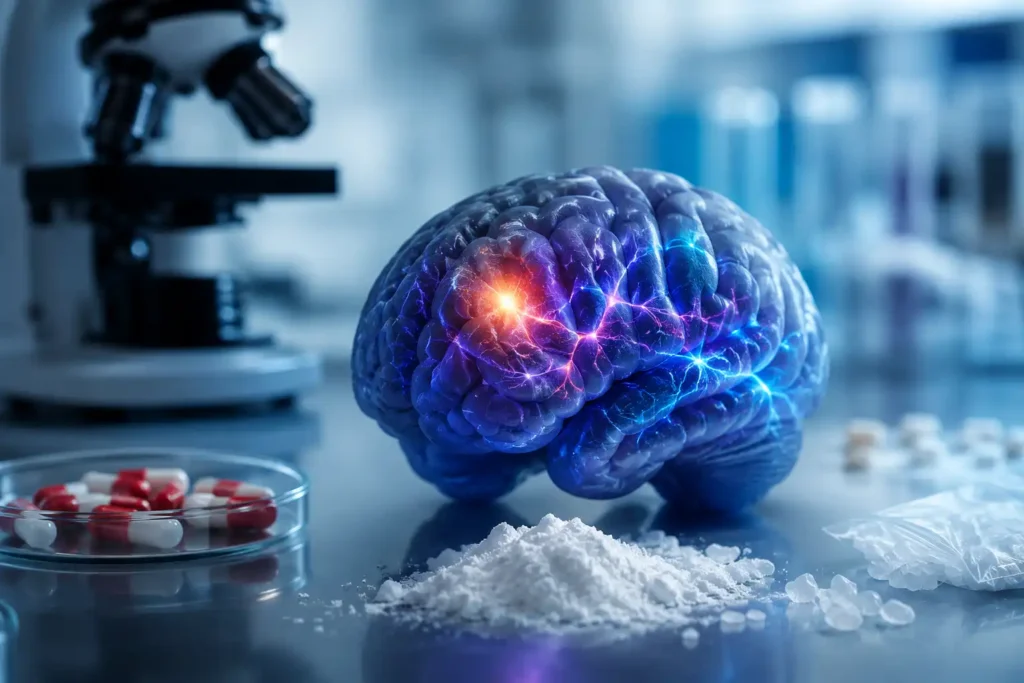
Arnaud Pontin (Image : IA / Gay Globe)
For centuries, cocaine addiction has been one of the most difficult problems to address. But in 2026, a new and increasingly troubling reality is emerging: people who use cocaine often no longer know exactly what they are taking.
Cocaine sold on the illicit market is frequently mixed with a wide range of substances whose composition and effects can be unpredictable. Some of these substances can be particularly dangerous and, in certain cases, may increase the speed at which dependence develops while also raising the risk of overdose. For users, the problem is therefore no longer simply cocaine itself. It is an illicit market in which the actual contents of a drug can be almost impossible to know or control.
Illicit cocaine is not necessarily made up entirely of cocaine. Dealers may cut it with various substances to increase the product’s volume, alter its effects, or simply create sensations that resemble those produced by cocaine. Among the adulterants that have been detected are levamisole, a veterinary drug, caffeine, and local anesthetics such as lidocaine and benzocaine, which can create a numbing sensation. Other substances, including certain sugars, starches, and medications, may also be added.
The situation becomes far more dangerous when powerful opioids such as fentanyl are present in cocaine, whether intentionally added or introduced through contamination. In that situation, a person may unknowingly consume a substance whose presence and concentration they have no way of determining, potentially increasing the risk of severe poisoning or a fatal overdose.
There is therefore no single, standardized formula for cocaine sold on the illicit market. The substances present, as well as their concentrations, can vary dramatically from one sample to another.
In 2026, one of the most serious dangers of the illicit drug market is therefore not simply how powerful cocaine is. It is the uncertainty surrounding what is actually in the product.
What if addiction has a molecular “switch”?
What if science had found a way to target one of the molecular mechanisms involved in addiction? It is one of the most intriguing questions being explored in addiction research today.
Scientists are paying close attention to DeltaFosB, a protein that plays an important role in the long-lasting changes produced by repeated exposure to certain drugs in the brain.
The concept is ambitious. By understanding and eventually controlling the biological mechanisms associated with DeltaFosB, researchers may one day be able to reduce or interfere with some of the changes that help sustain cocaine addiction. The same research could potentially have implications for addiction involving other substances, including alcohol.
That does not mean such a treatment currently exists. It does not.
Research has not yet reached the point where DeltaFosB can be safely manipulated as a routine treatment for people living with addiction. But the research raises a question that would have sounded almost like science fiction only a few decades ago: could medicine eventually target some of the biological mechanisms that help keep addiction going?
What exactly is DeltaFosB?
DeltaFosB is a protein that functions as a transcription factor. In simple terms, it can influence the expression of certain genes inside brain cells.
Researchers have been particularly interested in its role in the brain’s reward, motivation, and addiction pathways.
What makes DeltaFosB especially interesting is its ability to accumulate in specific areas of the brain following repeated exposure to certain drugs, including cocaine. Unlike many short-lived biological responses, DeltaFosB can remain present for an extended period of time.
That persistence may help explain why repeated drug exposure can produce long-lasting changes in how the brain responds to drugs and drug-related cues.
One way to think about DeltaFosB is as a kind of “molecular memory” of repeated drug exposure. The comparison is useful, but it has important limits. DeltaFosB is not simply “the addiction protein,” nor is addiction controlled by a single molecule.
Addiction is extraordinarily complex. It involves multiple brain regions, neural circuits, neurotransmitters, proteins, behavioral patterns, environmental factors, and genetic influences.
Still, DeltaFosB has become an important area of research because its accumulation appears to be associated with some of the long-term adaptations produced by repeated drug exposure.
If scientists can determine exactly how DeltaFosB contributes to those changes, they may eventually be able to identify new ways of interfering with the biological processes that reinforce compulsive drug-seeking behavior.
But there is a major difference between understanding a mechanism and being able to safely manipulate it in a human being.
We are still far from having a treatment that could simply “turn off” DeltaFosB and make addiction disappear.
Could the same mechanism be involved in several addictions?
The research becomes even more intriguing when scientists look beyond cocaine.
DeltaFosB has been associated with lasting adaptations in the brain following exposure to several addictive substances, including cocaine, methamphetamine, amphetamines, opioids, nicotine, alcohol, and certain cannabinoids.
This does not mean that all addictions are identical or that DeltaFosB causes every aspect of addiction. Rather, it suggests that this protein may be involved in biological processes that are shared by several forms of substance dependence.
That possibility is one of the reasons researchers are so interested in it.
Instead of developing completely different strategies for every addictive substance, could medicine eventually target biological mechanisms that contribute to addiction across multiple substances?
If that becomes possible, the implications could be significant.
A treatment aimed at a common biological pathway could potentially complement existing approaches and provide another way of addressing addiction at the level of the brain itself.
But again, this remains a research question, not an established medical treatment.
From promising research to an actual treatment
This distinction is critical.
In 2026, DeltaFosB is still primarily a research target. There is no approved medication that simply switches off DeltaFosB and eliminates cocaine addiction or any other form of addiction.
The brain is far too complex for such a straightforward solution.
The same biological mechanisms that contribute to problematic adaptations can also be involved in normal learning, motivation, reward, and adaptation. Attempting to interfere with one molecule without understanding its broader role could therefore create unintended consequences.
That is why researchers are not simply looking for a way to eliminate DeltaFosB.
They are trying to understand it.
The goal would ultimately be much more precise: determine which aspects of DeltaFosB activity contribute to pathological changes associated with addiction, and then find a way to influence those mechanisms without disrupting the protein’s normal functions.
Could blocking DeltaFosB too much be dangerous?
This may be one of the most important questions surrounding the entire research field.
If DeltaFosB is involved in addiction-related changes, could reducing its activity too aggressively interfere with normal brain function?
The answer is potentially yes, which is one reason why developing a treatment based on this mechanism would be so challenging.
DeltaFosB is not exclusively an addiction-related protein. It participates in several important biological processes, including forms of brain plasticity, motivation, learning and adaptation to repeated stimulation.
The brain constantly changes in response to experience. Some of those changes are harmful, while others are essential for normal functioning.
Simply eliminating DeltaFosB could therefore be neither realistic nor desirable.
An excessive or poorly targeted reduction in its activity could theoretically interfere with normal neural processes and produce side effects that scientists do not yet fully understand.
The challenge is therefore not necessarily to “turn off” DeltaFosB.
It is to learn how to control it.
The ultimate goal: precision
The ideal treatment, if science can eventually develop one, would not eliminate DeltaFosB throughout the brain.
Instead, researchers would ideally be able to target the specific mechanisms through which DeltaFosB contributes to the pathological changes associated with repeated drug exposure.
The goal would be to preserve its normal biological functions while reducing the changes that help maintain compulsive drug use.
In other words, medicine would not be trying to shut down the molecular switch completely.
It would be trying to learn exactly when, where, and how far that switch should be turned down.
That distinction could ultimately determine whether DeltaFosB becomes a useful therapeutic target or remains primarily a tool for understanding addiction.
For now, the science is still experimental. There is no medication that can selectively control DeltaFosB in people with addiction, and researchers still have major questions to answer before this approach could become a clinical reality.
But the potential is difficult to ignore.
If scientists can eventually develop a safe and precise way to influence the molecular mechanisms involved in addiction, the approach could represent a major shift in how addiction is treated.
Rather than focusing exclusively on the consequences of drug use, medicine could one day intervene more directly in some of the biological processes that help addiction persist in the brain.
That is why DeltaFosB has become such an intriguing piece of the addiction puzzle.
The future may not involve simply fighting one drug at a time.
It may involve learning how to change the brain’s response to addiction itself.
PUBLICITÉ

READ ALSO