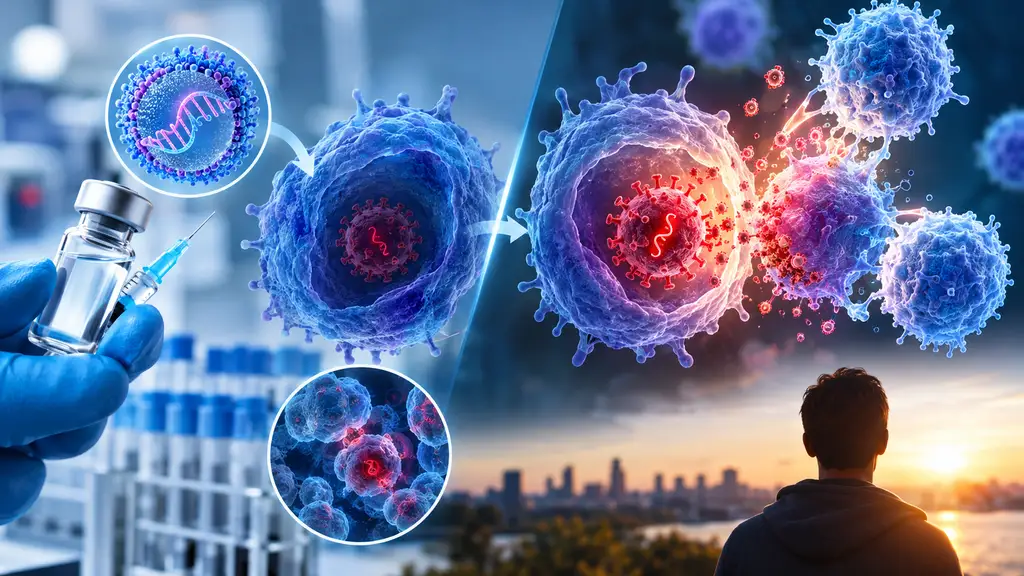
Arnaud Pontin (Image : AI / Gay Globe)
Could messenger RNA, the technology used in some COVID-19 vaccines, one day help eliminate HIV from the body? Researchers are exploring a way to wake up the virus hiding in certain cells, where it can survive even when medication keeps the infection under control. Early laboratory findings offer a reason for cautious optimism, although a cure is still a long way off.
HIV has challenged scientists for decades for one frustrating reason: treatment can keep the virus under control, but it cannot always get rid of it completely. Some infected cells can harbor the virus in a dormant state, hidden from the immune system and beyond the reach of existing medications. If treatment stops, the virus can become active again.
These hidden pockets of infection, known as viral reservoirs, are one of the biggest obstacles to finding a cure. Researchers are trying to find ways to draw HIV out of hiding and then destroy the infected cells before the virus can spread again. Messenger RNA is one of the technologies being explored in this effort.
The idea sounds simple enough, but putting it into practice is another matter. Waking up the virus is only half the battle. Scientists must also find a way to make the infected cells visible to the immune system and ensure they are eliminated without harming healthy tissue.
HIV is particularly difficult to eradicate because of the way it behaves inside the body. After infecting certain immune cells, especially CD4 T cells, it can insert its genetic material into the cells’ DNA and remain inactive for long periods. Some of these cells become part of the viral reservoir, allowing HIV to persist even when treatment is working well.
Antiretroviral medication prevents the virus from multiplying and can reduce the amount of HIV in the blood to an undetectable level. This has transformed life for people living with HIV. With effective treatment, they can expect to live long lives, and people who maintain a durably undetectable viral load do not transmit HIV sexually. But an undetectable viral load does not mean the virus has disappeared. It can still be present in cells throughout the body.
That is why controlling HIV and curing it are two very different things. Current treatments do an excellent job of keeping the virus in check, but they do not necessarily eliminate the hidden reservoirs that allow it to return if treatment is stopped. Finding a way to reach those reservoirs remains one of the most important challenges in HIV research.
Messenger RNA enters the search for an HIV cure
Messenger RNA became a household term during the COVID-19 pandemic. The technology gives cells temporary instructions for making a protein. In HIV research, scientists are investigating whether it can be used to stimulate the immune system or help expose the virus hiding inside infected cells.
Studies published in 2022 examined whether mRNA COVID-19 vaccines could trigger the reactivation of dormant HIV in samples of human cells in laboratory settings. The findings offered clues about how immune stimulation might make some previously silent virus detectable again.
It is important, however, not to read more into these results than they actually show. They do not mean that COVID-19 vaccines cure HIV, nor do they demonstrate that an mRNA injection can eliminate the infection in a person. Laboratory experiments are an early step in research, not proof that a treatment works in patients.
Still, the underlying idea is worth investigating. When HIV lies dormant inside a cell, the immune system may have little chance of recognizing that the cell is infected. If researchers can reactivate the virus, they may be able to make those cells easier to identify and destroy.
The approach is often called “shock and kill.” First, the dormant virus is encouraged to become active. Then, researchers try to identify and eliminate the cells carrying it. The concept is straightforward, but the biology is anything but simple.
Waking up HIV does not guarantee that every infected cell will be found. Some reservoirs are particularly difficult to reach, and infected cells can evade the body’s defenses. If the virus is not fully reactivated, some infected cells may remain hidden. On the other hand, stimulating the immune system too aggressively could cause unwanted effects.
Researchers must therefore work out how to reactivate enough of the virus to expose infected cells, then eliminate those cells without causing unacceptable damage to healthy tissue. They also need to establish whether the approach works in the human body, reaches the hardest-to-access reservoirs and prevents the virus from returning.
In the end, waking up HIV is only the beginning. The real test is whether scientists can make sure that the virus does not simply go back into hiding. Until that problem is solved, the strategy remains experimental.
A cure is still a work in progress
The idea of flushing HIV out of its hiding places is promising, but it is not yet a cure. Antiretroviral treatment remains essential for controlling the infection, and anyone considering changes to their medication should do so with their healthcare provider. Stopping treatment can allow the virus to multiply again.
A small number of people have achieved long-term remission or been considered cured of HIV following highly specialized medical procedures, including stem cell transplants used to treat certain serious cancers. These cases have shown that a cure is possible under particular circumstances. However, stem cell transplants carry substantial risks and are not a practical option for most people living with HIV.
That is why researchers are looking for alternatives. If mRNA-based approaches prove effective, they could eventually contribute to treatments that are less invasive and potentially available to more people. Much more research is needed, however, to establish whether they are safe and effective in patients.
For now, talk of an imminent cure would be premature. Laboratory findings can open new doors, but they cannot tell us whether a treatment will become available soon or whether it will work over the long term. Promising results must be tested, challenged and confirmed before they can become part of routine medical care.
None of this makes the research less important. After decades of work, scientists are still looking for ways to reach the reservoirs that have made HIV so difficult to eliminate. Every credible new avenue deserves attention, even when it is too early to know where it will lead.
A cure remains a major goal. The question is not whether researchers want to get there, but how they can do so safely and effectively.
Richard, 52, living with HIV for 23 years: “Hope makes me want to keep going”
In an interview with Gay Globe, Richard, 52, talks about living with HIV, something he has dealt with for 23 years. He takes his medication and has learned to live with the virus, but he still dreams of the day when he might no longer need treatment and could finally turn the page.
“I know my medication is important, and I would never do anything to put my health at risk. But after 23 years, I would love to wake up one morning without having to think about HIV or take my medication. That would mean an incredible amount to me.”
Richard knows how much treatment has changed since he was diagnosed. Medication has given people living with HIV a future that once seemed unimaginable, and he does not take that progress for granted. Still, even when the virus is under control, treatment remains part of everyday life. He would love to reach a point when it no longer has to be.
That is why new research catches his attention. Hearing that scientists are trying to wake up dormant HIV so they can identify and eliminate it gives him another reason to look ahead.
“I know that just because something works in a laboratory doesn’t mean we’ll have a treatment tomorrow. I’m not expecting miracles. But knowing that people are still working on this gives me hope. I’d love to live long enough to see a real cure become possible.”
For Richard, the possibility of a cure is about more than medicine. After more than two decades on treatment, he wants to imagine a new chapter in his life, one in which HIV no longer has such a constant place in his daily routine.
“It’s not that I can’t live my life now. I have plans, I have good days, and there are plenty of things I enjoy. But I would love to know what it feels like not to need HIV medication anymore. To be able to say that this part of my life is behind me would be huge.”
When asked what keeps him going, Richard comes back to one word: hope.
“Hope makes me want to keep going and see what happens next. I don’t know if a cure will come in five years, ten years or longer. Nobody can tell us that. But I want to be here to see what the future brings.”
For now, Richard continues taking his medication and looking after his health. He knows that scientific progress is not a promise, but he is not ready to give up on the possibility of a different future.
After 23 years living with HIV, he is not asking science to give him back the years that have passed. He simply hopes it can help make the years ahead different.
Hope matters in the fight against HIV
Living with HIV is about more than medication and medical appointments. For many people, it also means carrying memories of fear, prejudice and difficult experiences. The deadliest years of the epidemic left deep wounds, especially among those who lost friends and partners, feared a diagnosis or experienced rejection from people they trusted.
Treatment has changed the outlook for people living with HIV, but that does not mean every burden has disappeared. Some still worry about discrimination, dating, disclosing their status or how others will react. Others carry memories of a time when an HIV diagnosis could feel like a death sentence. Those experiences can stay with people long after their health has stabilized.
This is where hope can make a difference. It does not replace treatment or solve every problem, but it can help people see beyond their present circumstances. Knowing that researchers are still searching for new solutions can be a reminder that medicine is not standing still and that today’s limitations may not be permanent.
A promising scientific discovery can therefore mean something beyond the laboratory. For someone who has lived with HIV for decades, news of a new research direction can bring back the possibility of a future that once seemed out of reach. It can prompt questions, encourage conversations and offer a reason to look forward.
But hope should never be confused with a guarantee. A laboratory result does not mean a cure will be available in a few years. Some promising approaches fail to deliver the results researchers expected, while others need years of further study. Telling people that a cure is just around the corner before clinical trials support that claim can create false expectations.
There is room, however, to celebrate scientific progress while being honest about what remains unknown. Hope does not require anyone to believe that a cure is imminent. It simply means recognizing that the treatments available today may not be the final word.
For people living with HIV, that possibility matters. Hoping for a cure means imagining a different future, but it also means remembering that life is happening now. Relationships, work, creativity, personal goals and everyday pleasures should not have to wait for a medical breakthrough.
HIV was once associated almost exclusively with fear, loss and uncertainty. Advances in treatment have already transformed that reality for millions of people. Finding a cure would mark another extraordinary step, even if researchers cannot yet say when or how it will happen.
For those living with HIV, hope cannot erase the past or make every present-day difficulty disappear. But it can leave room for something more: the belief that life still holds possibilities. And after so many years of living with the virus, being able to look ahead while continuing to live fully today matters.
AVERTISING

Read also
- HIV: The 5 Breakthroughs of 2026 Bringing Researchers Closer to a Cure
- What If Immunotherapy Could Change the Future of HIV Treatment?
- HIV: Anti-PD-1 Immunotherapy, a Promising Path Toward Durable Remission
- HIV: New Statistics Reveal a Reality Few People Know About
- What Is the Perception of HIV/AIDS Among LGBTQ+ Youth in 2024?
- New Developments in the Fight Against HIV