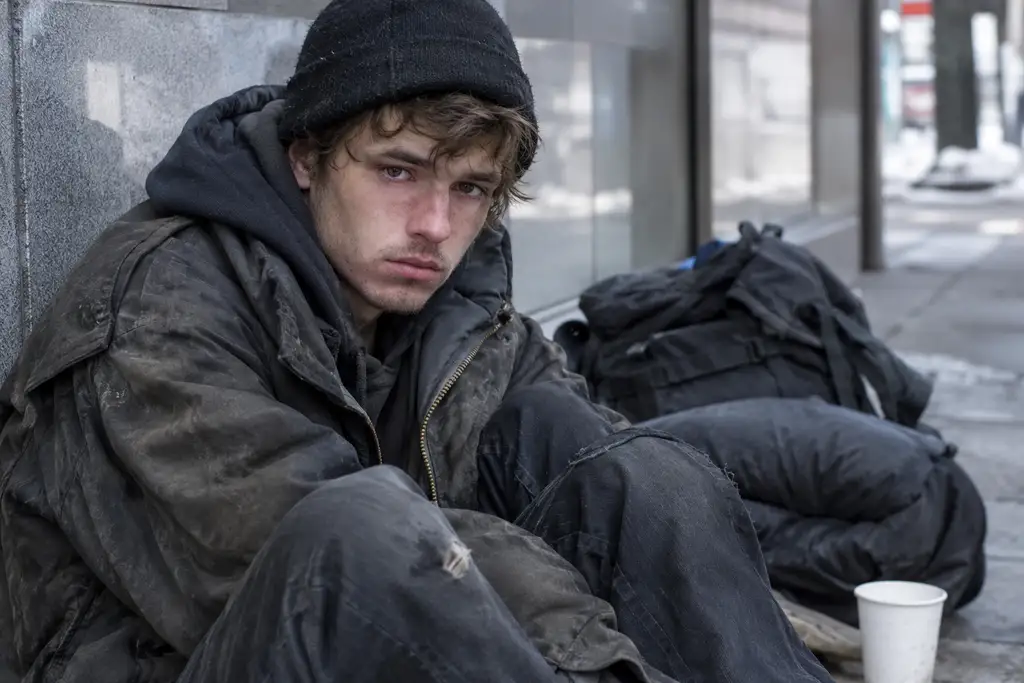
Roger-Luc Chayer (Image: AI-generated depiction of Julien / Gay Globe, created to protect his identity)
He was crouched on a bench, high on drugs, exposed to all the vulnerabilities of a sick society. Bent over, unconscious, he had taken refuge beneath the roof of the clouds to escape the reality of his life. I wasn’t afraid. I went over to talk to him.
He had settled onto one of the pink chairs in the Village, or perhaps he had passed out under the influence of drugs. Passersby looked at him with disdain, wondering what to make of the image he was projecting of the Village. No one came over to check whether he was still alive. I went closer and called out a hello. He slowly opened his eyes and smiled at me with such kindness. But what could possibly have led him to end up there?
I asked him if he was thirsty or hungry. He pointed to his backpack and told me he had everything he needed inside. I then asked whether he would like to talk for a while, explaining that I was a journalist and wanted to better understand his situation. He looked me straight in the eyes. For a moment, I thought he was going to refuse, but he nodded in agreement.
I sat down beside him without taking notes or making a recording. I wanted my article to reflect what my heart was telling me to write, rather than limiting myself to what I might have jotted down at the time. He appreciated the fact that I wasn’t recording him. He was afraid of being recognized.
Julien, 19, without a family, alone on the streets. Following a report to the Youth Protection Directorate (DPJ), when he was 16, he had been placed in foster care, where he felt comfortable, protected and safe. His fears and anxieties gradually diminished, but he never wanted to tell me why he had been placed in foster care or what had prompted the report. I respected his choice, because what mattered to me was not so much the reason for his placement as the way his story had ended.
Having also gone through the DPJ system at the age of 16, I could more or less understand his situation. In my case, after two or three months in foster care, I was considered mature and responsible enough to live alone in a rented room, manage my studies, pay my rent and handle my budget, under the supervision of a social worker who came to see me once a month to make sure I was doing well.
To me, the DPJ is an absurdity. In simple, human terms, the mission of the Youth Protection Directorate (DPJ) is to protect children and adolescents when their safety or development is compromised.
But behind this official definition lies a deeply human reality: the DPJ intervenes in the lives of young people who sometimes face difficult circumstances, who have not always chosen what happens to them and who need protection, support and help as they grow up.
What I find absurd is that, no matter how much young people are prepared for leaving their foster families at 18, the DPJ, whose very mandate is to protect them, abandons them at the very moment when they still need support. Today, 30% of young people living on the streets are reportedly former children who were in the care of the DPJ. Unable to find a job, continue their education or simply secure housing, they are left to fend for themselves, with social assistance covering only a fraction of their actual needs.
And that is exactly what happened to Julien!
At 19, Julien sleeps in a tent set up behind the Moreau railway tracks. Every day, he has to contend with the cold, a lack of privacy and the uncertainty of whether he will be able to stay in the same place the following night. He is regularly evicted and must then look for another spot where he can take shelter, carrying his few belongings in his backpack.
It is not that he hasn’t tried to get back on his feet. Even with the help of his social workers, Julien has been unable to find housing he can afford. His social assistance cheque does not allow him to pay rent, let alone cover his other essential expenses. Without a stable address, a telephone or a television, he is also cut off from some of the services, procedures and information that could help him improve his situation.
To take a shower, he has to rely on whatever opportunities come his way. To eat and meet his daily needs, he makes do with whatever resources are available. At 19, instead of preparing for his future, he spends much of his energy meeting the most basic needs: sleeping, washing himself and finding somewhere he won’t be forced to leave.
Julien says he was not using drugs before he ended up on the streets. A man introduced him to them, and he subsequently began using. His circumstances have made him particularly vulnerable, at a time when he was already isolated and had no real safety net.
He also has no idea what political measures might be proposed to help young people in his situation. Without a telephone or television, he is unaware of public debates or programs that might eventually be available to him.
What is striking about Julien is not only that he is homeless at 19, but that he can barely see a way out. He is not asking for an easy life. He wants to be able to rent a room, have a place to sleep, take care of himself and finally have the opportunity to rebuild his life. For now, even these basic goals seem beyond his reach.
Julien could be any citizen of any major city in the world. Thousands of young people like him experience or endure the same story, because the word living has almost lost its meaning here. When, at 19, you do not know where you will sleep that night, when you cannot afford a roof over your head despite receiving social assistance, and when you eventually lose even the hope of a better tomorrow, this is no longer simply a matter of poverty. It is a life that is gradually slipping away from those who should have the opportunity to build it.
After talking with him for nearly an hour, Julien decided to leave, his eyes filled with sadness, having told me his story and, above all, having been forced to relive it. As is the case for many people, if he uses drugs, it is not for pleasure, but simply to numb a profound pain, the pain left by the abandonment he experienced from both his foster family and the state.
Where do we even begin to get him out of this situation? I haven’t the slightest idea.
ADVERTISING
Read also
1. Montreal Faces Homelessness: A Reality Tourists Don’t See in the Brochures
2. Young People Abandoned: The Shock of Aging Out of Child Welfare Systems
3. Homelessness and Housing Crisis in Montreal
4. Montreal’s Gay Village: Soraya Martinez Ferrada Takes Action to Support Local Businesses
5. A Clean City or a Punitive City? Montreal Measures Lawns but Ignores Real Problems
6. La Mie Matinale: More Than a Bakery, an Institution in Montreal’s Gay Village