French journalist and contributor to Gay Globe Média, Arnaud Pontin focuses on international news, social issues, health and major topics shaping our society. His work reflects a thoughtful approach, grounded in research and a commitment to reliable information.
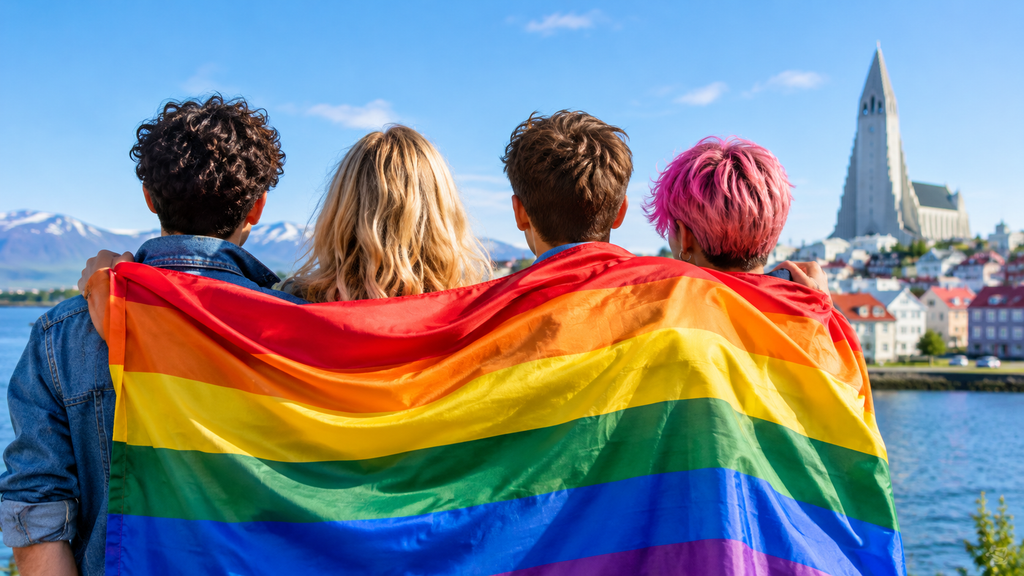
Arnaud Pontin (Image : AI / Gay Globe)
We unfortunately hear far too often about the countries where LGBTQ+ people are most persecuted, particularly gay men and transgender people, but rarely about the opposite: countries where members of these communities can enjoy a good quality of life, for a variety of reasons. Whether it is a sense of well-being, personal safety, equality under the law or social acceptance, four countries consistently stand out in this regard.
An international study published in Nature Human Behaviour, involving 82,324 LGBTQ+ respondents across 153 countries, also found that well-being is strongly influenced by the level of homophobia in society, family circumstances and economic insecurity. However, it did not identify a single country as the happiest place for LGBTQ+ people.
Among the countries where LGBTQ+ people report some of the highest levels of happiness are Iceland, followed by Denmark, the Netherlands and Canada!
Iceland: Why is this Nordic country so welcoming to LGBTQ+ people?
We unfortunately hear much more about countries where LGBTQ+ people are persecuted than about those where they can live freely and peacefully. Yet Iceland ranks among the world’s most welcoming countries, thanks to a combination of strong legal rights, social acceptance and public visibility.
Same-sex marriage has been legal there since 2010. Same-sex couples enjoy legal recognition comparable to that of heterosexual couples and have been able to adopt children jointly since 2006.
Iceland has also stood out for its progress in transgender rights. Since 2019, transgender people have been able to have their gender identity legally recognized without undergoing surgery or obtaining a psychiatric diagnosis. Non-binary identities are also recognized in administrative provisions.
The fight against discrimination is another cornerstone of Icelandic society. Legal protections apply in areas such as employment and access to goods and services. The country has also banned conversion practices targeting LGBTQ+ people.
But laws tell only part of the story. In Reykjavik, the annual Pride parade attracts thousands of participants, including many families, public figures and people who are not part of the LGBTQ+ community. This level of participation reflects the strong visibility of diversity throughout Icelandic society.
In several international rankings, Iceland achieves particularly high scores for equality and social acceptance. The Equaldex index, for example, gives the country a score of 93 out of 100.
However, not everything is perfect. Transgender people still face difficulties accessing appropriate healthcare, and discrimination has not entirely disappeared.
Denmark: A society where LGBTQ+ people have a place
Like Iceland, Denmark is among the countries most welcoming to LGBTQ+ people. Its distinctive features include a long tradition of recognizing LGBTQ+ rights, strong social visibility and an approach to equality that extends to family life, the workplace and public life.
Denmark made history in 1989 by becoming the first country in the world to legally recognize same-sex civil partnerships. In 2012, it took another major step by legalizing same-sex marriage. Same-sex couples can also adopt children and build families with full legal recognition.
Transgender people also benefit from significant protections. Since 2014, Denmark has allowed adults to legally change their gender without undergoing surgery or obtaining a psychiatric diagnosis. This approach represented a major step forward in recognizing the right to self-determination.
Family equality is also well established. Both women in a same-sex couple can be recognized as mothers from the birth of a child, provided the legal requirements are met. This gives same-sex parents recognition that goes beyond the simple legal recognition of marriage.
LGBTQ+ visibility is particularly strong in Copenhagen, where Pride is a major cultural event. The country has also made the fight against hate crimes and discriminatory speech an important part of its public policies.
Denmark, however, is not without contradictions. Legal protections do not resolve every difficulty experienced by LGBTQ+ people. Discrimination and prejudice persist, and conversion practices are not subject to an explicit general ban under Danish law, according to the ILGA World database.
What sets Denmark apart above all is its historical leadership: as early as 1989, it recognized that same-sex couples should be entitled to official legal recognition. Since then, the country has gradually extended equality to parenthood, gender identity and participation in public life.
Canada: A country where LGBTQ+ rights are among the most widely recognized in the world
Canada regularly ranks among the countries most welcoming to LGBTQ+ people. This reputation is based on significant legal progress, relatively high levels of social acceptance and protections covering family life, employment and public services.
One of the major milestones in this evolution came in 2005, when Canada became the fourth country in the world to legalize same-sex marriage. Since then, same-sex couples have enjoyed the same marital rights as heterosexual couples, including those relating to parenthood and family recognition.
The country also protects people against discrimination based on sexual orientation, gender identity and gender expression. These protections are enshrined in federal human rights legislation and the Criminal Code, which includes provisions addressing hate crimes.
Recognition of transgender people has also advanced. Since 2017, gender identity and gender expression have been explicitly protected under the Canadian Human Rights Act and the Criminal Code. Several provinces and territories also allow an X gender marker on certain official documents.
Another important factor is Canada’s regional diversity. Quebec played a historic role in this progress: in 1977, it became the first Canadian jurisdiction to include sexual orientation among the prohibited grounds of discrimination in its Charter of Human Rights and Freedoms.
However, behind this progressive reputation, the figures reveal a more complex reality. A Statistics Canada study published on November 4, 2026, found that only 32% of 2SLGBTQ+ respondents surveyed between 2021 and 2025 reported high levels of life satisfaction, compared with 50% of non-LGBTQ+ respondents. The proportion fell to 22% among transgender and non-binary people.
Even more concerning, 61% of 2SLGBTQ+ people said they had experienced discrimination or unfair treatment during the previous five years. That figure rose to 76% among transgender and non-binary people.
Canada therefore presents an interesting paradox: a country where rights are widely recognized by law, but where genuine equality and well-being have yet to become a reality for everyone.
ADVERTISING

Read also
- What If Canada Turned Its Back on the United States to Join the European Union?
- Canada and Europe: A New Strategic Alliance Takes Shape
- Queen City: Does Toronto Owe It All to Drag Queens?
- Ukraine: Historical Maps and Geography
- 60 Kilometres from Fear: A Gay Montrealer Shares His Terror of Trump’s America
- Trump’s Order 66: Carney Says Canada Will Lead