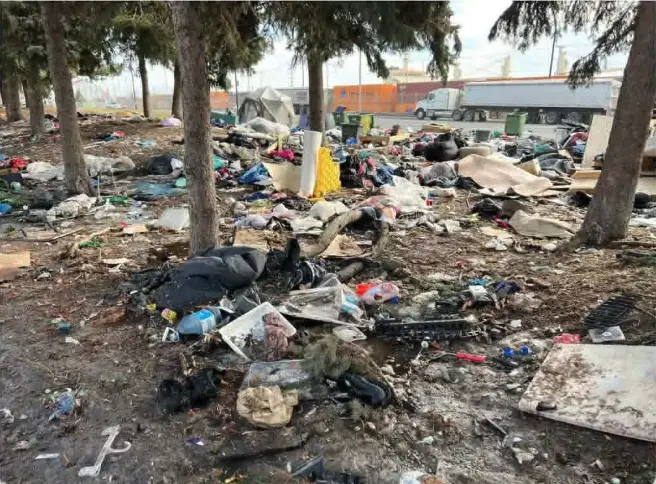
Groupe Gay Globe Média (Photo: Notre-Dame Street encampment – Francis Pilon – Journal de Montréal))
Our City of Montreal is truly a strange one. Yesterday, a business owner in Montreal’s Gay Village received several documents from the Ville-Marie borough which, according to him, are rather troubling and demonstrate that the City maintains a double standard, depending on whether you have the ability to pay a fine… or whether you are experiencing homelessness.
The documents go so far as to inform merchants and building owners that they must personally carry out certain street and alley cleaning tasks. A responsibility that, according to many, should normally be handled by the City using the taxes it collects. This request, which amounts to transferring part of the maintenance of public spaces onto citizens and businesses, has caused more than a few merchants and property owners to react with surprise.
Here is the complete text of the letter that accompanied the flyer:
VILLE-MARIE
Ville-Marie Borough
Borough Management Office
800 De Maisonneuve Blvd. East, 19th Floor
Montreal, Quebec H2L 4L8
July 17, 2026
SUBJECT: IMPORTANT REMINDER – CLEANLINESS AND USE OF PUBLIC PROPERTY
Hello,
In order to contribute to a clean, pleasant and safe environment for everyone, the Ville-Marie borough wishes to remind residents of certain essential rules regarding cleanliness and the use of public spaces (sidewalks, streets, tree pits, etc.).
These rules apply to merchants, residents and occupants. They aim to preserve quality of life, safety, and the attractiveness of our neighbourhoods.
We remind you that every merchant is responsible for keeping the area surrounding their establishment clean.
Our teams are currently observing certain issues related to:
- the presence of waste outside scheduled collection times or days;
- insufficient maintenance around businesses as well as the absence of garbage bins for their customers;
- unauthorized occupation of public property (e.g., sandwich boards).
This is why we are beginning an awareness and information phase aimed at improving knowledge of best practices and current obligations.
You will find in the attached flyer a clear summary of the rules to follow and the simple actions to take.
Please be advised: over the coming months, our field teams will strengthen enforcement of existing regulations.
We thank you for your cooperation and your commitment to making Ville-Marie a welcoming and attractive borough for everyone.
Ville-Marie, clean for all of us.
Regarding sidewalks, storefronts and building facades, everyone agrees: it is perfectly normal that occupants maintain the access points that allow the public to visit their businesses or enter their buildings.
It is also entirely reasonable — and we know this is a real problem in the Gay Village — that garbage only be placed on public streets on the scheduled collection day or, when regulations allow it, the evening before.
However, it is not the content of the letter itself that is raising concerns among many Montrealers, but rather the content of the accompanying flyer. According to several people, the flyer goes well beyond the responsibilities normally expected of merchants and building owners. Its content raises serious questions: through warnings and explicit threats of penalties, is the City attempting to transfer to citizens and businesses, without compensation, tasks normally carried out by municipal blue-collar workers and employees?
Here is the complete content of the flyer:
KEEPING PUBLIC SPACES CLEAN: A SHARED RESPONSIBILITY
MAINTENANCE AROUND YOUR BUSINESS
YOUR RESPONSIBILITIES
If you occupy a business or a building, you must not only maintain your own property, but also the public space located in front of it.
You must ensure that this space:
- is clean, without waste or harmful materials (for example: cigarette butts, cups, papers);
- remains clear at all times, except for snow, ice and an authorized fence;
- has grass no higher than 15 cm;
- has no accumulated dead leaves.
VIOLATION
Failure to comply with these rules may result in a fine ranging from $125 to $3,000.
WHAT AREA MUST YOU MAINTAIN?
- The sidewalk and curb in front of your business or building;
- The first 60 centimetres of the street, measured from the sidewalk or curb;
- The additional street right-of-way area;
- The adjacent alley, up to its centre.
WHY IS THIS IMPORTANT?
A clean public space:
- improves quality of life;
- increases downtown attractiveness;
- contributes to a pleasant living environment for everyone.
SPECIAL REQUIREMENTS FOR FOOD BUSINESSES
If you operate a restaurant, catering service, grocery store, or any other business that serves or delivers take-out food, you must:
- collect packaging and food waste related to your establishment (cardboard, paper, containers, leftover food);
- do so along the entire side of the street section where your business is located;
- dispose of this waste in your establishment’s garbage bins.
This is where the general astonishment begins. If you allow your lawn to grow higher than 15 centimetres, you can receive a fine. (Will inspectors equipped with measuring rulers come and lie down on your lawn to check its height? Imagine the scene!) If you allow dead leaves to accumulate on your property, that can also result in a fine.
Yet for years, horticulture and environmental experts have recommended leaving dead leaves on the ground. They act as a natural fertilizer for lawns, enrich the soil and help maintain a favourable moisture level in the spring, protecting young shoots from fluctuations in weather conditions.
But this appears to matter very little to the City. What seems to matter above all, according to several citizens, is strict compliance with the regulation… and, when applicable, payment of the fine. Understood?
Now, and this was something few Montrealers knew until recently, there is an obligation to maintain certain public spaces that are normally taken care of by municipal employees equipped with mechanical street sweepers. A difficult situation to explain, and one that raises many questions.
According to the flyer distributed to merchants and building owners, maintenance obligations would not be limited only to sidewalks or building facades. They would also extend to certain portions of public space, including the first 60 centimetres of the street measured from the sidewalk or curb, the additional street right-of-way area, as well as the adjacent alley up to its centre.
This would apply to EVERYONE, without exception! Whether you are a person with reduced mobility, a wheelchair user, someone who has lost a limb due to a war injury or a medical condition, or someone living with a functional disability, the obligation would still apply. Understood?
However, one of the problems contributing to Montreal’s dirtiness also comes from municipal management itself. By requiring the recycling of materials, the City finds itself every week dealing with piles of cardboard, tin cans and plastic that are blown away by the wind and sometimes end up scattered everywhere they should not be.
Another problem, which is not directly addressed by the City of Montreal, is the issue of people searching through garbage bags for recyclable materials. These bags, carefully placed at the curb in preparation for collection by sanitation workers, are often torn open, allowing garbage to spill into public or private spaces.
Rather than directly addressing those who tear open garbage bags, it seems much easier to fine merchants for damage caused by third parties, or for situations that are partly the result of the City’s failure to intervene against these behaviours.
THE PARADOX OF ENCAMPMENTS
While the City of Montreal warns that inspection teams will be travelling throughout the city with their measuring rulers and ticket books, it simultaneously tolerates the presence of genuine open-air dumps in several encampments, these new urban shantytowns occupied by people experiencing homelessness, often victims of the housing crisis or issues related to drug use.
The photograph accompanying this article speaks for itself. It was taken at an encampment located on Notre-Dame Street, in the eastern part of Montreal. Where are the inspectors and their ticket books in these situations? Nowhere.
Ultimately, the question is not whether Montreal should be clean. Of course it should. Merchants, property owners and citizens all have a role to play in maintaining the quality of their living environment. But a city cannot ask those who already pay taxes to silently become replacements for a public service that it itself has the responsibility to provide.
What deeply shocks many Montrealers is not the existence of rules, but the impression that they are being applied selectively. On one side, citizens, merchants and property owners are threatened with penalties for dead leaves, a few centimetres of grass, or garbage sometimes left behind by others. On the other side, in certain areas, much more serious situations continue without apparent intervention, particularly in encampments where unsanitary conditions have reached alarming levels.
A city cannot demand perfection from some while tolerating the unacceptable from others. It cannot use regulations as a disciplinary tool against those who financially contribute to its operation while appearing powerless in the face of major issues affecting safety, sanitation and human dignity.
The cleanliness of a city cannot be measured solely with a 15-centimetre ruler or a ticket book. It is also measured by an administration’s ability to be consistent, fair and present everywhere, for all citizens, without exception.
In Montreal, the problem may not be the absence of regulations. The problem may be determining who those regulations actually apply to.
ADVERTISING

READ ALSO
Montreal’s Gay Village: Soraya Martinez Ferrada Takes Action to Support Local Businesses
https://gayglobe.net/en/montreals-gay-village-soraya-martinez-ferrada/
La Mie Matinale: More Than a Bakery, an Institution in Montreal’s Gay Village
https://gayglobe.net/en/la-mie-matinale-montreal-gay-village-bakery/
The Pedestrianization of Sainte-Catherine East Street Returns for Summer 2026 in the Village
https://gayglobe.net/pietonnisation-sainte-catherine-est-village-montreal-2026/
Village Homelessness: The Story of Iram
https://gayglobe.net/itinerance-village-lhistoire-diram/
Montreal’s Gay Village
https://gayglobe.net/le-village-gai-de-montreal/
When the Gang Is Installed!
https://gayglobe.net/when-the-gang-is-installed/