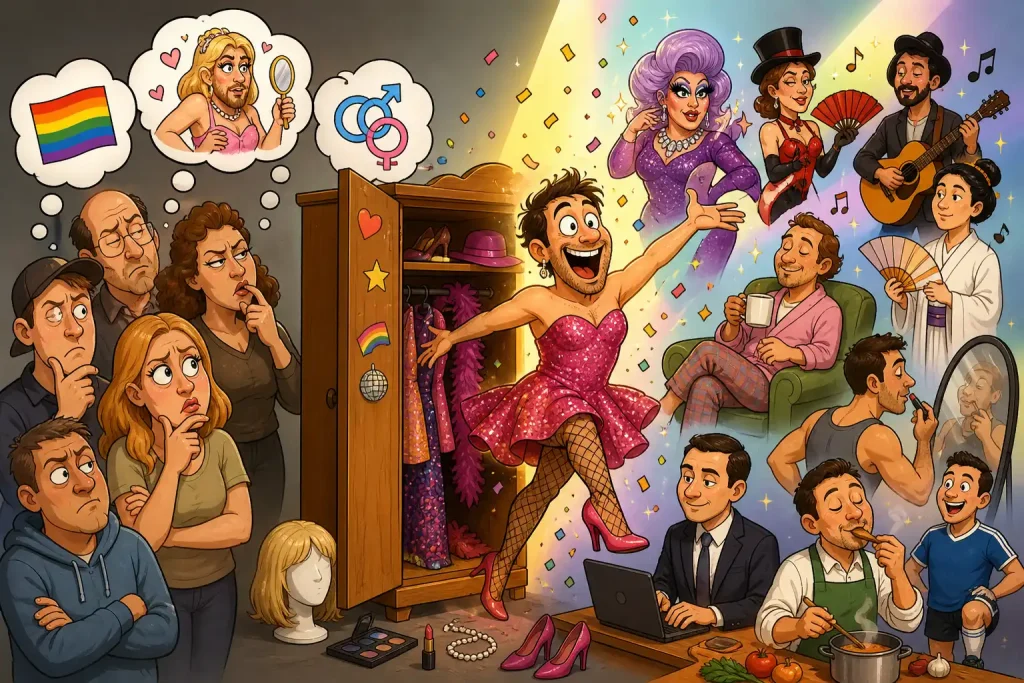
Arnaud Pontin (Image : IA / Gay Globe)
Myth or urban legend? A widely misunderstood perception
Most people in society believe that cross-dressers are all homosexual and that they engage in this practice because they identify as women. Myth or urban legend? Let’s demystify the issue.
Definition of a cross-dresser: much more than a common misconception
Often surrounded by clichés and confusion, the term “cross-dresser” refers to a person who adopts, either occasionally or regularly, clothing and aesthetic codes traditionally associated with a gender other than the one assigned to them at birth. Behind this seemingly simple definition lies a much richer reality, at the crossroads of personal expression, culture, and sometimes artistic performance.
Sexual orientation and gender identity: no automatic correlation
Contrary to a widely held belief, cross-dressing does not allow one to infer a person’s sexual orientation or gender identity. A cross-dressing man, for example, may be heterosexual, homosexual, or bisexual, without this being directly related to his practice. Similarly, this is not necessarily an approach aimed at “becoming” or identifying as another gender in everyday life.
A practice with multiple forms
Cross-dressing can take several forms. In some cases, it occurs within an artistic or stage context, particularly in cabaret, theatre, or drag performance, where exaggeration of features, costumes, and attitudes is an integral part of the act. In other situations, it reflects a more personal approach, linked to the pleasure of playing with clothing codes, exploring different aspects of oneself, or simply temporarily stepping outside social norms.
An ancient and cultural practice
Historically, cross-dressing has existed for centuries across many cultures, whether in the arts, ceremonies, or certain popular traditions. It has often been used as a tool to challenge gender norms, but also as a space of individual freedom in contexts where roles were strictly defined.
Cross-dressing and transidentity: an essential distinction
It is important to clearly distinguish cross-dressing from transidentity. Transidentity refers to a deep and lasting personal reality related to gender identity, whereas cross-dressing primarily concerns external expression, which can be temporary and context-dependent.
Is there a sexual profile of cross-dressers?
There is no reliable, global, or scientifically established ratio between gay and heterosexual individuals who engage in cross-dressing. In other words, no solid study currently allows us to state generally that “most cross-dressers are gay” or “most are heterosexual.”
What is known, however, based on limited research and partial data, is that cross-dressing—often studied under the concept of “cross-dressing”—occurs in relatively small proportions of the general population, mainly among men, and does not correspond to any specific sexual orientation. Some studies suggest, for example, that around 2 to 3% of men may have already experimented with some form of cross-dressing for sexual or identity-related reasons, but these figures vary widely depending on definitions and contexts.
Data that is difficult to establish with precision
Researchers emphasize a key point: it is methodologically difficult to establish robust statistics, as cross-dressing encompasses very different realities (from occasional clothing choices to regular practice, from private settings to artistic performance), and remains widely underreported.
ADVERTISING

READ ALSO