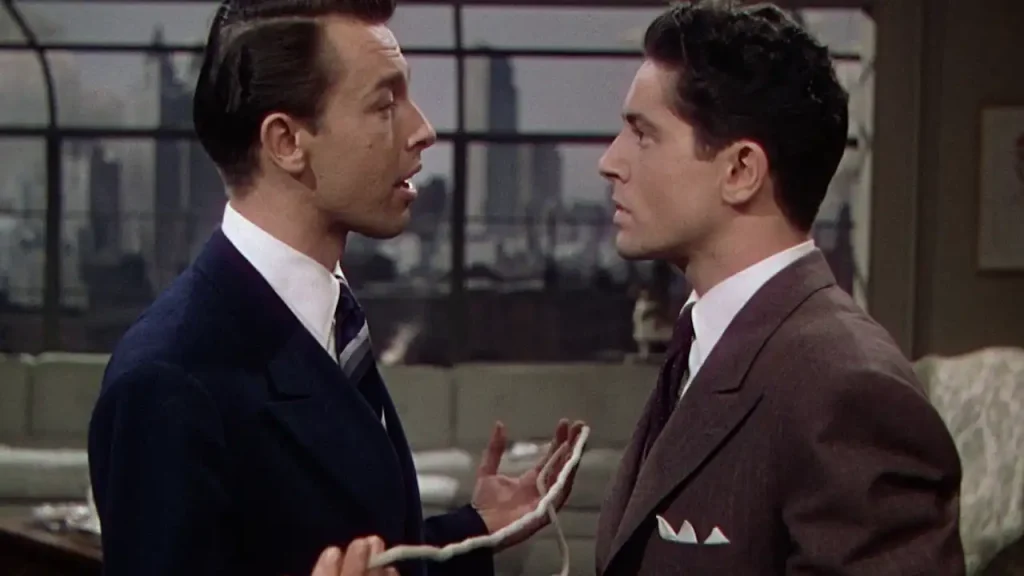
Carle Jasmin (Image : Rope – Alfred Hitchcock)
WATCH THE FILM HERE IN ORIGINAL ENGLISH VERSION AND IN HD
A film directed by Alfred Hitchcock that has intrigued audiences since 1948
This great classic of American cinema, directed by the master of suspense Alfred Hitchcock, has been unsettling audiences since its theatrical release in 1948.
A precursor of queer cinema according to film historians
Considered by film historians as the only film by Alfred Hitchcock to appear as a precursor of all gay cinema, Rope brings together two major actors whose best-kept secret in Hollywood was unknown at the time. Farley Granger and John Dall were both homosexual.
A drama with queer and theatrical undertones
So be it, why not go all the way by adding all the ingredients of a gay drama: an old silent film actress, a kind of retired drag queen, and a murder. The murder of one man, another…
Rope synopsis: a tense chamber drama
Rope tells the story of two brilliant and cynical young men, Brandon and Phillip, who murder a classmate as a pure intellectual challenge. Convinced of their superiority, they hide the body in a chest in the center of their apartment and immediately host a dinner party… right above the hiding place.
As the evening unfolds, the guests — including the victim’s family and their former teacher — move dangerously close to the truth. The latter, Rupert, begins to suspect something, disturbed by Brandon’s provocative attitude and by his own philosophical ideas being distorted.
Built almost entirely as a continuous take illusion, the film plays on psychological tension and confined space, turning a simple dinner into an oppressive chamber thriller where the crime threatens to erupt at any moment.
Constance Collier: an almost drag figure in Rope
In Alfred Hitchcock’s Rope, the character played by Constance Collier, Mrs. Atwater, can be read almost as a “drag” figure when viewed through the lens of performance and excess.
Like a drag queen, she embodies an overt theatricality: emphatic gestures, a distinctive voice, and a strong sense of self-staging. She does not aim for naturalism, but rather an amplified, almost caricatural presence that draws attention and diffuses the surrounding tension. Her speech patterns, her flourishes, and her slightly eccentric tone echo the tradition of camp, where exaggeration becomes a language.
There is also a “character within the character” dimension. Like many drag figures, Mrs. Atwater seems to perform a social role — a flamboyant grande dame — as if she were embodying an identity rather than simply inhabiting it. This creates an effect that is both humorous and unsettling.
Finally, in a film as tense as Rope, she acts as a counterpoint, much like a drag queen in a dramatic space: she introduces lightness and spectacle while paradoxically heightening the artificiality of the situation. Her presence suggests that everything in the apartment is staged — including the crime itself.
A suggested homosexual relationship between Farley Granger and John Dall
In Alfred Hitchcock’s Rope, the relationship between Farley Granger and John Dall is widely interpreted as homosexual, even though nothing is explicitly stated on screen. This reading is based on a combination of narrative, visual, and historical clues.
First, their closeness goes far beyond friendship. They live together, share an extreme secret — a murder — and function like a couple, with an almost marital dynamic: Brandon is dominant, confident, and provocative, while Phillip appears more fragile, nervous, and emotionally dependent. This complementarity echoes relational codes often associated with couples in classical cinema.
Secondly, the production context is essential. At the time, the Hays Code prohibited any explicit depiction of homosexual relationships. Filmmakers therefore relied on subtext, glances, silences, and coded behavior to suggest what could not be said. Alfred Hitchcock was known for pushing these boundaries, and Rope is often cited as a key example of queer coding in classical Hollywood cinema.
There is also a retrospective dimension. The fact that Farley Granger later confirmed his homosexuality, and that John Dall was also associated with this orientation, reinforced this interpretation, even if it is not sufficient on its own to define the characters.
What makes the film powerful is precisely this ambiguity: everything is suggested, nothing is confirmed, leaving the audience to read between the lines.
Farley Granger: a life marked by secrecy
Farley Granger (1925–2011) is a major figure of classical Hollywood cinema, best known for his collaborations with Alfred Hitchcock in Rope (1948) and Strangers on a Train (1951). Behind this visible career, he long led a private life constrained by the strict norms of the film industry at the time.
In Hollywood during the 1940s and 1950s, marked by the Hays Code and strong social pressure, homosexuality was taboo. Like many actors, Farley Granger had to navigate a system in which any public disclosure could end a career. He therefore lived his sexuality discreetly, in relationships with both men and women, never able to openly acknowledge it during his years of fame.
It was only much later, in his 2007 memoir Include Me Out, that he openly discussed his bisexuality and his relationships with several men, including figures from the artistic world. He describes a Hollywood where appearances were carefully controlled, but where a parallel life existed — often tolerated as long as it remained invisible.
His trajectory thus reflects a broader reality: that of a generation of artists forced to conceal their identity. Today, Farley Granger is often cited as an example of such complex journeys, where public recognition came long after their careers, allowing for a more open reassessment of their work.
John Dall: a career surrounded by silence
John Dall (1918–1971) is an American actor best known for his chilling role in Rope (1948) by Alfred Hitchcock, as well as his performance in The Corn Is Green (1945), which earned him an Academy Award nomination. His acting, often marked by nervous intensity and ambiguity, helped shape complex characters sometimes at odds with traditional masculine norms.
As with many actors from Hollywood’s Golden Age, his private life remained largely discreet, particularly regarding his sexuality. In the context of the Hays Code and a deeply conservative industry, any form of sexual nonconformity had to remain hidden. John Dall never publicly defined his sexual orientation during his lifetime, and what is known today relies mostly on indirect accounts and later interpretations.
Some film historians and biographers have suggested he may have been homosexual or bisexual, particularly due to his social circle and retrospective readings of his roles, including in Rope.
His trajectory thus illustrates another reality of classical Hollywood: that of silence. John Dall remains a figure surrounded by ambiguity, where the absence of public declaration reflects both the constraints of the era and the ongoing difficulty of fully reconstructing private lives today.
A personal experience of the film
Personally, as a great admirer of Alfred Hitchcock’s films — perhaps less of his early works but certainly of his colour films — I noticed long ago the interaction between the two lead actors, especially Farley Granger, whom I already found irresistibly handsome. I was not familiar with queer codes when I first saw the film, after buying a DVD box set which I still own, but I experienced a strong emotional response without knowing why.
WATCH THE FILM HERE IN ORIGINAL ENGLISH VERSION AND IN HD
ADVERTISING

READ ALSO