Roger-Luc Chayer (Image : Armees.com)
The President of the United States and NATO: Debates, History and Contemporary Issues
The President of the United States announced yesterday that he intends to withdraw 5,000 American soldiers from Germany in retaliation for statements made by the German Chancellor last week, suggesting that the war in Iran launched by the United States was a mistake.
NATO, the United States and Europe: a strained relationship
Repeatedly, President Trump states that NATO does not serve the United States and that it is rather the United States that defends and protects Europe, which he considers unfair and unjust.
The problem is that he does not understand history, and despite all attempts by his entourage to explain that if NATO is what it is today, it is due to the will of the United States and not the opposite.
When he repeats that NATO has never been there for the United States and that, despite current calls for assistance to help reopen the Strait of Hormuz, NATO proves to be an unnecessary organization, he increasingly threatens to withdraw from it.
We have already explained on Gay Globe how the president is mistaken and does not fully understand his history nor the effects and consequences of the Second World War. Here are some explanations he should know and that the public is certainly entitled to understand.
Creation of NATO and historical context
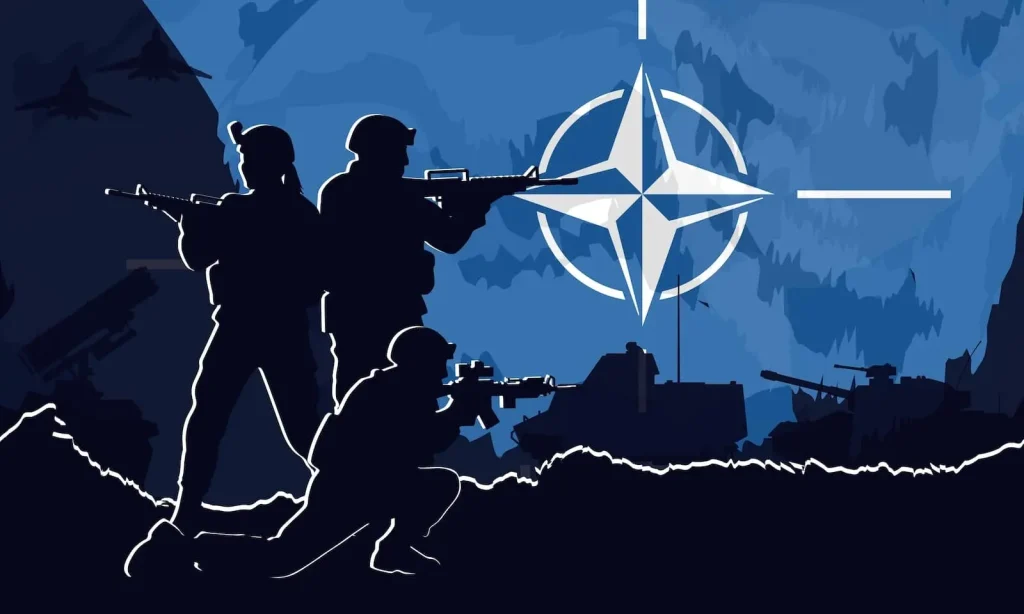
NATO — NATO (North Atlantic Treaty Organization) — was created in 1949 in a very specific context: the aftermath of the Second World War and the beginning of the Cold War.
Its initial objective was essentially military and political: to establish a collective defence alliance between the United States, Canada and several Western European countries in order to counter the perceived threat of Soviet expansion. In simple terms, it meant ensuring that any attack against one member state would be considered an attack against all, according to the principle of collective defence enshrined in Article 5 of the treaty.
Behind this logic also lay a broader strategic reality: preventing another war in Europe, stabilizing weakened Western democracies after 1945, and ensuring a long-term American military presence on the European continent to balance power against the Soviet Union.
NATO was therefore not designed as an organization “exclusively serving” the United States or Europe, but as a system of mutual security. Its fundamental logic was based on the idea that the security of the North Atlantic was indivisible: the defence of Europe contributed to North American security, and vice versa.
Military bases and shared responsibilities
In short, and let us be clear, NATO was created in a context where the United States sought to establish military bases in Europe in order to contribute to the continent’s security and contain the Soviet threat. It was a project strongly driven by Washington, but also accepted by the European countries involved.
Within this alliance logic, the American military presence has been accompanied by shared financial and logistical commitments among members. Each contributing state assumes part of the costs linked to this collective security architecture, in accordance with agreements established within NATO.
The case of France and Charles de Gaulle
France’s decision under General Charles de Gaulle to withdraw from NATO’s integrated military command in 1966 is mainly explained by a desire for national sovereignty.
De Gaulle believed that NATO’s structure gave too much power to the United States, particularly in military planning and strategic decision-making. For him, a defensive alliance should not mean the loss of autonomous control over national armed forces.
This decision also fit into a broader logic: France was developing its own nuclear deterrent at the time, the “force de frappe,” and wanted to retain sole decision-making power over its use without depending on a command structure dominated by Washington.
It was therefore not a withdrawal from NATO as a political alliance, but a withdrawal from its integrated military command. France remained a member of the organization and an ally of Western countries, while regaining greater strategic independence.
France would fully rejoin NATO’s military command in 2009 under President Nicolas Sarkozy, marking a return to deeper integration within the Alliance’s military structure.
Article 5 and support for the United States
President Trump also repeats that NATO has never been there to help the United States since its foundation, which is incorrect.
NATO Article 5 has been invoked only once in its history, on September 12, 2001, the day after the September 11 attacks in the United States.
This invocation followed the September 11 attacks, when member countries officially recognized that the attack against the United States constituted an attack against the entire Alliance.
This was the first and only activation of this collective defence article since NATO’s creation in 1949, and all member countries came to the defence and support of the United States following those attacks.
NATO, military interventions and limits of its mandate
President Trump is outraged that NATO does not come to his rescue to reopen the Strait of Hormuz, but he forgets that the organization is a collective defence alliance, not an automatic offensive intervention force. His advisers nevertheless point out that NATO intervened in the 1990s during operations against Serbia, in the context of the Kosovo War, but this intervention was based on specific political decisions and an international mandate, not on any automatic expansion of its missions.
In this context, a lack of understanding of historical facts makes any direct analogy with an intervention in Iran inaccurate, and here is why:
In the case of the war in Iran, the United States are the aggressors, not NATO. During the Kosovo War, it was NATO, following a political decision by member countries, that chose to intervene against Serbia. No member was forced to call on others for help, as it was a collective decision aimed at ending a conflict in the heart of Europe.
Conclusion: facts, interpretations and controversies
In conclusion, when President Trump claims that the United States is being exploited by NATO and Europe, this is incorrect. When he says that NATO has never intervened to support the United States, that is also false. And when he calls for NATO assistance for an intervention in Iran, claiming that it falls under its mandate, this is also incorrect, as it does not correspond to the foundations or rules of the Alliance.
In this context, and as several of his statements are based on contested interpretations of facts, one may recall a phrase used by his former press secretary during his first term: the president Trump does not lie, he presents “alternative facts”.
ADVERTISING

READ ALSO