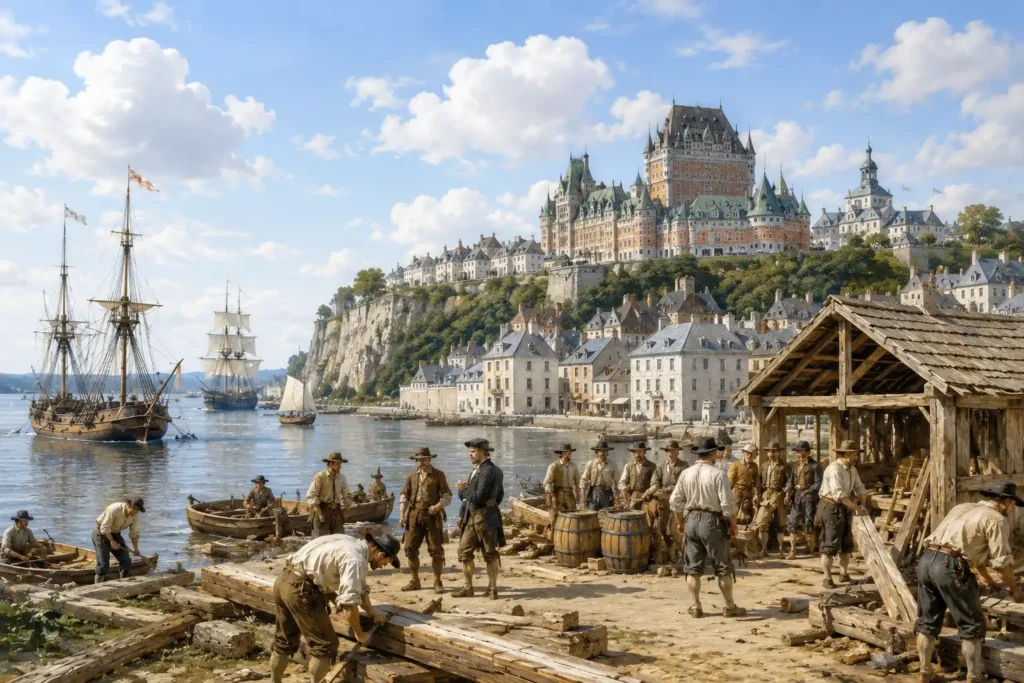
Research and special contributions by Carle Jasmin and Arnaud Pontin (Image: AI / Gay Globe)
Yes, here is the full English adaptation of your text, with key terms and concepts placed in bold for emphasis (such as LGBTQ+, Quebec, New France, Samuel de Champlain, and other central historical and thematic keywords):
In the summer of 1608, on the shores of the Saint Lawrence River, a few dozen men were busy around the rudimentary buildings that Samuel de Champlain had just erected. The winters were deadly, resources were limited, and the future of the colony remained uncertain. In this small settlement that would become Quebec, no one suspected that they were writing the first pages of a history which, four centuries later, would lead to one of the most open societies in the world regarding sexual and gender diversity in Quebec.
Traditional accounts of the founding of Quebec speak of explorers, missionaries, soldiers, and fur traders. They recount alliances with Indigenous nations, rivalries between European empires, and the hardships of life in New France. Yet an important part of this history remains largely absent from school textbooks: that of people who would today be identified as lesbian, gay, bisexual, transgender, or queer (LGBTQ+).
Their absence from the archives does not mean they did not exist. It rather testifies to the silence imposed by an era in which religion tightly framed private life and where certain behaviors were considered sins even before being perceived as crimes.
To find their traces, one must learn to read between the lines of ancient documents. One must search in judicial records, personal correspondences, religious reports, and sometimes even in rumors recorded by the authorities. This investigation often resembles historical archaeology: the clues are rare, fragmentary, and sometimes contradictory. Yet when gathered together, they reveal an inescapable reality: LGBTQ+ people have always been part of the human landscape of Quebec.
Before Champlain: when gender diversity already existed on Quebec territory
Long before French sails appeared on the horizon of the Saint Lawrence River, long before crosses were planted in the name of the King of France, and long before Quebec became the cradle of European presence in North America, peoples had already lived on this vast territory for thousands of years.
Their history did not begin in 1608.
And neither did the LGBTQ+ history of Quebec.
For a long time, Western historians told the story of sexuality and gender as a linear evolution: first Christian morality, then prohibitions, then struggles for rights, and finally contemporary recognition of LGBTQ+ people. This view is now being challenged. Research from recent decades has shown that even before the arrival of Europeans, several Indigenous nations held much more flexible conceptions of gender than those that dominated Europe at the time.
To understand the scale of the cultural shock that would occur in the 17th century, one must imagine two worlds meeting.
On one side, a Europe deeply marked by Catholicism. A society where male and female roles were clearly defined, where sexuality was closely monitored by the Church, and where behaviors judged deviant could lead to prison, exile, or even death.
On the other, a mosaic of Indigenous peoples whose traditions varied greatly from one nation to another, but where certain communities recognized the existence of individuals occupying roles that did not necessarily correspond to the male or female categories imposed by Western thought.
This reality surprised the first explorers.
And it deeply shocked many missionaries.
Accounts from the period often reveal more about the observers’ prejudices than about the behaviors they claimed to describe.
As is often the case in colonial history, those who wrote the documents were rarely those whose lives were being told.
The European gaze: between fascination and incomprehension
When a 17th-century French missionary set foot on the territory that would become Quebec, he discovered not only a new continent but a world that largely escaped his mental categories. His gaze was shaped by a Europe deeply structured by Christian thought, where the order of the world seemed self-evident: God created men, God created women, and each sex was assigned a precise role defined by both nature and morality. In this very closed intellectual framework, anything that deviated from this binary division immediately appeared as an anomaly, or even a threat to the divine order.
This gap largely explains how Europeans described the Indigenous societies they encountered. Missionaries recorded observations in their journals that mixed curiosity, moral judgment, and incomprehension, without always having the conceptual tools needed to interpret what they saw. They sometimes described social roles, practices, or gender identities that did not correspond to their own system of thought, but which they nevertheless translated through a Christian lens that inevitably distorted them.
One must imagine a medieval chronicler trying to describe the Internet: even with the best intentions, he would lack not only the vocabulary but also the fundamental concepts to understand what he was observing. This is exactly what happened in the first colonial accounts, where Indigenous reality was filtered through European categories that did not allow its full complexity to be grasped.
The result is often the same: a significant part of these realities disappeared behind incomplete descriptions, moral judgments, or erroneous interpretations, creating a fragmented historical memory from the very first contacts.
Multiple realities, not a single model
Today, the term “two-spirit” is frequently used to designate certain forms of gender and sexual diversity present within several Indigenous nations. But this contemporary notion, while useful for naming a long-ignored reality, must not obscure an essential historical truth: there has never been a single homogeneous Indigenous culture on Quebec territory.
The Innu, Wendat, Atikamekw, Mohawk, Abenaki, Cree, and Algonquin each had their own languages, social structures, and value systems. In some cases, specific roles were recognized for people who did not strictly correspond to European gender categories. In others, conceptions were different or simply structured differently, with no direct correspondence to our contemporary classifications.
Speaking of a single Indigenous reality would therefore be as reductive as claiming that all 17th-century Europeans shared an identical worldview. Real history is made of diversity, local variations, and cultural nuances that simplified narratives have too often erased.
This diversity recalls a fundamental truth: categories of gender and sexuality are not universal in form but are culturally constructed and therefore always situated in a specific historical context.
When colonization erases memories
One of the least-known aspects of colonization lies not only in territorial conquest but in the gradual transformation of the social and cultural structures of Indigenous peoples. Missionaries did not simply evangelize: they also sought to reshape ways of life, family structures, and social norms according to a European model considered universal.
In this process, the Christian family model gradually became the norm to be achieved. Traditional social roles were called into question, certain cultural practices were forbidden or discouraged, and part of the orally transmitted knowledge slowly disappeared over generations.
Later, residential schools would amplify this phenomenon by brutally interrupting the intergenerational transmission of languages, stories, and knowledge. Children grew up far from their communities, often deprived of their original culture, leading to a massive loss of historical continuity.
In this context, a significant part of the memory linked to gender and sexual diversity was also affected—not because it did not exist, but because it was not transmitted, documented, or recognized in dominant narratives.
The LGBTQ+ history of Quebec cannot therefore be understood without integrating this dimension of cultural erasure. Part of this memory disappeared long before the emergence of modern sexual liberation movements, not due to an absence of reality, but due to a rupture in transmission.
A colony of men in a world of men
When the first French settlers established themselves permanently in New France, another reality profoundly structured social life: the demographic imbalance between men and women. At several points in the 17th century, the colony had an overwhelming majority of men, to the point that French authorities openly worried about its stability and future growth.
The sending of the King’s Daughters (Filles du Roy) was precisely part of this logic of demographic rebalancing. But before their arrival, daily life in the colony was largely organized around male groups: soldiers in garrisons, sailors on ships, coureurs des bois in the forests, trappers isolated in remote territories, and workers grouped together in often precarious conditions.
For historians of sexuality, these environments inevitably raise important questions. How did individuals experience intimacy in these heavily masculine contexts? What forms of affective, emotional, or sexual relationships could emerge in these isolated spaces? And above all, what aspects of these lives completely escaped the authorities and therefore the archives?
Historical documents remain silent on many aspects of this reality. But this silence itself becomes a clue. For world history shows that in similar contexts, forms of same-sex sociability have always existed, in varying forms depending on the era and cultures.
The question is therefore not whether these realities existed, but rather how they were lived, perceived, and above all, rendered invisible.
The Church enters the bedroom
In 17th-century New France, the Catholic Church occupied a central place in the organization of society. Today, Quebec is often described as one of the most secular societies in North America, but this transformation is extremely recent on a historical scale. For centuries, the Church was omnipresent: it baptized, taught, married, buried, advised, and even influenced the decisions of civil authorities.
In this context, sexuality ceased to be solely a private reality and became a moral and religious issue. Marriage was considered the only legitimate framework for sexual relations, with procreation as its main objective. Pleasure itself occupied a marginal place in the theological discourses of the time, when it was not explicitly suspected.
In this moral universe, any sexuality judged non-conforming was liable to be condemned not only as a social deviation but as a spiritual fault. Homosexuality, in particular, was perceived not simply as forbidden behavior but as a transgression of the divine order itself.
This vision, deeply rooted in religious and social structures, would exert a lasting influence that extended well beyond the colonial period and continued to mark the following centuries.
Invisible lives behind the archives
One of the major challenges of LGBTQ+ history in early Quebec lies in the near-absence of direct testimonies. The people concerned very rarely left written traces of their intimate experiences, whether in the form of personal diaries, correspondences, or autobiographical accounts.
They did not create community organizations, political movements, or public platforms for advocacy. They lived in a framework where open expression of their identity was either impossible or dangerous.
The available archives therefore come mainly from institutions: courts, religious authorities, and colonial administrations. They only speak of LGBTQ+ people when a conflict broke out, when an accusation was made, or when a behavior was deemed problematic.
This asymmetry produces a profoundly unbalanced image of the past. It gives the impression that these lives only existed through the prism of repression, whereas in reality they existed in all their complexity, their everyday nature, and their humanity.
Behind every judicial file lies a complete existence, made of relationships, attachments, desires, but also survival strategies in a world that offered them neither recognition nor protection.
Scandals, trials, and lives under surveillance in New France
As New France became more structured in the 17th century, colonial administration and the Catholic Church refined their tools of social control. Parish registers multiplied, civil authorities organized daily life, and judicial mechanisms began to take root more firmly in cities like Quebec and Montreal. In this context, certain cases sporadically emerged from the archives—not because they were more frequent than other forms of transgression, but because they directly touched what the era considered the fundamental moral order.
These cases are rare, fragmentary, and often difficult to interpret, but they hold major historical importance: they constitute almost the only direct windows onto sexual and affective realities that the colony otherwise tried to keep silent.
The drum of Quebec: a name in the silence
Among the rare cases that have survived through time, that of the young military drummer of Quebec occupies a special place in the colony’s history. The available documents remain incomplete, but they allow us to reconstruct the broad outlines of an episode that marked the authorities of the time.
The character was young, integrated into the military structure, and performed an essential function in the daily operations of the troops. The drummer was not just a musician: he transmitted orders, set the rhythm for movements, and played a strategic communication role in a world where means of transmission were limited. His status made him visible, identifiable, and therefore particularly exposed.
When accusations circulated about him, they could not be ignored. In the French colonial system, matters touching on sexual morality were taken seriously not only judicially but also religiously and socially. The investigation mobilized witnesses, military authorities, and representatives of colonial justice.
The exact details of the case remain unclear, as is often the case in archives from this period. The sources are fragmentary, sometimes contradictory, and filtered through the legal and moral language of the time. But one thing remains clear: the young man became the object of a procedure that went far beyond the individual framework and fit into a logic of maintaining colonial order.
A fragmented but persistent history
Despite the scarcity of sources, these judicial, religious, and administrative fragments allow us to reconstruct an essential historical reality: same-sex relationships were not absent from New France, but they were rendered invisible by the social, religious, and legal structures of the era.
What the archives show above all is a system where the very existence of certain realities depended on their visibility to the authorities. What escaped the official gaze almost entirely disappeared from the written record, even though it continued to exist in daily life.
It is in this tension between presence and erasure that the LGBTQ+ history of old Quebec was built: a history made of traces, silences, and occasional appearances, where every preserved document becomes a precious fragment of a largely vanished world.
And as we move toward the end of New France, one truth gradually imposes itself: what is visible in the archives is only a tiny part of what actually existed.
The rest belongs to the silence of history.
When New France came under British domination following the Conquest, the inhabitants of the Saint Lawrence Valley saw their political universe transformed profoundly. A new administration gradually replaced French institutions, colonial authorities now answered to London rather than Versailles, and the rules governing public life evolved at the pace of reforms imposed by the new empire. For people who would today be described as LGBTQ+, however, this change of regime did not represent a liberation. Prejudices remained firmly anchored in society, and relationships between people of the same sex continued to be perceived as morally condemnable and legally reprehensible behaviors. The fear that already accompanied these realities under the French regime did not disappear with the arrival of the British; it simply expressed itself within a different political framework and through control mechanisms that gradually became more structured.
Montreal offers a particularly interesting example of this evolution. As the city developed at the turn of the 19th century, its port attracted sailors from Europe, passing merchants, soldiers, workers, and adventurers seeking new opportunities. This demographic growth slowly transformed urban life. While small rural communities made it difficult to hide one’s habits or acquaintances, cities offered a form of anonymity previously unknown in the colony. Without immediately creating a space of freedom, this concentration of population nevertheless allowed certain people to lead a more discreet existence, to form relationships away from the gaze of their family, or to meet other individuals sharing the same realities.
Historians today consider this urbanization to be one of the essential conditions for the emergence of the first homosexual subcultures. Long before the appearance of gay bars, activist movements, or modern political demands, large cities enabled men and women to discover that they were not alone. This awareness, often invisible in official archives, would play a fundamental role in the development of LGBTQ+ communities over the following centuries.
1867–1945: Living in the shadows in the Victorian era
When Canada officially became a federation in 1867, the communities that would form modern Quebec entered a period of spectacular transformations. Railways now connected regions once isolated, factories attracted thousands of workers to urban centers, and Montreal gradually established itself as the country’s economic metropolis. For the majority of citizens, these changes signaled entry into modernity. For people who would today be described as LGBTQ+, the reality was more nuanced.
At the end of the 19th century, homosexuality remained not only condemned by religious institutions but also criminalized by laws inspired by the British model. Newspapers of the time rarely spoke of sexual diversity. When they did, it was generally in the pages devoted to news items or trials. The people concerned had neither community organizations, nor public spokespersons, nor safe spaces to assert their existence. They lived in a society where discretion was not simply a social strategy: it was often a condition of survival.
This invisibility does not, however, mean that LGBTQ+ communities were absent. On the contrary, as Montreal grew, a parallel life began to take shape in the interstices of the city. Behind the respectable facades of downtown, in certain hotels frequented by passing travelers, in public parks after nightfall, or in establishments whose reputation was discreetly passed by word of mouth, men and women gradually discovered that they were not alone.
The Quebec metropolis at the end of the 19th century resembled in many ways the major European and North American cities of the same period. Officially, Victorian morality dominated public space. Religious sermons celebrated the traditional family, authorities valued respectability, and behaviors judged deviant were severely condemned. Unofficially, human reality was infinitely more complex. Desires do not disappear because a law prohibits them, any more than they fade under the effect of a Sunday sermon. They simply move toward less visible spaces.
Police archives from several Western cities moreover show a recurring phenomenon: the more authorities try to control certain practices, the more those practices develop their own codes, their own networks, and their own meeting places. Montreal was no exception. Even if the evidence remains fragmentary, historians have gradually uncovered traces of a discreet homosexual sociability that began to develop at the end of the 19th century.
This period also marks the appearance of a phenomenon that would cross the entire LGBTQ+ history until the second half of the 20th century: the double life. Many men got married, started families, and held respectable jobs while hiding an essential part of their identity. Some women experienced comparable situations. In a society where family honor was of capital importance, publicly revealing one’s attraction to a person of the same sex could lead to social exclusion, loss of employment, or a break with one’s circle.
To understand this era, one must abandon the simplistic image of a society divided between homosexuals and heterosexuals as we conceive it today. Modern identity categories did not yet really exist. Many people lived their affective relationships without having the words that would later allow them to define them. They navigated a world where notions of gender, sexuality, and identity were interpreted through cultural frameworks very different from our own.
This reality explains why 19th-century archives often resemble an immense incomplete puzzle. Direct testimonies are rare. Letters were destroyed. Personal diaries were not preserved. Families sometimes preferred to erase certain memories rather than pass them on to future generations. Yet when one gathers the scattered fragments found in judicial archives, newspaper chronicles, private correspondences, and medical files, a portrait begins to emerge.
This portrait reveals that the LGBTQ+ history of Quebec was not born in the 1960s or 1970s. Long before the marches, liberation movements, and rainbow flags, thousands of people were already living these realities. They did not have the rights or visibility that exist today, but they already formed the invisible foundations of a community that would gradually emerge from the shadows over the course of the following century.
ADVERTISING

READ ALSO
Homosexuality in Prehistory and Queer Archaeology: What Do Historical Evidence Really Say?
https://gayglobe.net/homosexuality-in-prehistory-and-archaeology-queer-que-disent-vraiment-les-preuves-historiques/
Homosexuality in Prehistory and Queer Archaeology: What Do Historical Evidence Really Say?
https://gayglobe.net/homosexuality-in-prehistory-and-queer-archaeology-what-do-historical-evidence-really-say/
A Historical Journey through Bisexuality
https://gayglobe.net/a-historical-journey-through-bisexuality/
The Evolution of the LGBT Acronym: Meanings, History, and Debates
https://gayglobe.net/the-evolution-of-the-lgbt-acronym-meanings-history-and-debates/
Gay Globe Magazine – Canadian LGBTQ+ Media Since 1998
https://gayglobe.net/about/