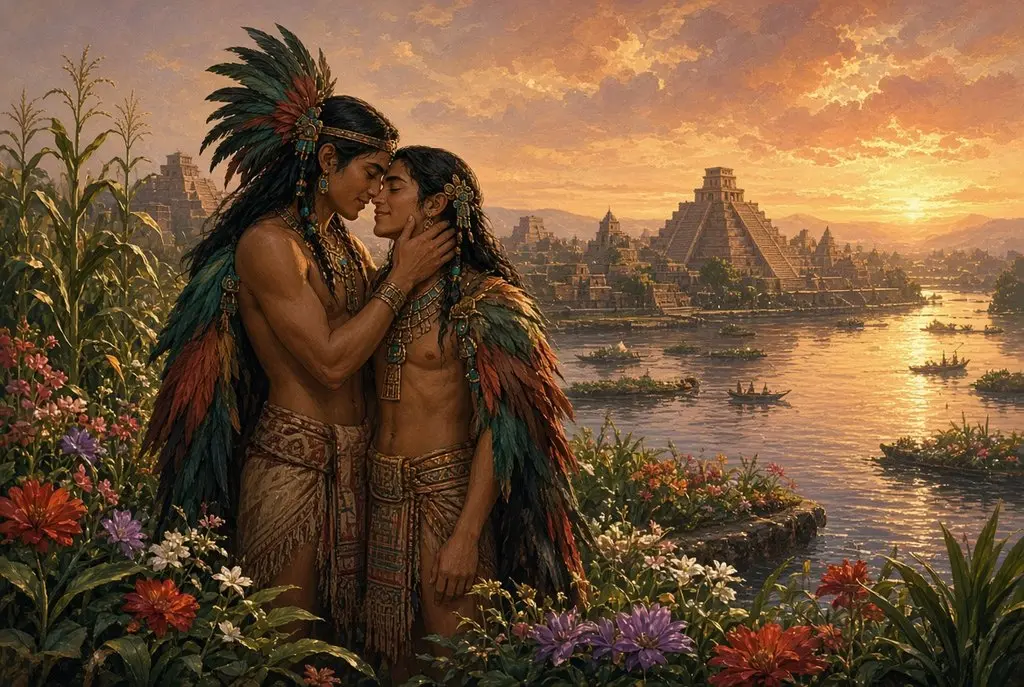
Carle Jasmin (Image : AI / GayGlobe.net)
I am truly happy today to offer you an article on a subject that has never been covered in the history of Gay Globe and that has been addressed very little elsewhere in the world: homosexual love among the Aztecs, a pre-Columbian civilization of Central America.
The Aztecs were a Mesoamerican people who built one of the most powerful empires in pre-Columbian America, mainly in the central region of present-day Mexico. They are best known for their capital, Tenochtitlan, founded around 1325 on an island in Lake Texcoco, on the site of present-day Mexico City. At its height, in the early 16th century, Tenochtitlan was an immense city that probably had several hundred thousand inhabitants.
The term “Aztecs” is widely used today, but the populations that made up this empire referred to themselves in particular as the Mexica and spoke mainly Nahuatl. The Aztec Empire developed through a skillful combination of political alliances, military conquests, and a tribute system imposed on numerous neighboring peoples.
The Aztec civilization also distinguished itself in several fields. Its architecture and urban planning, particularly through the city of Tenochtitlan and its imposing temples, demonstrate remarkable expertise. Its agriculture, based in part on chinampas, artificial islands designed for cultivation, made it possible to feed a large population. The Aztecs also possessed advanced knowledge of astronomy and had developed complex calendrical systems.
Trade played an important role in their society, particularly through extensive networks of markets. The transmission of knowledge, medicine, knowledge of plants, and the arts, including sculpture, poetry, and religious artistic practices, were also integral parts of their culture.
Religion occupied a central place in daily life. The Aztecs worshipped deities such as Huitzilopochtli, Quetzalcoatl, and Tlaloc. Some religious rites included human sacrifices, a practice documented by historical sources, although Spanish accounts may at times have exaggerated their extent.
The Aztec Empire was ultimately overthrown in 1521, when Spanish forces led by Hernán Cortés, supported by several peoples who were enemies of the Mexica, conquered Tenochtitlan, thereby bringing an end to one of the most important empires of pre-Columbian America.
Love in the Time of the Aztecs
Among the Mexica, love and sexuality were deeply connected to family, marriage, religion, and social organization. Marriage was an important institution, and unions were often overseen by families. Sexuality was therefore not simply regarded as a private matter: it also had social and religious dimensions.
Young men and young women were prepared for their roles in society, and procreation occupied an important place. This does not mean, however, that romantic feelings were absent. Nahuatl literature and poetry, on the contrary, demonstrate a great sensitivity to love, desire, separation, beauty, and emotional suffering.
Spanish chroniclers left several accounts concerning sexual relations between people of the same sex among the peoples of pre-Columbian Mexico. However, these accounts must be read with caution. Spanish authors were generally religious figures or observers from a Christian society in which homosexual relations were considered serious sins. Their descriptions of Indigenous sexual practices were therefore often accompanied by moral judgment.
Some sources mention men having sexual relations with other men and use categories that do not necessarily correspond to our current understanding of homosexuality. It is therefore historically risky to claim that the Aztecs had a conception identical to ours of a gay man, a lesbian woman, or a homosexual couple.
It is also necessary to distinguish between sexuality, identity, and love. An ancient source may provide evidence of a sexual practice without allowing us to know whether the people involved were in a romantic relationship, considered themselves a couple, or had an identity comparable to what we today call homosexual.
Did the Aztecs have a conception of homosexual love, or do Spanish sources only allow us to perceive certain sexual practices?
The most historically honest answer is: we cannot demonstrate that the Aztecs had a conception of “homosexual love” comparable to ours. The available sources primarily allow us to document certain sexual practices between people of the same sex, but provide much less information about the romantic feelings that may have accompanied them.
The Spanish sources of the 16th century do indeed describe sexual relations between people of the same sex among Mesoamerican peoples. However, they were written in a Christian context in which homosexual relations were morally and religiously condemned. Chroniclers therefore tended to describe these practices through the categories of their own society.
The problem is even greater when we speak of love. A sexual relationship between two men does not necessarily tell us whether they were in love, whether they formed a couple, whether they maintained a lasting relationship, or whether their relationship was occasional. We do not have enough direct Aztec testimony to answer these questions clearly.
There is, however, an essential distinction to be made: absence of evidence does not mean absence of love or homosexual emotional relationships. It is entirely possible that romantic bonds existed, but the surviving sources do not allow us to document them with the same precision as the sexual practices reported by the chroniclers.
Among the Aztecs, society was strongly structured around male and female roles. Men were generally associated with warfare, certain commercial activities, and political power, while women were primarily associated with household management, weaving, food preparation, and motherhood. These roles were not, however, entirely rigid: women could also engage in important commercial and religious activities.
People Who Fell Outside the Norms
Sixteenth-century Spanish chroniclers mention the existence of people whose behaviors or sexual practices were considered not to correspond to the masculine or feminine norms of their society. Some sources specifically refer to men who displayed feminine behaviors or had sexual relations with other men.
But it would be anachronistic to automatically describe them as “trans women,” “non-binary people,” or “homosexual people” in the contemporary sense. Modern categories of sexual and gender identity did not necessarily exist in this form in Mexica society.
What the sources seem to show instead is the existence of a strong social norm surrounding masculinity and femininity, with significant consequences for those who departed from it. Chroniclers describe certain sexual practices between people of the same sex in extremely negative terms, even presenting them as condemnable or “unnatural” behaviors.
It must nevertheless be kept in mind that we know these descriptions primarily through the eyes of Spanish conquerors and religious figures. Their objective was not to produce a neutral study of Mexica society. In particular, they sought to describe practices they considered sins in order to justify their condemnation and, in some cases, their repression.
One should certainly not imagine that a Mexica man who had a relationship with another man was automatically considered a person with a “homosexual orientation” in the modern sense of the term.
Historical sources are more concerned with the sexual act and the social status of the people involved than with any particular sexual identity. Some sexual behaviors between men appear to have been particularly condemned, but we know much less about lasting emotional relationships, love between men, or even how individuals themselves experienced their sexuality.
When a Man Adopted Feminine Behaviors
The question becomes even more delicate when it concerns men who adopted certain behaviors or activities considered feminine. Spanish chroniclers reported their existence, but generally described them in derogatory terms, in accordance with the moral and religious values of their time.
This indicates that the transgression of masculine norms was identifiable and socially significant in Mexica society. But these accounts do not allow us to determine whether the people concerned perceived themselves as men, as women, or according to a conception of gender different from ours.
It would therefore be historically incorrect to directly assign them the contemporary categories of transgender, non-binary, or homosexual person.
And the Women?
Historical sources are unfortunately much less abundant when it comes to sexual relations between women. This absolutely does not mean that they did not exist. Rather, it means that the surviving documents give us a very incomplete picture of female sexuality among the Mexica.
Spanish chroniclers were particularly concerned with practices they considered sins. Their documentation therefore had nothing to do with a modern investigation into the intimate lives of the populations they encountered.
So, What Could Actually Happen to a Person?
This is where overly categorical statements must be avoided. We cannot establish a single rule applicable to all people and all situations. Social status, context, the type of behavior, and probably the location could have been of considerable importance.
What we can say with greater certainty is that Mexica sexual norms were real and that certain transgressions could be severely punished. Sexual relations between people of the same sex were therefore not simply a matter of “sexual freedom,” as we might imagine it today.
But the other essential element is this: the sources tell us much more about the punishments than about the lives of the people concerned. We know that there were behaviors considered transgressive; we know much less about how those who practiced them lived, whether they formed couples, whether they experienced love, or whether they found social spaces where their sexuality could be tolerated.
It is precisely this documentary silence that makes the subject of “Love in the Time of the Aztecs” so interesting. Behind the condemnations reported by the Spanish chroniclers, there were necessarily human beings, their desires, their attachments, and their personal stories. But their own voice is unfortunately almost entirely inaccessible to us.
If Spanish chroniclers described same-sex relationships through the eyes of their time and according to Catholic morality, their accounts nevertheless constitute valuable historical traces. If we remove the religious judgment, what remains? There remain men who desired other men, sexual behaviors that the chroniclers observed sufficiently to report them and, behind these descriptions, the possibility of emotional relationships whose full history we will probably never know.
We cannot turn these men into “homosexuals” in the modern sense of the term, any more than we can claim that they necessarily lived love stories comparable to our own. But we can recognize one essential fact: desire between people of the same sex was part of the human reality of this pre-Columbian society. The judgment belonged to the chroniclers. The desire belonged to the people who experienced it.
ADVERTISING

READ ALSO
The Secret History of Québec’s LGBTQ+ Communities: From 1608 to Today
https://gayglobe.net/en/lgbtq-history-of-quebec/
Plato and Same-Sex Love: What His Writings Really Reveal
https://gayglobe.net/en/plato-same-sex-love/
Emperor Babur and His Love for Another Man: The Untold Story in the Baburnama
https://gayglobe.net/en/emperor-babur-love-for-another-man-baburnama/
Homosexuality in Prehistory and Queer Archaeology: What Do Historical Evidence Really Say?
https://gayglobe.net/homosexuality-in-prehistory-and-queer-archaeology-what-do-historical-evidence-really-say/
A Thousand-Year Journey: Exploring the History of the LGBT Community
https://gayglobe.net/a-thousand-year-journey-exploring-the-history-of-the-lgbt-community/
Gay Globe 11,900 Articles Published: 30 Years of LGBTQ+ Media History
https://gayglobe.net/en/gay-globe-11900-articles-30-years-lgbtq-media-history/