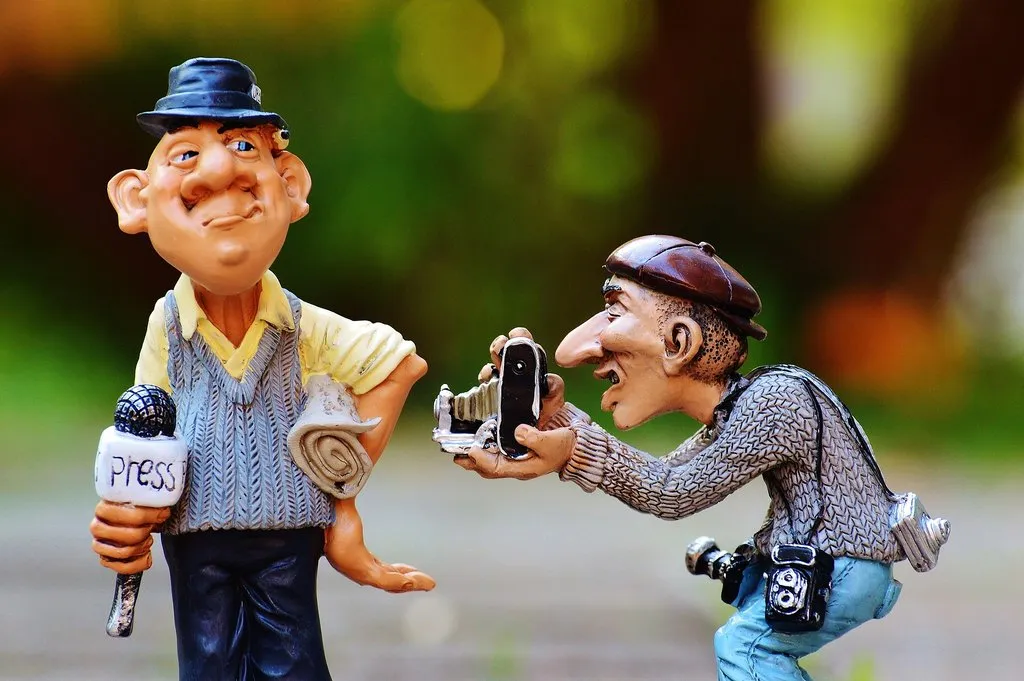
Roger-Luc Chayer (Image : Pixabay)
The author of this analysis has been a professional journalist for 33 years. He also served as president of the Montreal chapter of the Canadian Association of Journalists.
We are living today in an era where journalistic vigilance is more necessary than ever. The Web is now filled with fake media outlets and ghost media outlets that, behind an editorial appearance, produce practically no original information. Their model is simple: they take news published by legitimate media outlets, modify it slightly, sometimes to the point of distorting its meaning, and then republish it as if it were their own content.
This practice contributes considerably to blurring the boundaries between information, content recycling and disinformation. It also makes it more difficult for the public to identify reliable journalistic sources and verify the true origin of a news story.
Gay Globe has also officially examined this issue. At its request, the Conseil de presse du Québec issued a ruling on this matter, a document that can be consulted at: https://conseildepresse.qc.ca/decisions/d2026-01-008/
The problem from the point of view of the free circulation of news and journalistic analyses is that there are no longer any reliable ways to distinguish a real media outlet from a fake one. It is not enough to know the media outlet, as you know Gay Globe and the people behind this media group, because despite all my research, when visiting one of the pages of these fake media outlets, nothing makes it possible to conclude that it is a fraud. The news is presented as if it came from a real media outlet, but often, as with Montréal Minute, a single byline is attached to all the articles, and that person simply does not exist.
In this context, how can we still ensure that we are receiving information verified by a real journalist? And above all, is ethical journalism now threatened by this situation?
Who Can We Still Trust?
In a media environment where information circulates at unprecedented speed, one question has become unavoidable: how can the public still know whether the information they are reading has actually been verified by a journalist?
The question is far from theoretical. More and more websites present themselves as media outlets even though they produce little or no original content. They take news published by recognized media outlets, modify it slightly, sometimes change the headline or certain passages, and then redistribute it. For readers, it therefore becomes difficult to distinguish original journalistic work from simple content reproduction.
This reality raises a second, much more troubling question: is ethical journalism now under threat?
Because behind every genuine news report there are normally hours of research, verification, interviews, cross-checking of sources and, when necessary, requests for comments from the people concerned. This work has value, even when it is not visible in the final article.
The problem arises when content produced by a journalist can be taken almost immediately by other websites that have carried out none of these checks, while also benefiting from the visibility and traffic generated by the information. Ultimately, this situation risks creating deeply unequal competition between those who produce information and those who merely recycle it.
For the public, the issue is equally important. When a news story is reproduced several times on the Internet, its multiplication is not proof that it is true. False or inaccurate information can be copied by ten, twenty or fifty websites, creating the impression that it has been confirmed by several sources, when in fact it may have originated from a single initial article.
It is precisely in this new media reality that the role of the ethical journalist becomes so important.
Before the advent of these new tools for the automated production of information, I worked for years within several media outlets, whether print, radio or television. At that time, it was much more difficult to imagine entirely “robotized” information, particularly in what I would call “living” media, meaning media that allow the public to see or hear the journalist directly delivering their work.
But even this form of journalism is no longer protected. With deepfake tools and artificial intelligence technologies, it has become possible to create virtual presenters and journalists with astonishing realism, capable of making a person who appears completely real on screen say practically anything.
In other words, even live journalism, which once represented one of the strongest points of reference for distinguishing genuine information from manipulation, is no longer an absolute guarantee.
How Can We Distinguish Fact from Fiction in Information?
The first rule is probably the simplest: never assume that information is true simply because it is published on a website that looks like a media outlet. Today, the appearance of a website, the quality of its graphics, the presence of a logo or even the regular publication of news are no longer sufficient to demonstrate that it is a genuine journalistic media outlet.
The first reflex should be to determine who is actually behind the information. Is the journalist identified by name? Do they have a genuine professional presence? Can their other articles, career, interviews or work in other media outlets be found? A journalist who actually exists will generally leave verifiable traces of their professional activity.
You should then look at who publishes the media outlet. Is there an address, a team, an identifiable newsroom, contact information that makes it possible to communicate with someone? Does the media outlet clearly indicate who owns or publishes it? A publication that does not allow you to determine who produces it should already be treated with caution.
Another important clue is to trace the story back to its original source. When an article states that information comes from another media outlet, you should, whenever possible, consult the original article. Sometimes you discover that several websites are reporting exactly the same story, while all of them actually originate from a single initial source. The multiplication of articles therefore does not necessarily mean that there have been several independent verifications.
You should also pay attention to how the information is presented. Genuine journalistic work normally provides certain elements that allow the reader to understand where the information comes from: an interview, a document, an official statement, an identified source or several independent sources. Conversely, spectacular claims without any identifiable source should immediately raise suspicion.
Social media makes the situation even more complicated. A video showing a presenter on screen is no longer necessarily proof that a real journalist is behind the video. Deepfake and voice-synthesis technologies now make it possible to create extremely realistic images and voices. We must therefore also learn to verify the origin of the video, and not merely its appearance.
Finally, there is one rule that I consider essential: do not confuse repetition with confirmation. False information can be copied dozens of times within a few hours. If every website publishing it has taken it from the same source, we do not have ten confirmations: we have only one.
When in doubt, the best approach therefore remains to compare several genuinely independent sources, trace the information back to its origin and verify the identity of those claiming to have produced it.
In the age of ghost media and artificial intelligence, readers must unfortunately become a little bit like journalists themselves. Not to verify everything in depth, but simply to learn to ask the right questions: Who is speaking to me? Who verified this information? Where does it come from? And who can actually be held responsible for what has just been published?
ADVERTISING
READ ALSO
- Certified Media: Gay Globe Strengthens Trust in the Face of Misinformation
- Reader’s question: Are LGBT media subject to the same standards as traditional media?
- An ethical and deontological certification for Gay Globe
- Ethics and Privacy
- 11,900 Articles Published: Gay Globe Reaches a New Historic Milestone
- Analysis of Gay Globe by Artificial Intelligence: Gemini, ChatGPT, Grok and Claude Review GayGlobe.net