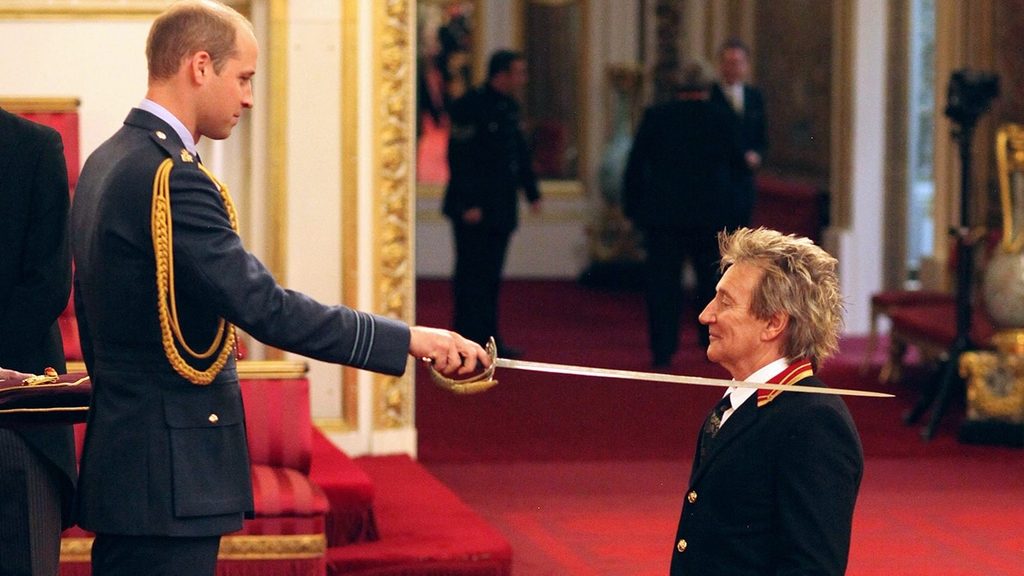
Carle Jasmin (Photo : PA via AP/Jonathan Brady)
What a pleasure it is to discover, or rather rediscover, an artist whom I knew well as quite a rock star, but whose involvement and views regarding our communities I was completely unaware of. Rod Stewart is an exceptional artist, but today, it is the human being I would like to tell you about.
According to my research on Wikipedia and Google, born on January 10, 1945, in London, Rod Stewart established himself over the decades as one of the great voices of British rock. With his immediately recognizable raspy voice, flamboyant style, and a career spanning more than six decades, he has sold hundreds of millions of records worldwide and left his mark on several generations.
Before achieving fame, Stewart got his start in various British bands, notably The Jeff Beck Group and Faces, before launching a solo career that would quickly become international. Songs such as Maggie May, Tonight’s the Night, Da Ya Think I’m Sexy?, Sailing, and I Don’t Want to Talk About It became classics.
But behind the image of the flamboyant and seductive rock star is a man who has often surprised people with his positions and his openness toward LGBTQ+ communities. Over the years, Rod Stewart has publicly expressed his support for gay artists and for recognizing their place in the music industry, while never hesitating to speak frankly about subjects sometimes considered sensitive.
Rod Stewart grew up in the British music scene of the 1960s and 1970s, where he was surrounded by many gay artists and professionals. He was particularly close to Long John Baldry, the singer who discovered him and who was openly gay. Stewart also recounted that he had a gay manager and a gay publicist and that, in his own words, he was “surrounded by gay men” at the time.
But the decisive element seems to have been the story of Georgie, a gay friend associated with the Faces circle. In 1976, Stewart dedicated The Killing of Georgie (Part I and II) to him, a song telling the story of the murder of a gay man in New York. At a time when homophobia was still extremely widespread, the fact that a major rock star would dedicate such a moving song to a gay man was quite exceptional. The Open University considers Stewart one of the first popular artists to publicly advocate for gay equality.
“Georgie was gay, I guess, nothing more, nothing less. He was the kindest guy I ever knew.”
What is particularly interesting is that Stewart did not simply write this song as a political statement: he personally knew the gay world he was referring to. As recently as 2016, he explained that Georgie’s story was connected to people he had actually known and that he had been deeply affected by what they were experiencing. He also said that gay men had told him, decades later, how much the song had helped them when they were young.
There is also a form of very British nonchalance toward sexuality in his attitude. In an interview with GQ, when reminded that he had shared a room with Long John Baldry without it ever being an issue for him, Stewart responded with considerable humour that he was completely comfortable with his own sexuality. He also explained that having gay people around him had “never bothered” him.
Rod Stewart: Convictions That Go Beyond the Stage
Rod Stewart’s commitment to LGBTQ+ people did not end with The Killing of Georgie, that moving song he dedicated in 1976 to a gay man who was murdered. Nearly half a century later, the rock star once again demonstrated that his convictions could come at a real price.
In 2023, Stewart refused to perform in Saudi Arabia, despite a substantial financial offer. He explained that he was grateful to have the choice of deciding where he could perform, whereas, in his view, many Saudi citizens do not have that freedom. He specifically cited women, the LGBTQ+ community, and the press among those facing restrictions and injustices.
“I would like my choice not to go there to shed light on the injustices that exist there and help bring about positive change,” he said.
What makes his decision particularly interesting is that it was clearly more than a symbolic gesture. Stewart had previously turned down an offer of more than one million dollars to perform in Qatar ahead of the 2022 World Cup, also citing the human rights situation.
And when asked what his attitude would be if one of his children were gay, his answer was disarmingly simple: he would be fine with it, as long as his child was happy. That statement perhaps sums up better than any lengthy speech how Stewart seems to view homosexuality: not as something a parent should fight or try to correct, but as a personal reality that does not change a person’s worth.
With Rod Stewart, there is therefore a remarkable continuity. In the 1970s, he sang the tragic story of a gay man who became a victim of violence and intolerance. Decades later, he publicly explained that he would accept his own child’s homosexuality. Then, in 2023, he refused a major concert opportunity because he did not want to turn a blind eye to the restrictions imposed, particularly on the LGBTQ+ community.
There is an immense consistency between the artist, his personal convictions, and his actions in everyday life, and it is precisely this kind of consistency that we need most in the age of Trump, as he works to dismantle all the gains, however modest they may be, in terms of LGBTQ+ rights.
When you really think about it, what Trump is doing to LGBTQ+ people in his country bears, in some respects, certain similarities to what we find in some Muslim-majority countries where Sharia law is applied. This is obviously not a comparison of identical legal systems, but rather an observation that, in both cases, individual rights can be called into question in the name of an ideological or moral vision imposed on society as a whole.
And to think that Mr. Trump was still criticizing Paris and London this week, falsely implying that Sharia law was recognized or applied there as a parallel legal system. He even claimed that, in those two capitals, it had become “almost a second way of life.” A claim that obviously does not correspond to the legal reality of either city.
ADVERTISING

READ ALSO
Dolly Parton, the LGBT Icon Who Didn’t Know It, Dies at 80
Lire l’article
Drag Queens: How an Artistic Expression Became a Controversial and Unavoidable Global Cultural Phenomenon
Lire l’article
Love Between Men Among the Aztecs: What Spanish Chroniclers Actually Revealed
Lire l’article
The Secret History of Québec’s LGBTQ+ Communities: From 1608 to Today
Lire l’article
La Mie Matinale: More Than a Bakery, an Institution in Montreal’s Gay Village
Lire l’article
Shawn Mendes, Pride Anthem Rumors and Massive Misinformation: A Social Media Controversy Going Viral
Lire l’article