This article is the result of an exhaustive journalistic investigation conducted by Gay Globe Média. The information presented herein has been verified and, whenever possible, corroborated through relevant sources and documentation. In the interest of accuracy, balance, and journalistic rigor, the editorial team at Gay Globe Média offers the City of Montreal the opportunity to submit comments, clarifications, corrections, or additional information concerning the facts reported in this article.
This opportunity to respond is provided exclusively to allow the City to present its perspective and, where applicable, to identify any factual information it considers inaccurate or incomplete. Any request for correction must be accompanied by specific information or documentation enabling the editorial team to assess its validity. The editorial team retains full editorial independence in evaluating any comments received and in deciding whether to publish, modify, or maintain the information presented in this article.
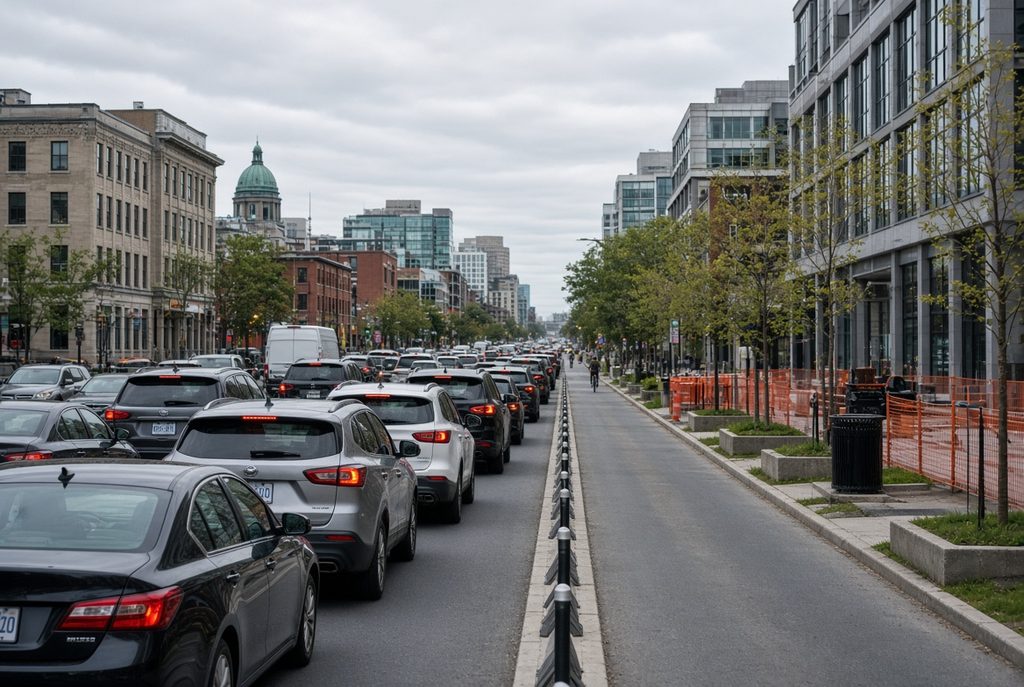
An exclusive investigation by Groupe Gay Globe Média (Image: AI / Gay Globe)
For nearly 20 years, Montrealers have observed that various policies seem to have been gradually put in place to transform the city of Montreal on several levels, particularly with regard to automobile mobility, restrictions imposed on traffic, as well as obstacles, both natural and artificial, that are multiplying throughout the road network.
For a long time, we believed that these policies essentially reflected the will of Montreal’s elected officials. Over time, however, they have given the impression, at least on the surface, of being improvised or implemented without an overall vision, with the negative consequences we know today.
Rather than promoting economic development and the commercial vitality of the Greater Montreal metropolitan region, certain decisions appear to contribute to slowing down, or even complicating, traffic on numerous arteries that are nevertheless vital and essential to the normal functioning of a major city. The situation could, by analogy, be compared to the progressive obstruction of the main arteries of a heart, with the consequences one can imagine for the health of the human body as a whole.
An example of this could be seen a few years ago, following particularly troubling statements by Luc Ferrandez, who was then mayor of the Plateau-Mont-Royal borough. During a public meeting, he stated in particular: « If we want to take action, we have to fight climate change. We have to discourage individual car ownership, we have to discourage the use of cars downtown. And congestion is a solution. Making life difficult for motorists is one of the solutions.
So, when we do this, we do it with full knowledge of the consequences. We say to ourselves: we are going to remove cars from where they cause the most problems, around parks and schools. And then, they will go elsewhere. That elsewhere will become less comfortable. We have to narrow those streets. We have to make them narrower. We have to install speed bumps, we have to install more traffic lights. Then, after that, it is not enough. We have to go even further. »
The full video can be viewed at https://gayglobe.net/Ferrandez26.mp4
But here is the point: these decisions may not be considered solely as a succession of improvised measures by the administrations of Denis Coderre or Valérie Plante. They also fit within certain orientations advocated by C40 Cities, an international organization of which Montreal is a member.
What is C40 Cities?
C40 Cities is an international network bringing together nearly 100 major cities around the world to collaborate and coordinate their efforts to combat climate change. Its work focuses in particular on the reduction of greenhouse gas emissions, transportation, air quality, energy, urban planning, and reducing dependence on automobiles. Its members include Montreal, Paris, London, New York, Los Angeles, Tokyo, Bogotá, and Amsterdam.
The strategies advocated by C40 Cities are broad, but they are based on a central idea: transforming urban systems to significantly reduce carbon emissions while making cities healthier and more resilient.
The main strategies are:
- Reduce the use of fossil fuels, with the overall objective of contributing to halving their use by 2030.
- Transform transportation: electrification of vehicles and buses, development of public transit, walking and cycling, reduction of polluting vehicles, and creation of zero-emission zones.
- Reduce the role of automobiles in urban space, notably through planning that gives priority to pedestrians, cyclists, and public transit. As part of the Green & Healthy Streets program, participating cities have, among other things, committed to developing a significant zero-emission zone by 2030.
- Decarbonize buildings: energy efficiency, clean energy, and lower-emission construction.
- Transform urban planning toward denser, more accessible neighborhoods that are less dependent on automobiles.
- Improve air quality, particularly by addressing emissions from transportation.
- Transform food systems, notably by promoting more sustainable and more plant-based food in municipal services.
- Reduce and better manage waste, with greater emphasis on source reduction, reuse, and recycling.
- Adapt cities to climate change: greening, heat management, flood prevention, and protection of vulnerable populations.
- Integrate social justice into the climate transition so that the benefits — cleaner air, housing, green jobs, mobility — are accessible to everyone.
However, its mobility program explicitly promotes the reduction of polluting vehicles, decreased dependence on automobiles, car-free or low-emission zones, walking, cycling, and public transit.
To reduce the role of automobiles, C40 does not rely solely on vehicle electrification.** It advocates transforming the way people travel and the way urban space is allocated.**
More specifically, the strategies include:
Reduce the space allocated to cars. This is probably one of the most important elements. C40 encourages cities to reallocate lanes and road space to buses, bicycles, and pedestrians. In its 2025 report, C40 indicates that 79% of signatory cities are already permanently reallocating road space previously devoted to cars to active and sustainable modes of transportation.
Restrict automobile access to certain areas. C40 encourages car-free zones, low-emission zones, and zero-emission zones, where the most polluting vehicles are banned or heavily restricted.
Make automobiles less necessary. The objective is to simultaneously develop public transit, cycling, and walking so that citizens can make more trips without a car. C40 refers in particular to “people first” planning and to cities designed around people rather than vehicles.
Massively increase the availability of public transit. C40 and its The Future is Public Transport campaign notably advocate the objective of doubling the proportion of trips made by public transit by 2030, with networks that are more frequent, accessible, reliable, and affordable.
Make car use more restrictive or more expensive in certain contexts. Among the measures used by some cities are congestion pricing, traffic restrictions, parking regulations, and higher parking fees. C40 presents, for example, congestion pricing and fuel taxes as instruments that can encourage a shift from private cars to public transit.
Transform neighborhoods themselves. C40 supports models such as Barcelona’s “superblocks,” low-traffic neighborhoods, and the 15-minute city, which seek to bring essential services closer to residents and reduce automobile travel.
C40 Cities: Who Decides the Future of Our Streets?
Here we find several of the measures implemented by the City of Montreal that have the effect of restricting the free movement of people, goods, and automobiles. But a fundamental question remains: in whose name, and with what democratic mandate, are these orientations being implemented?
These choices must also be examined in light of Montreal’s membership in the C40 Cities network, an international organization that advocates significant transformations in mobility and urban planning. Have Montrealers been consulted about the City’s membership in this organization and the commitments that stem from it? Have they ever been called upon to express their views on these orientations?
More troubling still, our investigation raises another question: was Montreal’s membership in C40 Cities and the City’s commitment to its principles actually the subject of a vote by City Council? If no vote formally authorized this commitment, it would then be necessary to explain through what process a municipal administration can join an international network and implement orientations capable of transforming citizens’ daily lives so profoundly.
This is not a secondary question. When a public policy changes traffic, parking, the use of streets, and access to automobiles, citizens have the right to know who decided what, under what mandate, and with what democratic authorization.
Montreal and C40: Membership Dating Back to Denis Coderre
Montreal’s membership in C40 Cities does not date back to the administration of Valérie Plante. The City submitted its membership application in November 2015, when Denis Coderre was mayor, and Montreal officially became a member of the international network in December 2016. C40 currently confirms that Montreal has been a member since 2016.
In April 2017, Mayor Coderre’s office described this membership as a “strong signal” of Montreal’s leadership in the fight against climate change and in urban diplomacy.
The membership did not, however, remain merely symbolic. Montreal subsequently participated in several C40-related programs and commitments, including Deadline 2020, and subsequently made several commitments to reducing greenhouse gas emissions that align with the network’s orientations.
One point nevertheless remains to be clarified: which municipal body officially authorized Montreal’s membership in C40? Our research has not yet identified a City Council resolution explicitly authorizing this membership.
This question is important because C40 is not merely a discussion network: its programs propose concrete orientations concerning transportation, urban planning, reducing the role of automobiles, and transforming cities. It therefore remains to be determined precisely which municipal decision committed Montreal to this network and through what democratic process.
What the Documents Establish
The City officially acknowledges that Montreal has been a member of C40 since 2016. Its open data even indicates that certain greenhouse gas reporting requirements are carried out “as required by C40.” A university study specifically examining Montreal’s membership in C40 indicates that the official membership application was submitted in November 2015 and that Montreal became a member at the end of 2016. This research specifically examines Denis Coderre’s role in placing this membership on the political agenda.
When compared with another major Canadian city, Toronto, the difference is striking: its city council expressly adopted a decision authorizing the mayor to sign an agreement with C40.
And What About Montreal?
In the minutes of the Executive Committee meetings from 2016 that I was able to locate, resolutions are duly numbered and decisions relating to international commitments appear when they are submitted to the committee. For example, the minutes of May 4, 2016, contain numerous formal decisions by the Executive Committee.
But at this stage, I have not found a resolution of the following type: “It is resolved to authorize the City of Montreal to join the C40 Cities Climate Leadership Group.” Nor have I found a City Council resolution from 2015 or 2016 explicitly stating that Montreal was joining C40.
Despite my research in the City of Montreal’s accessible decision-making archives, I have, to date, found no City Council or Executive Committee resolution explicitly authorizing Montreal’s membership in C40 Cities. The City nevertheless states that it became a member of the network in 2016 and has since implemented several commitments associated with the organization. The question of which municipal body formally authorized this membership therefore remains to be clarified.
If C40 membership or a particular commitment subsequently results in concrete municipal decisions — changes to traffic, parking regulations, street redesign, the creation of low-emission zones, investments in public transit, etc. — these measures must be adopted by the competent municipal authority, in accordance with the applicable rules.
And there is a particularly interesting element in Montreal’s case: the City itself acknowledges that some of its policies are directly structured around C40 commitments. For example, it indicates that its Climate Plan accountability system was developed based on orientations recommended by C40. It also indicates that its annual greenhouse gas emissions reporting is carried out according to C40 requirements.
Even more revealing, Montreal’s 2020–2030 Climate Plan explicitly states that the potential creation of a zero-emission zone in downtown Montreal is part of the movement of cities committed to C40. The document nevertheless specifies that such an initiative would require consultation with partners and public consultation.
A Question of Equity and Democracy
The overall set of City of Montreal policies aimed at changing Montrealers’ habits, but especially at making concrete decisions concerning traffic, obstructions, ghost construction sites, and the management of public space, may have the effect of penalizing a significant portion of the population, particularly motorists. These motorists pay registration fees and contribute financially to the use and maintenance of the road network. They are therefore entitled to expect municipal decision-making bodies to do everything within their power to ensure that traffic on public roads remains as fluid as possible.
Yet an increasing share of public space is being reallocated to bicycles and other modes of transportation that are generally not subject to the same registration and insurance requirements as automobiles. The same applies to scooters and other similar vehicles, which also use road space without being subject to the same obligations or, in many cases, the same mechanisms of contribution or responsibility.
This article above all raises a fundamental question: are we institutionalizing a particular conception of equity that imposes increasingly significant constraints on certain users of public space, while giving more room to other modes of transportation, without citizens necessarily having been informed of all the orientations underlying these choices? How far can a municipal administration go in transforming the rules of collective life without citizens actually being consulted or decisions being clearly submitted to their elected representatives?
ADVERTISING

READ ALSO
Montreal’s Gay Village: Soraya Martinez Ferrada Takes Action to Support Local Businesses
Read the article
Montreal Pride 2026: An Exceptional 20th Anniversary Edition Celebrating Diversity and Inclusion
Read the article
Gay Globe Media: A Montreal LGBTQ+ Media Institution Since 1998
Read the article
11,900 Articles Published: Gay Globe Reaches a New Historic Milestone
Read the article
Let’s Have a Laugh: Analysis of Gay Globe by Artificial Intelligence
Read the article
Montreal’s Gay Village: A Community, Cultural and Urban Transformation
GayGlobe.net English section
Thank you for providing this valuable information.