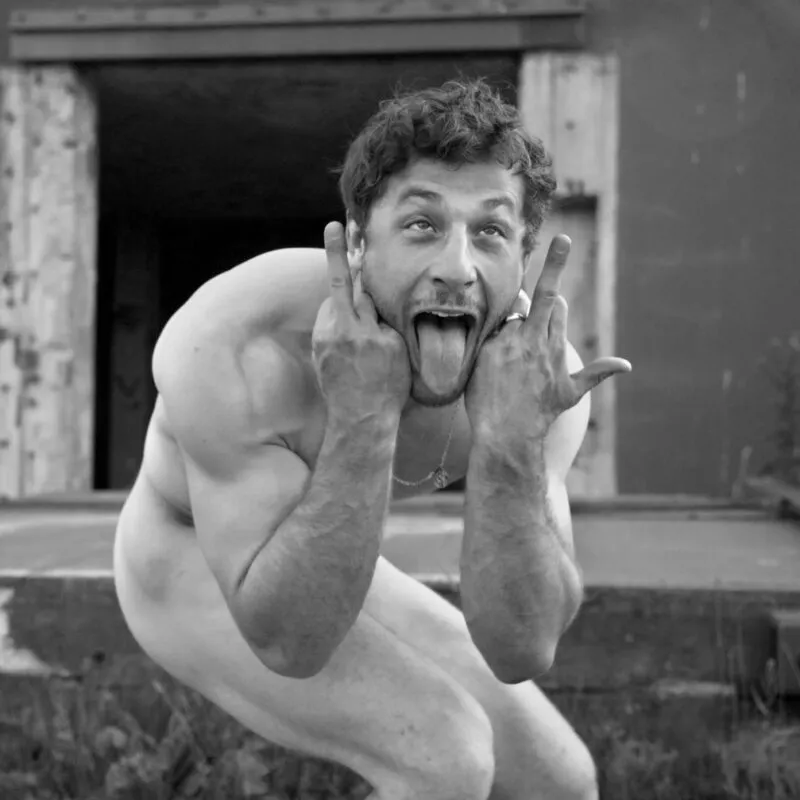
Roger-Luc Chayer (Photo: Marc Martin, “Chardons” — reproduced for news reporting purposes)
Mathis Chevalier is not gay. He is heterosexual. And that is precisely what makes his story so interesting.
A former MMA fighter, model and actor, he has everything some people associate with masculinity: the physique, the muscles, the gaze, the strength and the confidence traditionally expected of a man who steps into a cage to fight. But there is a problem for the self-appointed guardians of masculinity: Chevalier supports LGBT people. Or rather, he refuses to leave them alone.
In a sporting world where homophobia has unfortunately not completely disappeared, he has chosen to take a stand. And that position regularly earns him homophobic insults on social media. For some people, defending gay people or trans people is apparently enough to call their own definition of masculinity into question. Chevalier does not play that game.
He is not trying to become less masculine in order to be accepted by LGBT people. Nor is he trying to prove that he is “masculine enough” to reassure those who are afraid of difference. He is simply being himself. And that may be what bothers people the most.
His background is all the more interesting because he comes from MMA, a world in which the image of the fighter is often built around power, toughness and highly codified masculinity. Chevalier knows those rules because he lived by them. A former European junior amateur MMA champion, he spent years at the heart of that environment. Then he decided he would no longer allow himself to be boxed in.
In 2022, he agreed to appear in Mon CRS, a short film by Marc Martin. He plays a police officer confronted with a love story involving a trans woman. A role that radically breaks with the clichés usually associated with an MMA fighter. But Chevalier seems to appreciate contradictions precisely for that reason.
He can be muscular and defend LGBT people. He can be heterosexual and fight homophobia. He can embrace his masculinity while rejecting the toxic behaviours that some people would impose on him in the name of that same masculinity. There is no contradiction in that.
The real contradiction lies with those who still believe that a man has to prove his masculinity by rejecting gay people, looking down on trans people or mocking anything that does not fit their personal definition of what it means to be masculine. Chevalier answers them, in a way, simply by being who he is.
His LGBT flag can appear alongside his fighter’s physique. And contrary to what some people seem to believe, one does not cancel out the other.
In September 2026, his message once again found an echo in the French press. He continues to talk about masculinity, homophobia and the constant pressure that pushes some men to play a role in order to be considered “real men.” He has chosen not to play along.
That may be his most interesting fight. Because ultimately, Mathis Chevalier is not asking men to become someone else. He is simply asking them to understand that they can be themselves without needing to put others down.
In the cage, he learned to take the punches. On social media, he now takes the insults. And he keeps moving forward. Not because he wants to become an LGBT icon. But because he believes that a man has absolutely nothing to lose by defending other people’s freedom. And that, in some circles, still seems like a revolutionary idea.
About Marc Martin and Chardons
Marc Martin is a French photographer and artist whose work focuses in particular on the male body, sexuality, desire and the norms surrounding masculinity. His collaboration with Mathis Chevalier is particularly interesting because it places a former MMA fighter in situations that are far removed from the traditional image of the male athlete.
The Tomber des nu(e)s project, created with Chevalier over a period of about two years, draws in particular on references to art history and the representation of the male body. Chevalier poses nude, sometimes adopting poses inspired by famous sculptures or paintings. The photograph Chardons is part of this series.
What is interesting is that Chevalier was not simply chosen as a model. He says himself that the idea for the project came from him: when he was still young and very muscular, he suggested to Martin that he photograph him nude. At first, he explains, he wanted to preserve a record of his athletic body. The project then evolved into a much freer reflection on the body, nudity and masculinity.
And this is where Martin’s work takes on a particularly interesting LGBT dimension.
In an interview published by Playgirl, Chevalier explains that the photographs created with Martin can be interpreted as a way of turning the codes of toxic masculinity on their head. He notably refers to a reinterpretation of Velázquez’s Venus at Her Mirror, in which a strong man’s body is placed in a pose traditionally associated with the representation of the female body.
Chardons is part of that same approach: the body of a fighter, with everything it traditionally represents in terms of strength and masculinity, becomes an artistic subject that can be viewed differently.
And Chevalier fully embraces that ambiguity. He is not trying to erase his image as an athlete or hide his masculinity. On the contrary, he puts it on display and then subverts it.
That is probably what makes his collaboration with Marc Martin much more interesting than a simple nude photo shoot. The male body is no longer merely the body of the fighter who throws punches. It also becomes a body that can be looked at, staged and freed from some of the rules imposed by traditional masculinity.
The project resulted in the Tomber des nu(es) exhibition at Galerie Obsession in Paris in 2024, as well as a 296-page book published by AGUA éditions.
Read also
- Rui Takahashi: The Japanese Volleyball Player Who Chose to Speak Openly About His Sexual Orientation
Read the article - Black Market Peptides: The Hidden Danger Seductive to Many Gay Men in Gyms
Read the article - Gay Masculinity and the Rise of Digital Masculine Culture
Read the article - Nudity in Ancient Greece, Devoted to the Adoration of the Male Body
Read the article - The Prostate and Male Pleasure: Understanding Its Surprising Role in Sexuality
Read the article - Male Genital Dysmorphia: Symptoms, Treatment and Resources
Read the article