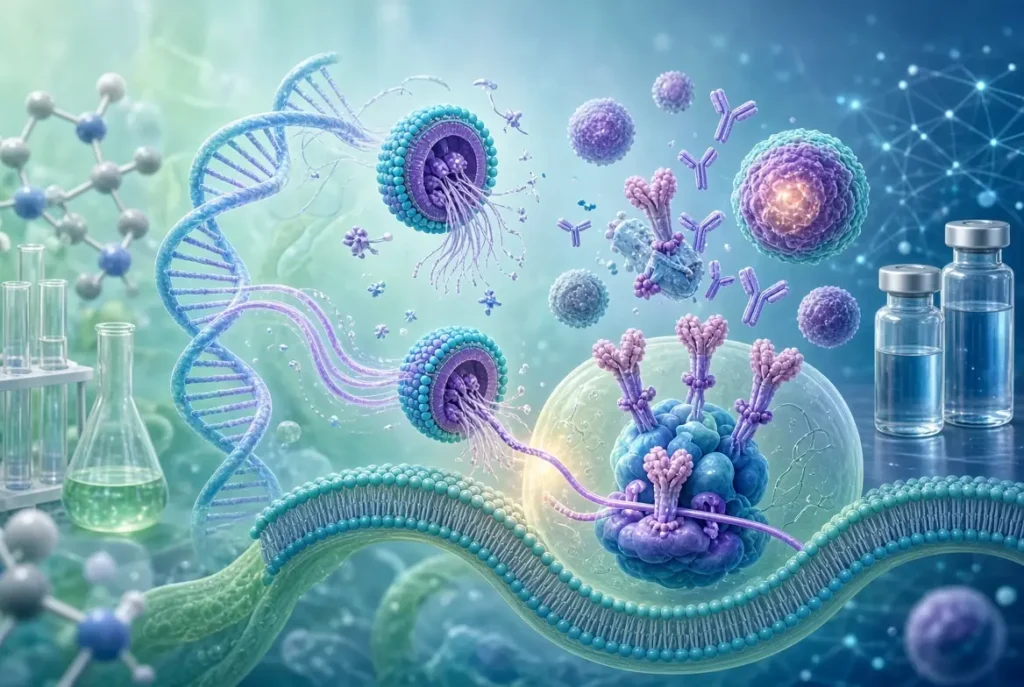
Roger-Luc Chayer (Image : AI / Gay Globe)
We’ve heard a great deal about vaccines using messenger RNA technology during the COVID-19 pandemic, as though it were an entirely new technique. Some people even became conspiracy theorists, embracing all sorts of claims circulating on the Web that falsely suggested these vaccines caused serious diseases and that vaccination should be avoided.
Obviously, COVID-19 vaccination has proven its effectiveness. It is notably thanks to vaccination that, several years later, we can live normally and go about our public activities without the same concerns for our health or for the capacity of our healthcare system.
Yet messenger RNA technology is far from new.
A technology that began long before COVID-19
We heard a great deal about vaccines using messenger RNA technology during the COVID-19 pandemic, as though it were an invention that had suddenly appeared in 2020. This perception is understandable, since messenger RNA vaccines were developed and used on a very large scale for the first time at that point. But in reality, this technology is the result of several decades of scientific research.
The story began long before the pandemic. As early as the 1960s, researchers began to understand the fundamental role of messenger RNA in our cells. Messenger RNA essentially acts as a temporary copy of genetic information that allows our cells to produce certain proteins. This discovery gradually opened the door to an idea that seemed almost futuristic at the time: why not use RNA directly as a way of instructing our own cells to produce a protein capable of triggering an immune response?
The problem is that messenger RNA is extremely fragile. When injected directly into the body, it can be rapidly destroyed and can also trigger a significant inflammatory response. For years, researchers therefore worked to find a way to protect the RNA and allow it to enter cells without being immediately eliminated.
Research spanning several decades
During the 1970s and 1980s, advances in molecular biology made it possible to better understand how RNA could be manipulated. In 1989, a team of researchers notably demonstrated that synthetic messenger RNA could be introduced into cells and used to produce a protein. This experiment represented an important step toward what we now call messenger RNA technologies.
But the journey from a laboratory demonstration to a vaccine that could be administered to millions of people was still a very long one.
During the 1990s and 2000s, several scientists continued their research into messenger RNA, particularly in the fields of vaccines and the treatment of certain diseases. One of the major obstacles remained the immune system’s reaction to the RNA itself. Researchers had to find a way to use this molecule without the body destroying it before it could perform its function.
It was within this long scientific history that the work of several researchers became decisive. Katalin Karikó and Drew Weissman, in particular, spent years studying ways of modifying RNA so that it could be better tolerated by the body. Their research, published in the early 2000s, helped overcome a major obstacle that had previously prevented the effective medical use of this technology.
In 2005, their work demonstrated, among other things, that certain elements of messenger RNA could be modified to significantly reduce the inflammatory response it triggered. This discovery would become one of the scientific foundations of future messenger RNA vaccines.
The missing piece: protecting the RNA
Another problem still had to be solved: how could this fragile molecule be transported into cells?
Researchers gradually developed delivery systems using tiny lipid particles. These lipid nanoparticles protect the messenger RNA and facilitate its entry into cells. This delivery technology would prove essential to the development of COVID-19 vaccines.
Thus, when the coronavirus responsible for COVID-19 emerged at the end of 2019, scientists were by no means starting from scratch. They already had several decades of research on messenger RNA, previous work on coronaviruses, accumulated knowledge about vaccines, and techniques capable of rapidly producing RNA sequences.
The pandemic simply brought all of these advances together at the same time.
After COVID-19, messenger RNA moves forward
COVID-19 ultimately served as a real-world demonstration of a technology that had been studied for decades. But its story obviously does not end with the coronavirus.
A new milestone has now been reached in the United States. On August 5, 2026, the U.S. Food and Drug Administration approved mFlusiva, the messenger RNA influenza vaccine developed by Moderna. It is a vaccine using the same broad technological platform as the messenger RNA vaccines already used against COVID-19 and respiratory syncytial virus.
The vaccine is authorized for the prevention of influenza in people aged 50 and older. For those aged 50 to 64, the authorization is based on a traditional approval process. For people aged 65 and older, the FDA granted accelerated approval, accompanied by an additional study intended to confirm the clinical benefit.
The development of mFlusiva is particularly interesting in the context of the history of messenger RNA. The vaccine, known as mRNA-1010 during its development, contains three messenger RNAs encoding hemagglutinin proteins corresponding to the main influenza strains targeted by the seasonal formulation. These RNAs are encapsulated in lipid nanoparticles, a technology that has become fundamental to the messenger RNA platform.
The results reviewed by the FDA show that, in the Phase 3 study conducted among adults aged 50 and older, the vaccine demonstrated greater relative efficacy than the standard-dose influenza vaccine used as the comparator, particularly against influenza A viruses. The FDA concluded that the available data supported a favorable assessment of the vaccine’s benefit-risk profile.
This decision is important for a reason that goes far beyond influenza. It demonstrates that messenger RNA is no longer associated solely with the COVID-19 pandemic. The platform is beginning to be used to develop vaccines against different infectious diseases and could eventually find applications in other areas of medicine.
The next time messenger RNA is described as a “new technology,” it is therefore worth remembering one essential fact: the technology was new to the general public, but certainly not to science.
ADVERTISING

READ ALSO
Hepatitis A and Hepatitis B Vaccination in Gay Men: From the 1990s Public Health Campaigns to Bepirovirsen Innovation — https://gayglobe.net/en/hepatitis-a-b-vaccination-gay-men-1990s-bepirovirsen/
HPV vaccine: near-complete protection against several cancers confirmed in Europe and North America — https://gayglobe.net/en/hpv-vaccine-protection-cancers/
COVID-19 and mRNA: The Medical Revolution Born from a Pandemic — https://gayglobe.net/en/mrna-covid-medical-revolution/
Bepirovirsen: a major new hope in the fight against chronic hepatitis B — https://gayglobe.net/bepirovirsen-a-major-new-hope-in-the-fight-against-chronic-hepatitis-b/
HIV and Misinformation: The History of Miracle Cures and Scams — https://gayglobe.net/hiv-misinformation-online/
HIV Is No Longer a Death Sentence: End of an Era and Historic Closure in Toronto — https://gayglobe.net/hiv-is-no-longer-a-death-sentence-end-of-an-era-and-historic-closure-in-toronto/