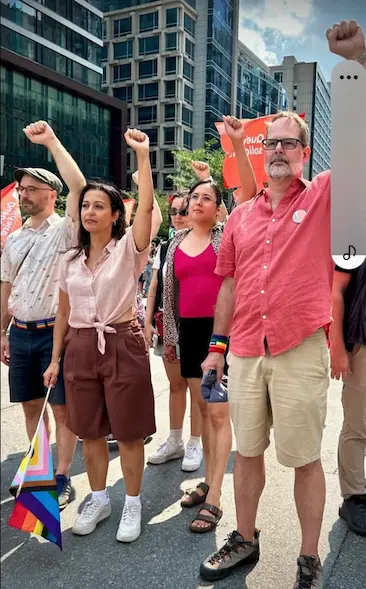
Roger-Luc Chayer (Photo: Québec solidaire (Ruba Ghazal) – 2026 Montreal Pride March)
Yesterday, Montreal hosted the 2026 Montreal Pride Parade, the culmination of ten days of festivities that attracted approximately 12,000 participants and an even larger number of spectators. It was a particularly spectacular edition, which took place without any major incidents and once again demonstrated Fierté Montréal’s ability to mobilize the public around LGBTQ+ realities and demands.
But in the midst of this celebration, one image quickly attracted attention and sparked numerous critical comments on social media: that of members of Québec solidaire, accompanied by Alexandre Boulerice, the party’s candidate in Gouin and former federal member of Parliament for the New Democratic Party.
With his fist raised and an LGBTQ+ bracelet around his wrist, Mr. Boulerice displays all the visual codes of activist solidarity with the LGBTQ+ communities. Yet this image raises a question that deserves to be asked: beyond symbols and public appearances, what concrete place has this solidarity actually occupied throughout his political career?
This is precisely where the unease expressed by some Internet users seems to take root. For several observers, simply displaying LGBTQ+ colors or raising one’s fist during a parade does not, by itself, constitute a record of LGBTQ+ engagement toward the communities concerned. The question then becomes one of the gestures made, public interventions, positions taken and personal actions actually undertaken over the years.
The presence of a politician at a Pride parade is obviously not objectionable in itself. It nevertheless legitimately becomes a matter for discussion when the symbols being displayed appear more visible than the record some attribute to him.
Perhaps it is this gap between the image being projected and the record that some citizens believe they can observe that explains why this photograph, seemingly ordinary at first glance, has provoked so many reactions.
At a time when LGBTQ+ communities continue to face very real challenges, the question remains: is political solidarity measured by the number of bracelets worn and fists raised, or by the concrete actions taken when the cameras are no longer there?
I nevertheless want to make it clear that it is not so much Mr. Boulerice’s presence that concerns me, nor even the use of our collective symbols to create, as an election approaches, a carefully calibrated image of closeness to the LGBTQ+ communities. What is more troubling is his association with a party that many Quebecers now consider disconnected from the realities, concerns and sensibilities of Quebec society.
This is a question that deserves closer examination, because behind the images of political convenience and slogans lie positions, decisions and concrete actions. And on this question, we will return to it in a future article.
Before presenting the results of my research into the concrete actions undertaken by Mr. Boulerice, both as a member of the NDP and on a personal level, I want to highlight one element that I find particularly revealing: Alexandre Boulerice has always refused to grant an interview to Gay Globe. I had already mentioned this in an article published in the magazine approximately thirteen years ago (Issue #89).
In Gay Globe Magazine No. 89, published approximately 13 years ago, I myself wrote that Alexandre Boulerice, then an NDP member of Parliament for Rosemont, was refusing to grant an interview to Gay Globe, that the media had attempted to obtain an interview with him for several months, and that he had also made no mention of World AIDS Day since his election. The article expressed the editorial interpretation that this demonstrated a “possible discomfort” with the homosexual issue.
More broadly, after consulting the available archives from 2011 to August 2026, I have found no interview given by Alexandre Boulerice to Fugues magazine, despite the publication’s significant presence in Montreal’s LGBTQ+ political news and despite the numerous mentions of Mr. Boulerice in its pages.
Alexandre Boulerice has given numerous interviews to major Quebec and Canadian media outlets throughout his career, but Gay Globe has documented, since the beginning of his mandate, persistent difficulty in obtaining an interview with him. Despite Boulerice’s occasional presence in Fugues, I have so far found no individual interview with him in that magazine.
This absence deserves to be noted, particularly when questioning the nature and consistency of his relationship with Quebec’s LGBTQ+ media.
Alexandre Boulerice: what have been his political interventions on LGBTQ+ issues within the NDP?
Since arriving in the House of Commons in 2011, Alexandre Boulerice has taken positions on several issues affecting the LGBTQ+ communities. His parliamentary record nevertheless reveals a more nuanced reality than the image of an MP who devoted the entirety of his political activity to LGBTQ+ rights. His interventions have focused primarily on a few specific issues: discrimination against gay and bisexual men, conversion therapy, transgender rights and the health of LGBTQ2+ communities.
If we completely set aside his parliamentary role, votes and the NDP’s official positions, and look only at what Alexandre Boulerice has personally and concretely done for LGBTQ+ individuals and organizations, the record I can document is much more limited.
The best-documented personal action is his participation in Fierté Montréal activities.
In August 2021, Fugues reported that Alexandre Boulerice participated in the Fierté Montréal march alongside Jagmeet Singh. The magazine placed him at the end of the procession with the NDP leader.
There are also traces of his participation in Pride in previous years, particularly in communications surrounding Montreal’s Pride parades. But care must be taken not to turn participation in a parade into personal activism: being present at a political march constitutes an act of support and visibility, but does not by itself demonstrate sustained involvement with LGBTQ+ organizations.
Following this targeted research, I have not found documentation comparable to what Fugues has published, for example, about Réal Ménard or André Boulerice. And this comparison is particularly instructive.
Fugues describes Réal Ménard’s personal involvement with the Coalition des minorités sexuelles du Grand Montréal and the Groupe de discussion pour hommes gais, followed by a long series of political actions directly connected to gay rights demands. In the case of André Boulerice, Fugues documents, among other things, his involvement that helped lead to Quebec’s civil union legislation for same-sex couples and his own marriage to his partner in 2004.
I find nothing equivalent for Alexandre Boulerice.
Does Alexandre Boulerice have genuine personal involvement with LGBTQ+ communities, beyond his parliamentary positions? There are public gestures of support, particularly his presence at Pride, but I have not found a personal LGBTQ+ community record comparable to that of other Quebec politicians.
When I saw the photograph above circulating yesterday, I initially felt a profound sadness at seeing our symbols used in this way within a political context. I immediately wondered whether it could be a form of political pinkwashing (a strategy of publicly displaying support for LGBTQ+ communities in order to project a favorable image, without that demonstration necessarily corresponding to concrete and sustained involvement with those communities).
The question is legitimate, particularly when one considers the relatively discreet personal presence of Alexandre Boulerice within LGBTQ+ communities and the absence, to my knowledge, of interviews he has given to gay media, particularly Fugues and Gay Globe. But the facts I have available do not allow me, for the time being, to cross that line and conclude that this constitutes pinkwashing.
Nevertheless, one question remains worth asking: what real place does Alexandre Boulerice give to LGBTQ+ communities when he is not in front of the cameras or operating within a political context?
ADVERTISING

READ ALSO
Trump Threatens Gay Marriage: Clinton Sounds the Alarm
https://gayglobe.net/trump-threatens-gay-marriage-clinton-sounds-the-alarm/
The Pink Triangle and Trump: A Troubling Journey Towards Totalitarianism
https://gayglobe.net/the-pink-triangle-and-trump-a-troubling-journey-towards-totalitarianism/
“I Was Not Fit to Govern”: Donald Trump’s Explosive Confession
https://gayglobe.net/i-was-not-fit-to-govern-donald-trumps-explosive-confession/
Against Trump, a King to Protect Canada’s Sovereignty
https://gayglobe.net/against-trump-a-king-to-protect-canadas-sovereignty/
What if Canada turned its back on the United States to join the European Union?
https://gayglobe.net/what-if-canada-turned-its-back-on-the-united-states-to-join-the-european-union/
Full speech of Prime Minister Mark Carney at the 2026 World Economic Forum in Davos
https://gayglobe.net/full-speech-of-prime-minister-mark-carney-at-the-2026-world-economic-forum-in-davos/