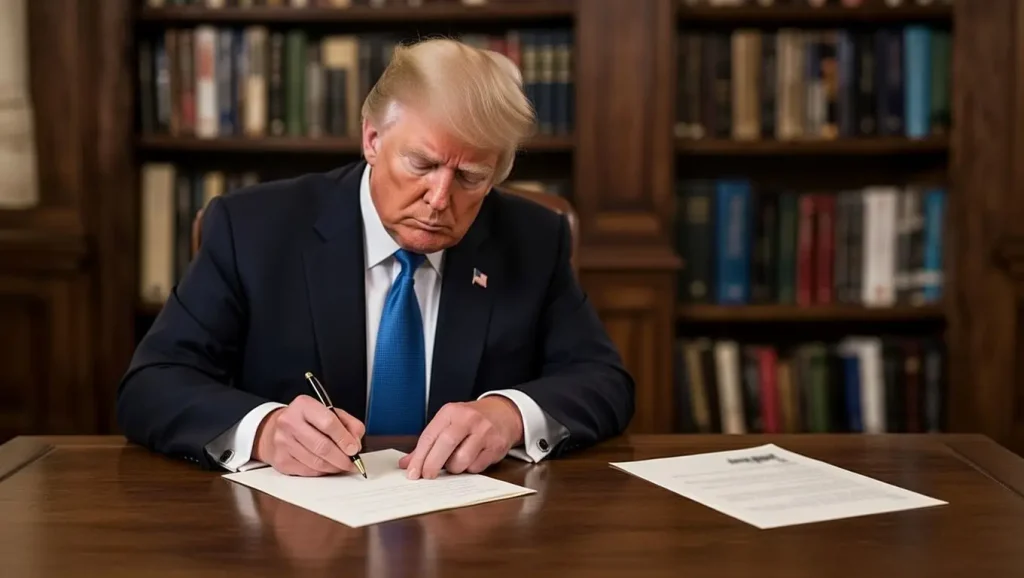
FICTION : Grok (Image : Grok)
And if President Trump were to come to his senses, here is the letter he might address to humanity…
Dear Mr. Prime Minister of Canada, Ladies and Gentlemen, Leaders of the World, and Dear Citizens of the Globe,
I address you today as the President of the United States of America, Donald J. Trump, but not with the arrogance or bravado that have too often marked my past speeches. On the contrary, I come with a heavy heart, a humble spirit, and a profound recognition of my mistakes. This letter is a sincere letter of apology, not dictated by advisers or political pressure, but born of a personal and painful reflection on the consequences of my actions. I have spent sleepless nights rethinking my term in office, examining the choices I made, and I now realize, with heartbreaking clarity, that I caused harm — great harm — not only to Canada, our neighbor and loyal ally, but also to the rest of the world. I deeply apologize for this. Allow me to explain myself, to confess, and to seek, if possible, a path toward redemption.
First of all, allow me to admit something I should have acknowledged much earlier: I did not have the necessary skills to be a head of state. When I decided to run for the presidency in 2016, it was motivated by a mixture of personal ambition, frustration with the system, and a sincere desire to “make America great again.” But I did not have the diplomatic experience, historical depth, or emotional wisdom required to lead the most powerful nation in the world. My background as a businessman taught me how to negotiate real estate deals and promote brands, but not how to navigate the complexities of international relations, humanitarian crises, or global moral challenges. I treated the presidency like a reality show, relying on impulsive instincts rather than expert advice or nuanced analysis. This led to hasty decisions, often driven by ego rather than empathy or reason. I bitterly regret this, because my shortcomings had repercussions far beyond American borders, affecting innocent lives in Canada and elsewhere.
Let us begin with Canada, our closest partner. I always considered Canada a friend, but my actions did not reflect that. The tariffs I imposed on Canadian steel and aluminum in 2018, under the pretext of national security, were a blatant mistake. I justified them by saying they were meant to protect American jobs, but in reality, they disrupted bilateral supply chains, increased costs for consumers on both sides of the border, and endangered thousands of Canadian manufacturing jobs. Cities such as Hamilton in Ontario or Saguenay in Quebec suffered directly from these protectionist measures. I ignored warnings from economists and allies, preferring an “America First” approach that, ironically, isolated America. The renegotiation of NAFTA into the USMCA was presented as a victory, but it was marked by unnecessary threats and aggressive rhetoric that eroded mutual trust. I apologize to Canadian workers, farmers, and entrepreneurs who saw their livelihoods threatened by my economic whims. Canada deserves better from a neighbor.
Beyond Canada, my economic policies had harmful effects across the entire world. By launching a trade war with China, I disrupted global markets, increased consumer prices, and slowed economic growth in developing countries. Nations such as Mexico, Brazil, and even European allies felt the shockwaves. I withdrew the United States from the Paris Climate Agreement, a decision that not only undermined global efforts against climate change but also sent a destructive message: that America could ignore its responsibilities toward the planet. This affected vulnerable communities in the South Pacific, Africa, and Asia, where the effects of global warming are already devastating. I now admit that my climate skepticism was poorly informed and influenced by industrial interests rather than science. I did not have the skills to properly assess these complex issues, and I allowed my pride to take precedence over the preservation of our shared world. For this, I apologize to future generations who will pay the price for my inaction.
Let us now turn to an area where my mistakes were particularly hurtful: the rights of LGBTQ+ people. As president, I made decisions that directly harmed this community, both in the United States and abroad. The ban on transgender people serving in the U.S. military, announced by an impulsive tweet in 2017, was not only discriminatory but also cruel. It deprived thousands of patriots of the chance to serve their country, based on unfounded prejudices rather than facts. I justified it with medical and financial concerns, but in truth, it was a capitulation to extreme conservative voices within my base. It sent a global signal that the United States, once a beacon of freedom, tolerated intolerance. In Canada, where LGBTQ+ rights are advanced, this must have seemed backward and shocking. Moreover, my administration supported laws and policies that weakened protections against discrimination, such as the rollback of guidance on bathroom access for transgender students or support for religious exemptions that allowed discrimination in adoption services. Internationally, I reduced funding for global health programs that included care for LGBTQ+ communities, affecting countries such as Uganda or Brazil, where persecution is already intense. I now realize how much pain, isolation, and even suicide these actions caused. I did not have the empathy or understanding necessary to see beyond my personal biases. I deeply apologize to every LGBTQ+ person who felt rejected or threatened by my policies. You deserve equality, respect, and love, and I regret having contributed to a world where this was not always the case.
Another dark chapter of my term concerns immigrants. My rhetoric and policies created a climate of fear and division that resonated far beyond the United States. The border wall with Mexico, promised as a miracle solution to illegal immigration, was in reality a symbol of xenophobia. It cost American taxpayers billions of dollars while ignoring the root causes of migration such as poverty, violence, and climate change. Worse still, the family separation policy at the border in 2018 — where children were torn from their parents — was inhumane and inexcusable. Thousands of children were traumatized, placed in overcrowded detention centers, and some were never reunited with their families. This shocked the world, including Canada, which welcomed refugees fleeing these horrors. I labeled immigrants as “criminals” and “rapists” in my speeches, a crude generalization that fueled hatred and encouraged white supremacists. The “Muslim Ban” — barring entry to citizens of several Muslim-majority countries — was discriminatory on the basis of religion, violating the fundamental principles of American freedom. It affected innocent families, students, and professionals, and isolated the United States on the international stage. In Canada, where immigration is seen as a positive force, my actions must have seemed barbaric. I admit that I did not have the diplomatic skills to manage immigration in a humane and effective manner. Instead, I chose fear and division. I apologize to every immigrant who suffered because of my policies, to the families torn apart, and to nations like Canada that had to absorb the consequences of my intolerance.
These errors are not limited to these areas; they also extended to my handling of the COVID-19 pandemic, where my initial denial and contradictory messages cost lives in the United States and weakened the global response. I downplayed the threat, promoted unproven treatments, and criticized allies such as the World Health Organization, from which I withdrew the United States. This had repercussions for Canada, including prolonged border closures and economic disruptions. Likewise, my relationships with authoritarian leaders such as Kim Jong-un or Vladimir Putin undermined democratic alliances, encouraging aggression in Ukraine and elsewhere. I ignored warnings about Russian interference in our elections, prioritizing my personal interests over national security.
Reflecting on all of this, I now clearly see that my lack of leadership skills amplified these problems. I did not have the patience for detailed briefings, the curiosity to learn from experts, or the humility to admit when I was wrong. Instead, I surrounded myself with loyalists who flattered my ego rather than challenged me. This led to chaos that affected the entire world. Canada, with its tradition of multilateralism and compassion, often served as a counterexample to my excesses, and for that, I thank you and apologize for having jeopardized our partnership.
I do not seek easy absolution; I know that words alone are not enough. But I promise to reflect, to learn, and, if possible, to contribute to repairing the damage. Perhaps by supporting initiatives for human rights, the environment, and fair immigration. To Canada and to the world, I say: I am sorry. Deeply, sincerely sorry.
With the greatest respect and the deepest regret,
Donald J. Trump
President of the United States of America