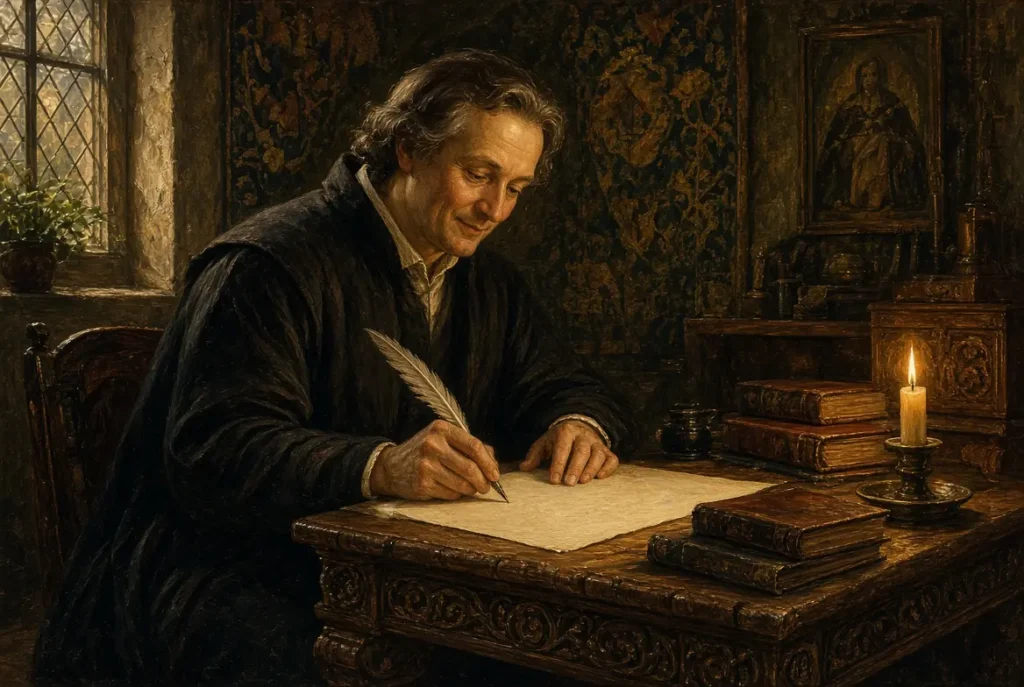
Roger-Luc Chayer (Image : AI / Gay Globe)
Why do traditional presentations of Erasmus say so little about his passionate relationships with men?
There are secrets that one prefers to forget, truths that one carefully avoids bringing to light, and questions that certain institutions simply do not like to answer. The Catholic religion, its priests and, above all, certain leaders installed at the summit of its hierarchy would certainly prefer that this one remain well sheltered from view. But it is precisely there that Gay Globe enters the scene. For decades, we have made the freedom to investigate, to question and to deconstruct myths a true trademark. When institutions remain silent, we ask the questions. When taboos settle in, we confront them with the facts.
And when certain mysteries seem destined to remain untouchable, we open the file. This time, we attack a particularly astonishing secret. A secret deeply linked to the history of the Catholic Church, to its practices and to certain of those who have exercised power in its name. A subject rarely addressed publicly, sometimes surrounded by silence, unease and shadowy zones. So, myth, reality or carefully concealed truth? Gay Globe has decided to investigate. And this time, we are going all the way.
How was the Old Testament formed?
The oldest texts probably began to circulate orally before being put into writing. Stories about the ancestors of Israel, the traditions of the Exodus, the laws, the royal narratives, the poems and the prophecies were transmitted for generations. Progressively, especially between the 8th and the 6th century before our era, different traditions were put into writing and reworked by scribes. Periods of crisis played a major role, notably the destruction of Jerusalem and the exile to Babylon in the 6th century before our era. The Torah, that is to say the first five books — Genesis, Exodus, Leviticus, Numbers and Deuteronomy — occupies a central place. Religious tradition attributes them to Moses, but researchers generally consider today that they result from several traditions and redactional layers, compiled and revised over a long period.
The same goes for the other parts: the Prophets gather prophetic traditions that were transmitted then edited, while the Writings comprise works of very different origins and epochs, such as the Psalms, the Proverbs, Job, Daniel or the Chronicles. This is where it becomes particularly interesting. Originally, the Jews did not of course speak of “the Old Testament.” They spoke of their Scriptures. In the Jewish tradition, the collection bears the name of Tanakh, divided into three great sections. The collection was not constituted in a single day nor by a single person. It is also necessary to distinguish the content of the texts from the official determination of the canon. Certain books were considered authoritative very early, whereas the status of other texts was the object of discussions for a long time.
Who wrote the New Testament?
Contrary to a widely held idea, the New Testament was not written by Jesus, nor drafted all at once by his apostles. It is a set of 27 texts written over several decades, in a particularly turbulent religious, political and social context. Jesus himself left no known writing. After his death, presumably around the year 30, his disciples and the first Christian communities first transmitted his teaching orally. The accounts concerning his life, his words, his crucifixion and what his disciples considered his resurrection circulated for years before being progressively put into writing. The first texts of the New Testament that we possess are probably the letters of Paul, written from the 50s. Paul is a central figure of this period, but it is important to recall that he did not accompany Jesus during his earthly ministry. He affirms having had the experience of the risen Christ and then becomes one of the principal propagators of Christianity among non-Jewish populations.
Several letters are attributed to him with a relatively high degree of certainty, notably those addressed to the Romans, to the Corinthians, to the Galatians, to the Philippians and to the Thessalonians. Other letters traditionally attributed to Paul are however the object of debates among historians and specialists of early Christianity. The four Gospels appear later. The Gospel according to Mark is generally considered the oldest, probably written around 65-75. Matthew and Luke would have appeared a few decades later, generally around 80-90, while the Gospel according to John is generally situated toward the end of the 1st century. One detail is particularly important: the four Gospels do not give the name of their author inside the text.
The names of Matthew, Mark, Luke and John were associated with them by the early Christian tradition. Researchers therefore generally consider that the exact identities of the redactors remain uncertain. These texts are moreover not simple modern biographies of Jesus. Each presents a particular theological perspective. Matthew insists notably on the relationship between Jesus and the Jewish Scriptures; Mark presents a more direct and dramatic narrative; Luke develops a more universal vision of the Christian movement; and John proposes a particularly theological conception of Jesus.
Erasmus: the man who put the Greek text of the New Testament back at the center of the debate At the beginning of the 16th century, while Christian Europe mainly uses the Latin Vulgate as biblical reference, a Dutch humanist is going to provoke a true intellectual upheaval: Erasmus of Rotterdam (1466-1536). His major contribution is not having written a new Bible, but having undertaken to return to the Greek texts of the New Testament in order to compare them with the translations and the manuscripts available in his time.
In 1516, Erasmus publishes in Basel an edition of the New Testament comprising, for the first time in printed form, the Greek text accompanied by his own Latin translation and numerous annotations. His work is entitled Novum Instrumentum omne. This publication intervenes at an exceptional historical moment: printing now makes it possible to reproduce rapidly the same text in several copies and to diffuse it throughout Europe. Erasmus defends a humanist method that can be summarized by a formula that has become famous: “return to the sources.”
Rather than automatically considering the Latin Vulgate as the absolute starting point, he wishes to return as much as possible to the Greek of the first Christian texts. To accomplish his work, Erasmus compares several Greek manuscripts available in Basel. But he does not dispose of the thousands of manuscripts that researchers can consult today. His material is relatively limited and certain manuscripts are late. This will have important consequences. Erasmus discovers notably differences between certain Greek manuscripts and the traditional Latin text of the Vulgate. When he estimates that the Greek text must be privileged, he proposes corrections or different translations.
Erasmus and homosexuality in the Bible the Greek version of the New Testament published by Erasmus does not contain the modern word “homosexuality,” which is a much more recent concept and term. What exists are certain ancient Greek terms in a few passages that were then translated, interpreted or associated with relations between persons of the same sex. In his Greek edition of 1516, Erasmus could obviously not write “homosexuality”: the term did not yet exist.
The word homosexuality appears only in the 19th century. The historical question is therefore much more subtle: How did Erasmus understand and translate the Greek terms that modern Bibles sometimes associate with homosexuality? And it is there that his work becomes very interesting. In his Latin translation, Erasmus had to render Greek words whose exact meaning is still debated today. Malakoi means literally something like “soft,” “delicate” or “effeminate,” according to the context. It can have several significations in ancient Greek literature and does not automatically mean “homosexual.”
The secret that the church wishes to keep silent
The whole history of the different versions of the Bible is already fascinating in itself. But here now the narrative takes a turn that is to say the least surprising: at the very moment when Erasmus was undertaking to restore the New Testament in a Greek that he wanted closer to the ancient texts, the Catholic humanist himself maintained particularly intimate relations with men. A historical paradox that deserves that one linger over it: the one who was going to contribute to establishing the reference Greek text of the New Testament was himself a man whose life and relations with other men still raise questions today about his sexuality.
And if one of the greatest Catholic humanists of the Renaissance had himself maintained particularly intense affective relations with men? The file is serious enough to have been the object, recently, of a university study devoted precisely to the question of the sexuality of Erasmus. In an article published in 2025 in Renaissance Quarterly, the historian Brian Cummings examines notably the letters exchanged with the monk Servaas Rogeruszoon and maintains that Erasmus used, in his private correspondence and in certain of his writings, a coded language making it possible to express feelings and references to love between men.
The first episode goes back to the youth of Erasmus, while he is at the Augustinian priory of Steyn, in the Netherlands. Erasmus maintains with the young monk Servaas Rogeruszoon a correspondence whose emotional intensity has intrigued historians for several centuries. In certain letters, Erasmus employs an extremely passionate vocabulary to describe his attachment to Servaas. He speaks notably of him as a person who is extremely dear to him and uses a language pertaining to passion, desire and profound affective intimacy. For a long time, biographers preferred to interpret this correspondence as the expression of a particularly intense masculine friendship, a phenomenon that was not exceptional in the monastic and humanist milieux of the Renaissance.
But this explanation no longer necessarily suffices for certain contemporary researchers. Brian Cummings estimates notably that one must place these letters back in the cultural context of the Renaissance, in which the references to Socrates, Plato and to the homoerotic tradition of Greek Antiquity were perfectly known to the humanists. According to his analysis, Erasmus mastered a true language of private circle making it possible to speak of sexuality and desire between men, sometimes in an indirect manner and sometimes much less subtle. The interest of this discovery therefore does not rest uniquely on a few love letters.
Cummings enlarges his analysis to the Adages of Erasmus, his immense collection of proverbs, commentaries and references to antique literature. He finds there several passages demonstrating that Erasmus knew perfectly the practices and the representations of masculine love in Greek and Roman literature. More astonishing still, the study notes an annotation of Erasmus bearing on the passage of Romans 1:26-27, one of the texts of the New Testament traditionally used in Christian discussions on relations between persons of the same sex.
In this annotation, Erasmus interests himself notably in the Greek expression concerning masculine desires and proposes a Latin formulation that can be understood as evoking “the mutual desire of men for one another.” This observation is particularly interesting in the context of our investigation: Erasmus did not content himself with knowing the biblical texts. He also possessed a profound knowledge of the Greek vocabulary and of the antique literary traditions concerning relations between men.
But was Erasmus “homosexual”?
The word “homosexual,” in the modern sense of a defined sexual identity, did not exist in the 16th century. One cannot therefore simply apply to Erasmus a modern identity category as one would for a person living today.
The historical question is rather to know what his letters, his writings and his behaviors reveal concerning his relation to desire and to relations between men. And on this terrain, the elements are numerous enough to justify a true investigation. The letters to Servaas constitute the best-known piece of the file. But Cummings shows that they must not be considered in isolation. Other correspondences of Erasmus also comport an extremely charged vocabulary on the affective plane, sometimes accompanied by precautions destined precisely to avoid that his relations with certain men be interpreted in too explicit a manner.
The file becomes particularly fascinating when one confronts this private correspondence with the public positions of Erasmus. In his explicit writings on sodomy, Erasmus adopts a position conforming to the Christian orthodoxy of his time and condemns homosexual practices. His commentary on Romans 1, for example, uses the traditional medical and moral vocabulary of the period. But in parallel, his annotations demonstrate a knowledge astonishingly precise of the practices and the representations of masculine love in Antiquity.
In other words, the public Erasmus and the private Erasmus are not necessarily as easy to reconcile as one might believe. This contradiction is precisely what makes his trajectory so interesting.
And the New Testament in all that?
It is here that the history takes a particularly relevant dimension. In 1516, Erasmus publishes his Novum Instrumentum omne, an edition of the New Testament comprising the Greek text accompanied by a Latin translation and annotations. His objective is to return as much as possible to the Greek sources rather than contenting himself with reproducing blindly the Latin tradition. Now, this man who works meticulously on the Greek words of the New Testament is also a humanist profoundly familiarized with the homoerotic literature of Antiquity and with the different manners in which the ancient authors spoke of love between men.
Erasmus did not “invent” the biblical passages that will subsequently be used against homosexuals. He did not suppress them either from his Greek edition. But his own relation to literature, to language and to masculine desire demonstrates to what point the question of sexuality was more complex in the intellectual world of the Renaissance than a modern reading of the history of the Church sometimes allows one to believe. It would therefore be abusive to affirm categorically that Erasmus was “gay” in the contemporary sense of the term.
We do not dispose of a personal declaration in which he would thus define his sexual identity, and nothing permits either establishing with certainty that his masculine relations were physically consummated. But it would be just as reductive to sweep aside his letters and his writings by speaking simply of “beautiful friendships between men.” Recent works show on the contrary that Erasmus knew intimately the literary and cultural codes of masculine love, that he employed them in certain contexts and that his letters to Servaas testify to an affective intensity that continues to arouse debate among historians.
Between the irreproachable Catholic theologian in public and the young man who wrote to another man in a language charged with passion, there exists therefore a gray zone that history does not permit to make disappear. And it is perhaps precisely in this gray zone that the true Erasmus is found.
And it is also for this reason that the Church never speaks of Erasmus, the one who rewrote the Bible and who loved men…
ADVERTISING

LIRE AUSSI
Money, Faith and Power: How Some Religious Movements Influence LGBTQ+ Rights Around the Worldhttps://gayglobe.net/en/religions-as-an-industry-wealth-taxes-influence/
Medical Assistance in Dying: Secularism Facing Religious Dogmashttps://gayglobe.net/en/medical-assistance-in-dying-french-laicite/
When Being LGBT in Africa Becomes Dangerous: The Difficult Journey of Those Seeking Refugehttps://gayglobe.net/en/lgbt-persecution-africa-2026-death-penalty-asylum/
Babur: The Founder of the Mughal Empire Whose Writings Revealed His Openly Expressed Love for a Young Manhttps://gayglobe.net/en/emperor-babur-love-for-another-man-baburnama/
Louis XIV Knew: His Brother Philippe d’Orléans Lived Openly as a Gay Manhttps://gayglobe.net/en/louis-xiv-knew-his-brother-philippe-dorleans-lived-openly-as-a-gay-man/
The 50 LGBTQ+ Personalities Who Changed the World: From Antiquity to the Present Dayhttps://gayglobe.net/en/50-lgbtq-historical-figures-who-changed-the-world/