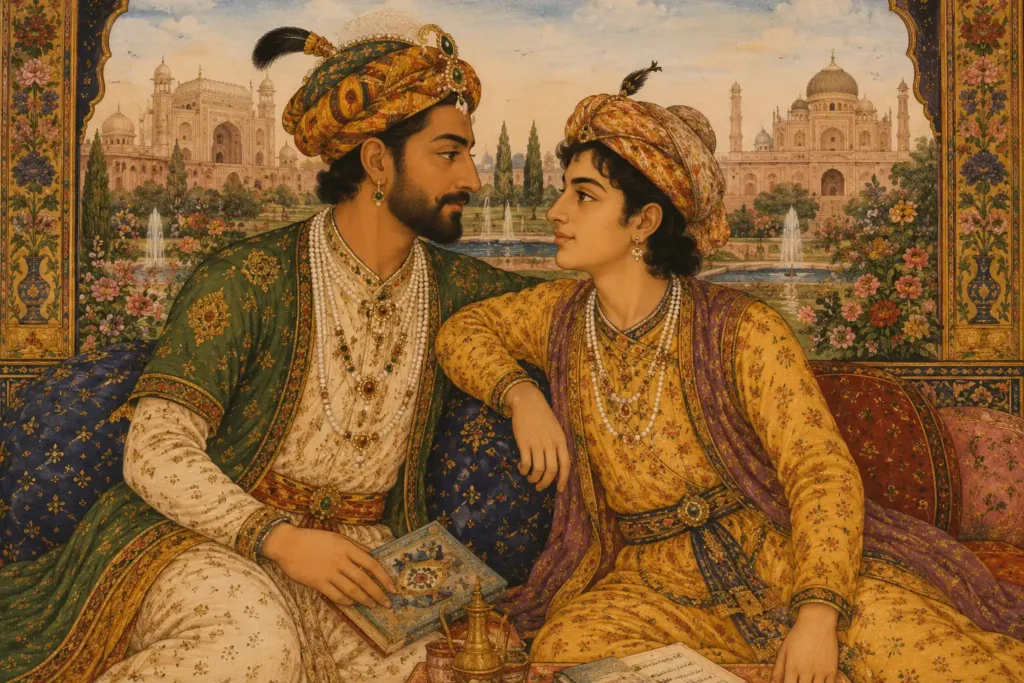
Arnaud Pontin (Image : AI / Gay Globe)
The Emperor Babur, founder of the Mughal Empire, was born in 1483 and wrote with remarkable honesty about the romantic feelings he experienced for another young man in his autobiography, the Baburnama. At a time when concepts of sexuality differed profoundly from those of the modern world, his account stands as an exceptional historical document. While it is impossible to assign him a sexual orientation using today’s categories, Babur remains a fascinating historical figure whose writings reveal an uncommon openness and continue to illustrate the diversity of human love throughout history.
Born in 1483 in the Ferghana Valley, Babur is best known as the founder of the Mughal Empire, a dynasty that would shape the history of South Asia for more than three centuries. A brilliant military strategist, poet, memoirist, and visionary ruler, Babur also left behind one of history’s most remarkable personal testimonies: that of a man who candidly described the deep affection he felt for another man. More than five centuries after his death, his writings continue to contribute to scholarly research on the history of sexuality, gender, and emotional expression.
Zahir-ud-Din Muhammad Babur was born on February 14, 1483, in Andijan, in the Ferghana Valley, located in present-day Uzbekistan. He descended from two of history’s greatest conquerors—Timur (Tamerlane) through his father and Genghis Khan through his mother. Following his father’s death, he inherited a small principality at just eleven years of age.
His youth was marked by continuous warfare, fragile alliances, and repeated military setbacks. On several occasions, he attempted to recapture the prestigious city of Samarkand, but without lasting success. These defeats ultimately drove him southward. In 1504, Babur conquered Kabul, in present-day Afghanistan. This victory finally gave him a stable political base from which he prepared the greatest achievement of his career.
In 1526, Babur crossed the Hindu Kush Mountains with a relatively small but exceptionally disciplined army. At the First Battle of Panipat, he decisively defeated Sultan Ibrahim Lodi through an innovative combination of artillery, cavalry, and Ottoman-inspired battlefield tactics. This victory marked the birth of the Mughal Empire.
Over the following years, Babur consolidated his authority across much of northern India. Although he ruled for only four years after his conquest, he established the foundations of an empire that would later flourish under Akbar, Jahangir, Shah Jahan—the builder of the Taj Mahal—and Aurangzeb. When Babur died in 1530, he was succeeded by his son Humayun.
Unlike many rulers of his era, Babur did not rely solely on court historians to record his life. Instead, he wrote the Baburnama himself, an autobiography that has become one of the most important historical sources on Central Asia and the Mughal Empire.
The work remains remarkable for its deeply personal tone. Babur writes not only about wars and politics but also about landscapes, flowers, fruits, wildlife, cities, his triumphs and failures, his regrets, and his innermost emotions. This honesty makes the Baburnama one of the most extraordinary autobiographical works of the early modern period.
Baburi: A Love Story Told Without Hesitation
One of the most famous passages in the Baburnama concerns a young man named Baburi. As a teenager, Babur recounts falling deeply in love with him. He writes that he blushed whenever they met, lost his composure in Baburi’s presence, and found himself unable to speak to him. He describes these emotions with a sincerity that continues to surprise modern historians.
Babur also composed poetry inspired by this love and admitted that he had never before experienced such powerful emotions. His account is not vague or ambiguous. Most historians agree that he was describing a genuine romantic attachment.
However, nothing in the Baburnama indicates that the relationship was physical or sexual. The historical evidence simply does not go that far.
Can Babur Be Described as Homosexual?
This is precisely where historians urge caution.
The word “homosexual” is a modern concept that emerged centuries after Babur’s lifetime. During the sixteenth century, societies in Central Asia did not classify individuals according to the sexual orientation categories used today. For this reason, scholars generally prefer to say that Babur expressed romantic love or emotional attraction toward another man rather than assigning him a modern sexual identity.
This does not change the fact that Babur also married several women, as was expected of rulers of his time, and fathered numerous children. Some contemporary writers describe him as bisexual, but this remains a modern interpretation rather than a historical certainty.
What remains beyond dispute is that Babur deliberately chose to preserve this deeply personal experience in his own autobiography.
Personal memoirs written by fifteenth- and sixteenth-century monarchs are exceptionally rare. Even rarer are those in which a ruler openly reflects on his love for another man with such honesty and naturalness. For this reason, Babur occupies a unique place in modern scholarship on the history of sexuality, gender, and human emotions.
Researchers emphasize that his account broadens our understanding of emotional relationships within medieval Muslim societies and challenges simplistic assumptions about the past.
Beyond this deeply personal dimension, Babur remains one of history’s greatest empire builders.
His political legacy is immense. The Mughal Empire became one of the world’s most influential early modern states, fostering advances in administration, architecture, Persian literature, and the arts that profoundly shaped the Indian subcontinent. Today, the Baburnama is studied in universities around the world both as a major historical source and as a literary masterpiece.
More than five centuries after his death, Babur continues to fascinate historians. A formidable conqueror, gifted poet, meticulous writer, and founder of one of history’s greatest empires, he is also one of the very few rulers whose writings provide such an intimate glimpse into the complexity of human emotion.
Although it is impossible to define Babur’s sexual identity according to modern concepts, his account of his love for the young Baburi remains one of the most remarkable testimonies in world historical literature. At a time when personal memoirs were exceedingly rare, Babur left behind a document reminding us that love, longing, and emotional diversity have always been part of the human experience—even if they were understood differently than they are today.
ADVERTISING

READ ALSO
A Thousand-Year Journey: Exploring the History of the LGBT Community
https://gayglobe.net/a-thousand-year-journey-exploring-the-history-of-the-lgbt-community/
The Last Witnesses: What Survivors of the AIDS Epidemic Want to Pass On to Young LGBTQ+ People Before They Are Gone
https://gayglobe.net/en/hiv-lgbt-rights-history/
Gay Globe 11,900 Articles Published: 30 Years of LGBTQ+ Media History
https://gayglobe.net/en/gay-globe-11900-articles-30-years-lgbtq-media-history/
Gay Globe Magazine – Canadian LGBTQ+ Media Since 1998
https://gayglobe.net/about/
The Evolution of Homosexual Media in France: A History of Visibility and Struggle
https://gayglobe.net/levolution-des-medias-homosexuels-en-france-une-histoire-de-visibilite-et-de-lutte/