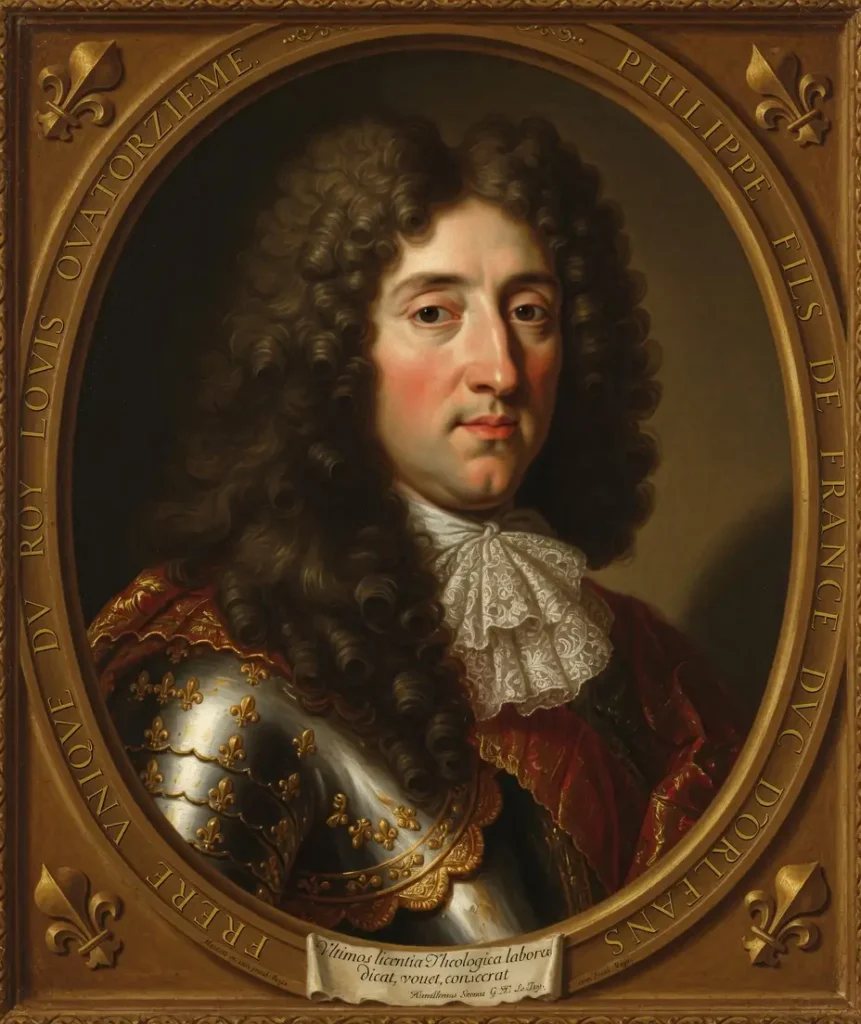
Carle Jasmin (Image: Philippe I, Duke of Orléans, by Robert Nanteuil (Reims, 1623 – Paris, December 9, 1678), engraver – Colorized by Gay Globe)
It is often mistakenly believed that European monarchies systematically punished and persecuted homosexuality. History, however, has repeatedly shown that the reality was often far more nuanced. Several kings, queens, emperors, and members of royal families maintained romantic or emotional relationships with people of the same sex. Here are a few notable examples.
James VI of Scotland and I of England (1566–1625)
Many historians believe that James VI and I maintained romantic relationships with several male favorites, most notably Robert Carr and George Villiers, Duke of Buckingham. His letters to Buckingham are remarkably affectionate and remain one of the primary sources fueling this historical debate. James was married to Anne of Denmark and fathered several children.
Frederick II of Prussia (“Frederick the Great”) (1712–1786)
His sexual orientation continues to be debated, but many historians believe Frederick the Great was probably gay, or at the very least showed little interest in women. His marriage was never consummated, and he spent much of his life surrounded by male companions.
Ludwig II of Bavaria (1845–1886)
The famous builder of Neuschwanstein Castle is now widely regarded as having been gay. His personal diaries and correspondence reveal his feelings for several men. He never married.
Christina of Sweden (1626–1689)
Queen Christina of Sweden, who reigned from 1632 to 1654, never married and openly rejected traditional female roles. Her relationship with Ebba Sparre, one of her ladies-in-waiting, is well documented through their correspondence. Historians continue to debate the exact nature of their relationship, although many believe it was romantic.
Queen Anne (1665–1714)
Queen Anne maintained an exceptionally close relationship with Sarah Churchill, followed later by Abigail Masham. Some historians interpret these relationships as romantic, while others describe them as intense friendships typical of the period.
One particularly compelling example comes from the French court, where the French monarchy openly knew of and tolerated the homosexuality of Philippe I, Duke of Orléans, the younger brother of King Louis XIV.
Philippe I, Duke of Orléans: Louis XIV’s Flamboyant Brother Who Defied the Conventions of His Time
Whenever the court of Louis XIV is mentioned, the image of the Sun King tends to overshadow that of his younger brother, Philippe I, Duke of Orléans. Yet this prince, known simply as “Monsieur,” was one of the most fascinating and unconventional figures of the French monarchy. A lover of luxury, a patron of the arts, a brilliant military commander, and a man whose relationships with other men were known throughout the court, Philippe embodied the contradictions of an era in which power and appearances often outweighed moral judgment.
Born on September 21, 1640, at the Château de Saint-Germain-en-Laye, Philippe was the second son of King Louis XIII and Anne of Austria. When his father died in 1643, his elder brother became King Louis XIV, while Philippe was raised under the protection of his mother and Cardinal Mazarin. From an early age, his education differed from that of princes destined to rule. Fearing that he might one day become a rival to his brother, the regent encouraged an upbringing centered more on the arts, entertainment, and the refinement of court life than on military or political affairs.
Over the years, Philippe developed a passion for magnificent clothing, jewels, elaborate wigs, and lavish celebrations. At Versailles, he became one of the court’s most elegant and fashionable figures. His sometimes extravagant appearance attracted the attention of foreign ambassadors, yet it never diminished his status. Among his many male favorites, the most famous was Philippe de Lorraine, Chevalier de Lorraine, with whom he maintained a long-lasting relationship that was no secret to anyone at court.
Contrary to a widespread misconception, Louis XIV was fully aware of the situation. The king tolerated his brother’s relationships as long as Philippe fulfilled his dynastic obligations. Philippe married Henrietta of England, sister of King Charles II of England, and together they had several children. Following Henrietta’s untimely death in 1670, he married Elizabeth Charlotte of the Palatinate, better known as Madame Palatine, whose extensive correspondence provides an unusually candid account of court life and of her husband’s relationships with his male favorites.
Although Philippe has often been portrayed as a frivolous prince, that reputation conceals a genuine military talent. In 1677, during the Franco-Dutch War, Louis XIV entrusted him with command of the Army of Flanders. On April 11, Philippe won a decisive victory at the Battle of Cassel, inflicting a crushing defeat on the forces of William of Orange, the future King of England. The victory astonished Europe and demonstrated that the Sun King’s younger brother possessed remarkable strategic abilities.
Ironically, this triumph also marked the end of his military career. According to many historians, Louis XIV was uncomfortable with the popularity his brother had gained. Concerned that a victorious prince might become a political rival, the king never again entrusted Philippe with a major military command. Philippe returned to Versailles, where he devoted himself to his estates, his art collections, and court life.
Beyond his flamboyant personality, Philippe I, Duke of Orléans, played a significant role in French history. He founded the House of Orléans, a branch of the House of Bourbon, from which Louis-Philippe I, the last King of the French, would later descend. His son, Philippe II, Duke of Orléans, would become Regent of France during the minority of Louis XV.
Philippe I, Duke of Orléans is regarded as one of the most extraordinary figures of the Grand Siècle. His life reminds us that, despite the moral strictness often associated with European monarchies, certain realities were tolerated when they involved princes of the blood. His homosexuality, widely known among his contemporaries, neither prevented him from occupying a central place within the French royal family nor from leaving a lasting mark on French history. He remains one of the best-documented examples of a prominent member of the French monarchy who lived openly in same-sex relationships while faithfully fulfilling the responsibilities imposed by his royal rank.
ADVERTISING

READ ALSO
A Thousand-Year Journey: Exploring the History of the LGBT Community
https://gayglobe.net/a-thousand-year-journey-exploring-the-history-of-the-lgbt-community/
Homosexuality in Prehistory and Queer Archaeology: What Do Historical Evidence Really Say?
https://gayglobe.net/homosexuality-in-prehistory-and-queer-archaeology-what-do-historical-evidence-really-say/
The Last Witnesses: What Survivors of the AIDS Epidemic Want to Pass On to Young LGBTQ+ People Before They Are Gone
https://gayglobe.net/en/hiv-lgbt-rights-history/
Jean-Jacques-Régis de Cambacérès: The LGBTQ+ Architect Behind the Napoleonic Code
https://gayglobe.net/en/the-man-behind-the-civil-code/
11,900 Articles Published: Gay Globe Reaches a New Historic Milestone
https://gayglobe.net/en/gay-globe-11900-articles-30-years-lgbtq-media-history/