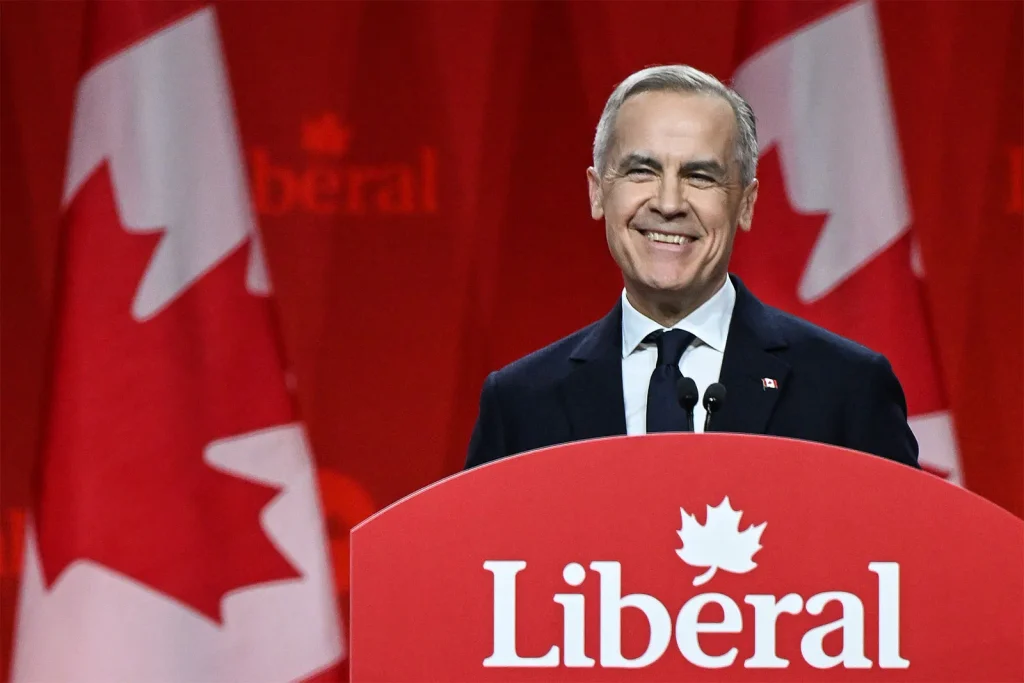
Opinion by Roger-Luc Chayer (Image : Britannica)
Not every country in the world is fortunate enough to have a head of government who is so popular, and above all, to see that this popularity extends well beyond its own borders. In Canada, Mark Carney was elected with a minority government and has since gradually demonstrated his strength, his talent and, above all, his ability to keep a cool head. He stands out through logic, rigor and a form of generosity toward Canadians as well as toward his international partners. And above all, he knows what he is talking about.
Those who have followed me for years know that I very rarely express my political opinions. I prefer to question, analyze and, when necessary, criticize the policies put in place, regardless of the government imposing them. This is, in fact, one of the fundamental roles of journalism: to keep a critical eye on those who exercise power in order to allow readers to better understand the consequences of social, economic or other policies.
But as a Canadian, and particularly since the beginning of the repeated attacks against Canada’s sovereignty and economy by Donald Trump and his puppeteers, I must admit that I have been watching with great interest the way Canada’s prime minister is handling this crisis. And I am learning a great deal from this strategy.
Because we have to call things by their name: Donald Trump acts like a bully. He threatens, provokes, imposes, sometimes backs down, comes back for more, tests limits and often seems convinced that simply speaking louder is enough to get what he wants. Mark Carney, however, does not play that game.
He does not shout louder. He does not stoop to insults. He does not seek to impress his opponent through spectacular gestures. He responds with facts, logic, economics and a manifestly superior understanding of financial and commercial mechanisms. And something rather rare is happening: it works.
Canada may not have the military means or economic means of the United States, but it possesses something that Trump seems to have great difficulty neutralizing: an ability to stand firm without losing its composure. And the rest of the world is watching.
Because in this confrontation, Canada has become much more than simply a commercial neighbor of the United States. It has become a real-life laboratory showing how a country can respond to the economic intimidation of a much larger power without giving up its sovereignty.
And contrary to what some may have believed at the beginning of this trade war, Canada has not folded. It negotiates. It diversifies its markets. It protects its interests. It responds when necessary. And above all, it does not seem afraid. Perhaps that is what bothers Donald Trump the most. For once, the bully has found someone who refuses to play by his rules.
And it works.
Has Trump really won his economic war against Canada?
To measure the effectiveness of the trade war waged by Donald Trump against Canada, we must go beyond political statements and look at the numbers. The comparison between 2024, the last full year before the trade war began, 2025, the first year of tariff confrontation, and the data available in 2026 makes it possible to draw a much more nuanced picture.
The short answer is surprising: Canada has suffered a real economic shock, but it has not been economically brought to its knees. Some indicators have deteriorated, particularly exports to the United States and Canada’s trade deficit. But others show an economy that is adapting, diversifying its markets and remaining capable of growth.
GDP: Significant slowdown, but no collapse
In 2024, the Canadian economy was already experiencing relatively modest growth. In 2025, real GDP increased by 1.7%, its weakest annual pace since the contraction of 2020. Statistics Canada attributes this slowdown in part to declining exports, particularly to the United States.
But the 2026 figure somewhat changes the picture.
After an increase of only 0.1% in the first quarter, Canadian real GDP increased by 0.8% in the second quarter of 2026. This growth was notably supported by exports, household consumption and business investment. Exports jumped 3.6% in the second quarter, their strongest increase since the beginning of 2023.
Canada is therefore not in a permanent recession. Rather, it is going through a period of weak growth that is extremely dependent on the evolution of trade relations with the United States.
What is also interesting about Prime Minister Carney is that he is increasingly being invited to participate in international forums in order to negotiate agreements with partners that the United States threatens, neglects or simply does not consider important in Trump’s plans.
The strongest point of this trade war and Donald Trump’s hostile rhetoric is the invitation made by the European Political Community. In May 2026, Mark Carney was invited as the first non-European leader in history to the European Political Community summit, held in Yerevan, Armenia. The invitation came from European Council President António Costa and Armenian Prime Minister Nikol Pashinyan.
The President of the European Council had described Canada as a key partner and ally of Europe, emphasizing that its presence as the first non-European guest demonstrated the strategic rapprochement between Canada and Europe.
And there is another even more spectacular invitation coming this week: Carney is to travel to Strasbourg and attend, on September 16, 2026, the State of the Union address by European Commission President Ursula von der Leyen, as an honored guest, before addressing the European Parliament himself on September 17.
Could Canada become the first associated state of the European Union?
Here, we must distinguish facts from diplomatic rumors. Canada is not currently an associated state of the European Union, and no official decision has been made in this regard. But the idea is circulating increasingly seriously in European political and diplomatic circles, as Mark Carney strengthens ties with European governments. If such a formula were to come into existence, it could represent much more than another trade agreement.
Canada already has a free trade agreement with the European Union, but a possible associated-state status could go much further: trade, investment, defense, energy, artificial intelligence, critical minerals, research, worker mobility and strategic cooperation could be integrated into a much closer relationship. And this time, the interests would clearly be reciprocal.
For Europe, Canada represents a particularly interesting partner at a time when relations with Washington have become much less predictable. Canada has immense natural resources, significant reserves of critical minerals, a developed energy industry, recognized technological expertise and a defense industry that could be more deeply integrated into European supply chains.
Canada is also a member of the G7 and NATO and controls a considerable portion of Arctic territory. For a Europe seeking to strengthen its strategic autonomy, this is not a minor detail.
For Ottawa, the interest would be just as obvious.
The European Union represents a market of hundreds of millions of consumers and an economic power capable of offering Canada a true gateway to Europe, but also to supply chains and capital that Ottawa wants to benefit from more fully. Defense, however, could be the area where this new relationship would take on its greatest importance.
Canada has already obtained a special place in the European SAFE program devoted to defense investments. A much closer association could allow Canadian and European companies to work more closely together in weapons, cybersecurity, military artificial intelligence, communications and strategic infrastructure.
There would also be another issue: energy.
Europe has been seeking for several years to reduce its dependence on certain foreign suppliers. Canada, for its part, is seeking new markets for its energy and mineral resources. A strengthened Canada-Europe relationship could therefore create transatlantic supply chains in which both partners would be much less vulnerable to decisions made in Washington or Beijing.
For decades, Canada lived with an unavoidable economic reality: the United States was by far its main partner and its natural market. This dependence is not about to disappear. It would be irresponsible to claim otherwise.
But Donald Trump may have triggered something he certainly did not anticipate: a spectacular acceleration in the search for Canadian alternatives. Canada is not necessarily seeking to replace the United States. Rather, it is seeking to no longer be forced to depend on it. That is a fundamental distinction.
A Canada that traded more with Europe, Asia and other partners would not be an anti-American Canada. It would simply be a Canada less vulnerable to the decisions of a single foreign government.
Rather than responding to Donald Trump solely with tariff retaliation, Ottawa appears to be seeking to build something much more lasting: a network of economic and strategic partners large enough for Canada to negotiate with Washington from a position of strength rather than dependence.
If the concept of an associated state of the European Union were eventually to become a reality, Canada could therefore become the first country to occupy a very particular position: neither a member state of the European Union, nor simply a commercial partner, but a privileged economic, technological and military ally of Europe.
We will know more on September 17, during the prime minister’s address. But in this chess game between Canada and the United States, Mark Carney is involved in every move, while Donald Trump seems increasingly on the defensive, announcing that an agreement with Canada is coming very soon, one that Canada would have neither requested nor negotiated.
Another alternative fact that could well end up in the historical annals of the worst president the United States will ever have known.
ADVERTISING

Read also
- Trump Wants to Punish Canada. America Will Pay!
- Trump Launches His Order 66, Carney Resists
- Trump Faces Global Resistance: Could King Charles III Intervene?
- Supporting Trump Until the Elections: A Global Ordeal
- Canadian Citizenship, Hostile Actions: Is Musk in Violation of the Criminal Code?
- McGill University, Trans Healthcare and Trump’s 2025 Executive Order: Fact Check on Hormone Therapy Claims