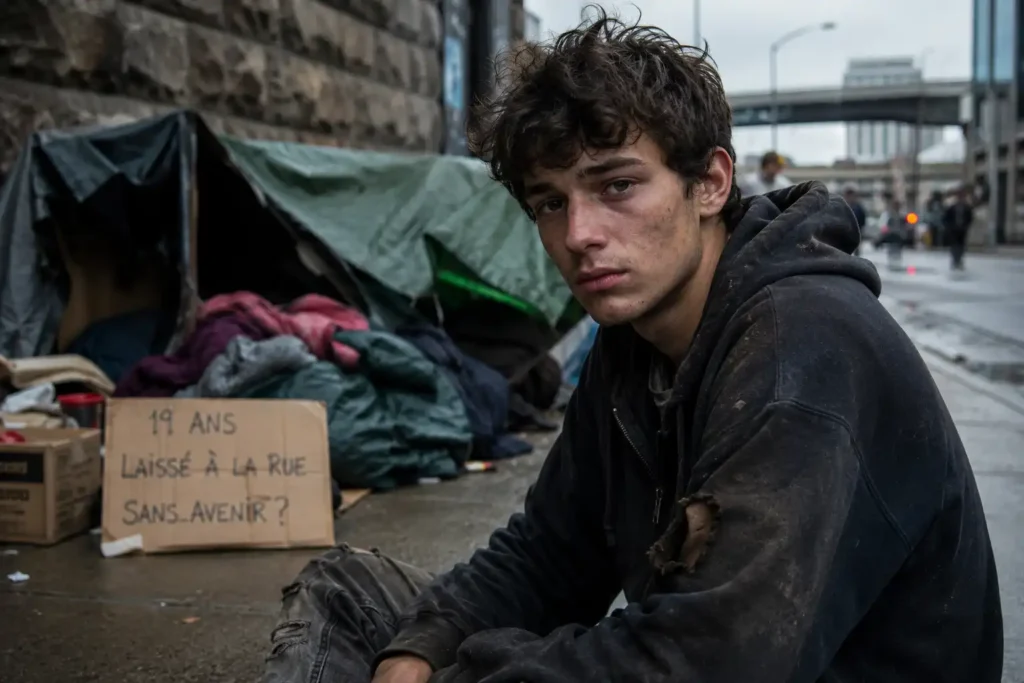
Roger-Luc Chayer (Image: AI-generated to protect Dany’s identity and dignity / Gay Globe)
There are human tragedies that force us to question the responsibility of the State and its role in the creation of social crises that could nevertheless have been avoided.
In most countries, at least in Western democracies, childhood and youth are protected by government child protection agencies. In Quebec, this responsibility falls under the Direction de la protection de la jeunesse (DPJ). In the United States, it is handled by Child Protective Services (CPS). In Europe, each country has its own system: in France, it is mainly the Aide sociale à l’enfance (ASE); in Belgium, services vary by region and community; in Germany, the Jugendämter are responsible for child protection; while in the United Kingdom, this mission is carried out by local social services.
Dany’s case is heartbreaking. This young man from Montreal, Quebec, was placed under the responsibility of the Direction de la protection de la jeunesse (DPJ) and placed in foster care at the age of 12 due to family violence and physical abuse committed by a mother in severe difficulty.
He attended school, completed high school with only one additional year, and was planning to continue his studies at cégep (a college pathway to university in the Quebec education system) in education.
“I was surrounded by teachers who knew my situation and who invested a lot in helping me succeed, because I had no one else to encourage me,” Dany explains.
But everything changed on his 18th birthday. The law does not provide for children under DPJ care to continue receiving support once they reach the age of legal majority. Financial support for foster families and youth centers ends immediately, and young people are required to leave. Go where? That is the tragedy.
Some foster families allow young people to remain for a limited time, sometimes as if they were still part of the household. But this represents less than 1% of families with the financial capacity to support a young adult transitioning to independence. It must also be acknowledged that most foster families, despite their dedication, depend on government funding.
Dany’s foster family tried to prepare him months before his 18th birthday by helping him acquire basic items to furnish a small apartment. But in Montreal, as in most major cities across North America and Europe, a severe housing crisis is underway.
As Dany found himself on social assistance with about $700 per month, how could he afford a $1,750 monthly studio, not including utilities, food, internet, and transportation? How could he even consider continuing his cégep education under such conditions?
So what was bound to happen did happen. Dany had to leave his foster home and, last May, ended up living in a tent in a state of homelessness on Notre-Dame Street, alongside people struggling with drug addiction, prostitution, and others who have lost all hope.
At 19 years old, alone and homeless, the State created a case of youth homelessness, without hesitation. This situation is simply unacceptable. Worse still, Dany is gay.
There is no reliable universal statistic that precisely measures the proportion of gay or LGBTQ+ youth abandoned into homelessness at the age of majority, for a simple reason: studies on youth homelessness do not systematically break down foster care exits or homelessness by sexual orientation at the point of aging out, in a consistent or comparable way across countries.
However, research does establish a set of consistent findings.
First, LGBTQ+ youth (including gay youth) are significantly overrepresented in youth homelessness populations. According to several North American and European studies, they represent between 20% and 40% of homeless youth, while they account for approximately 5% to 10% of the general youth population, depending on the country and methodology. This overrepresentation is one of the most consistent findings in the academic literature on youth homelessness.
According to the Government of Quebec, available data shows that young people exiting child protection services are among the groups at highest risk of experiencing homelessness.
In Quebec, the most important study on this subject is the EDJeP project (Study on the Future of Youth in Care), led by researchers from the École nationale d’administration publique (ENAP) and the Youth Research Network Chair. Its findings are particularly concerning.
The main findings are as follows:
More than one-third (around 33%) of youth with prolonged involvement in the DPJ system experience at least one episode of homelessness within the first years after leaving care.
Among those who become homeless, 36.6% remain in that situation for more than one month.
Youth who experience homelessness show significantly higher rates of mental health issues: 53%, compared to 33% among those who maintain residential stability.
They are also more likely to be involved in the criminal justice system: 44% report being arrested by police in the past 12 months, compared to 25% among youth in stable housing.
Researchers also found that stable placements in foster care are a major protective factor. Youth who complete their placement in foster care experience far fewer episodes of homelessness (18.5%) than those leaving other types of placements (44.3%).
Another phase of the same study already showed that around 20% of youth experienced some form of homelessness just 13 months after leaving care, while nearly one-third experienced significant housing instability.
Each year, more than 2,000 young people leave DPJ care in Quebec as they approach age 18. Many must become independent very quickly, often without family support, with weaker educational backgrounds and limited financial resources.
Dany was once organized, naturally clean, intelligent, and full of hope for the future—until he ended up on the street. During my interview with him, the tall young man—now six-foot-three—was visibly emaciated. His pants were torn, his clothes had not been washed in at least a month, and it was clear he had not eaten properly for several days.
The State had created embodied despair. Dany had lost his dignity, a right nevertheless guaranteed under the Quebec Charter of Human Rights and Freedoms.
In Quebec, the DPJ and related services are legally mandated to protect minors. Their mandate generally ends at age 18, except in special cases (extended supervision, voluntary programs, etc.). From that point on, young people transition into “general” systems: social assistance, housing, healthcare, and education.
The core issue is not a total absence of support, but rather a sudden transition shock. Many young people leave care without stable family networks, savings, or solid educational pathways. At the same time, the housing crisis intensifies the gap between their resources and the cost of living.
There are transition-to-adulthood programs, but they are often time-limited and not always accessible.
In Quebec, the main program is the Youth Qualification Program (PQJ), designed for youth aged 16 to 25 who have been involved with the DPJ. It aims to support social and professional integration, housing stability, and autonomy.
There are also Transition to Independent Living (TIL) programs, often delivered with community organizations, including financial and psychosocial support.
However, several limitations are frequently highlighted: a break in service continuity at age 18, uneven access to programs, and above all a structural factor: economic precarity and the housing crisis.
In Dany’s case, because he had no major behavioral or health issues and did not meet emergency criteria, he did not qualify for priority intervention. The result: ciao bambino, go sleep in your tent.
Dany tried to find work, but his appearance and situation quickly became a barrier. No one wanted him, not even small local businesses.
I was deeply shaken by my meeting with him and by writing this article, as I see no short-term solution. I held Dany in my arms, leaving him to face his fate, which I hope will become more favorable in the future.
As for the State, I have a very different opinion…
ADVERTISING
READ ALSO
Iran: the execution of Saleh Mohammadi raises many unanswered questions — https://gayglobe.net/iran-the-execution-of-saleh-mohammadi-raises-many-unanswered-questions/
Alcohol and Health: The Type of Drink Changes Everything According to a Major Study — https://gayglobe.net/alcohol-and-health-the-type-of-drink-changes-everything-according-to-a-major-study/
HIV: Anti-PD-1 immunotherapy, a promising path toward durable remission — https://gayglobe.net/hiv-anti-pd-1-immunotherapy-a-promising-path-toward-durable-remission/
How Oregon, Portugal, and Canada Handle Drug Decriminalization: What You Need to Know — https://gayglobe.net/how-oregon-portugal-and-canada-handle-drug-decriminalization-what-you-need-to-know/
The Repression of Male Homosexual Prostitution Worldwide: Police Methods, Laws, and Legal Protections — https://gayglobe.net/the-repression-of-male-homosexual-prostitution-worldwide-police-methods-laws-and-legal-protections/
You Won’t Believe What’s Happening with the World’s Oldest Profession — https://gayglobe.net/you-wont-believe-whats-happening-with-the-worlds-oldest-profession/
The priorities of Montreal’s new administration and the challenge of cleanliness in Ville-Marie — https://gayglobe.net/the-priorities-of-montreals-new-administration-and-the-challenge-of-cleanliness-in-ville-marie/
When the Internet sows doubt, print regains its credibility — https://gayglobe.net/when-the-internet-sows-doubt-print-regains-its-credibility/
Why Wanda Ventham Is Still Adored by Gay Men More Than 50 Years After Alerte dans l’Espace — https://gayglobe.net/why-wanda-ventham-is-still-adored-by-gay-men-more-than-50-years-after-alerte-dans-lespace/
Invisible Alliance: The Debut Science Fiction Novel by Roger-Luc Chayer — https://gayglobe.net/invisible-alliance-the-debut-science-fiction-novel-by-roger-luc-chayer/