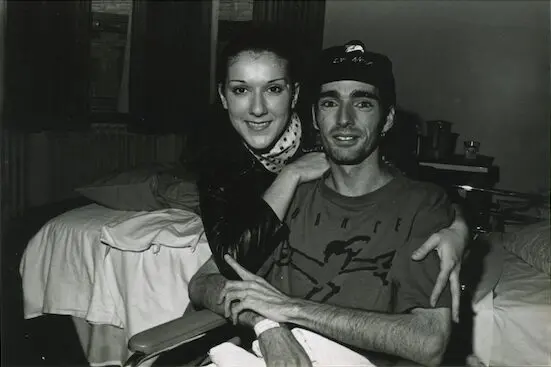
Photo: Céline and the Partner of a Gay Globe Staff Member
Roger-Luc Chayer & Arnaud Pontin (Photos : Gay Globe Media)
We all know that Céline Dion has been deeply committed to the fight against HIV since the very early days of the epidemic in Canada. Her dedication to this cause is remarkable.
Her commitment has never been flashy or ostentatious—it has been expressed sincerely, consistently, and meaningfully, with special attention to the dignity of those affected. From the onset of the AIDS crisis in the 1980s, while still a young artist, Céline Dion quickly understood the gravity of the pandemic and the devastation it caused, both medically and socially.
At a time when HIV was still heavily stigmatized—even in the media and entertainment industry—she chose to make her voice heard by supporting awareness and prevention campaigns. She took a stand in a climate where few public figures dared to do so, particularly because the disease was still closely associated with marginalized and stigmatized groups, especially homosexuals. By choosing not to remain silent, Céline Dion demonstrated a moral courage that went far beyond her artistic duties. She did it without calculation, without any image strategy—she did it out of deep human conviction.
Her commitment also manifested through concrete actions. In 1998, for example, she agreed to lend her voice to the iconic song Love Can Move Mountains, adapted for an awareness and fundraising campaign for the fight against HIV/AIDS. Her performance of this song at charity galas and benefit events helped embed a message of compassion and solidarity in the hearts of the public. She knew her voice could reach millions, and she used her fame to amplify messages of prevention and support.
Céline Dion also maintained close ties with organizations actively working to fight AIDS. She supported several campaigns of the Canadian Red Cross and made substantial donations—often discreetly—to community associations helping people living with HIV. Unlike some celebrities who stage their philanthropy, Céline often preferred to act behind the scenes, convinced that the real value of her support lay not in publicity but in real-world impact. Several community workers have testified that her financial assistance helped keep certain centers open and maintain services like testing and psychological support.
She also took part in public education campaigns aimed at reducing prejudice surrounding HIV. In the 1990s and 2000s, her image was used—with her full consent—in campaigns targeting youth, to talk about prevention, respect, and responsible sexuality. Céline Dion understood that her public image was both powerful and comforting. She represented, for millions, a symbol of sincerity and kindness. She put that image to use in the service of sensitive causes, ensuring that the message was one of hope, empathy, and truth.
One of the most touching aspects of her commitment was her ability to connect personally with people affected by the illness. During her international tours, she often asked for representatives from AIDS organizations to be invited backstage—not to be photographed or promoted, but to hear their stories, understand their reality, and show them appreciation. Many people living with HIV still speak emotionally about those encounters. Céline Dion spoke to them with tenderness, without pity or judgment. She recognized their full humanity.
Another significant moment in her activism was her indirect but essential participation in global events like World AIDS Day. Even when she wasn’t on stage for the event, she lent her voice, name, and image to videos, online campaigns, and publications designed to raise global awareness. Through her team, she ensured that donations were directed to international organizations like amfAR (The Foundation for AIDS Research) and to clinics in developing countries still struggling with the epidemic.
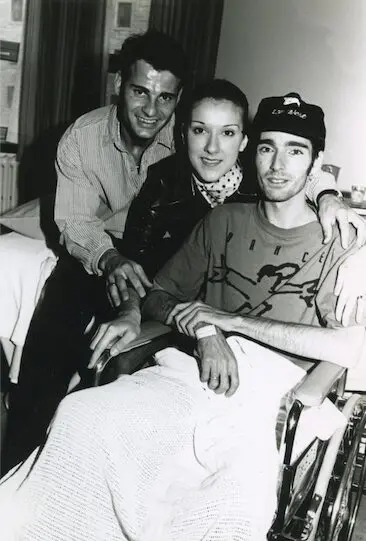
Photo: Céline visiting with the partner of Michel Cloutier, a member of the Gay Globe staff
Céline Dion’s association with Gay Globe magazine was part of a sincere and symbolically powerful gesture of support for the LGBTQ+ community—particularly at a time when HIV was a major issue within that community. At a time when many artists were still hesitant to associate themselves openly with LGBTQ+ publications or causes, Céline Dion accepted to appear on the cover of the magazine—a gesture both rare, bold, and deeply meaningful.
This gesture was not trivial. It came at a time when HIV-related stigma was still deeply embedded in public attitudes. To be associated with an openly gay community media outlet—one that directly tackled subjects like prevention, treatment, and the testimonies of people living with HIV—was more than visibility: it was a declaration of solidarity. There was no commercial gain to be made, no marketing strategy to justify the move. She did it because she believed in the legitimacy of that voice, and because she understood how powerful her presence on that cover could be for readers often marginalized or ignored by mainstream media.
In that specific context, her contribution helped break a sense of isolation. By taking part in the initiative, she gave people affected by HIV—and the broader LGBTQ+ community—a form of recognition, a sense of human validation. She used her aura to say their struggle deserved to be seen, heard, acknowledged. Her image was not simply decorative—it lent legitimacy, as though she were silently telling those fighting in the shadows that their cause mattered just as much as any great humanitarian effort.
This partnership also gave Gay Globe greater visibility beyond its regular readership. Céline Dion’s simple decision to appear in the publication drew the attention of mainstream media, opening a door for HIV-related issues within the LGBTQ+ community to be heard more widely. It forced more conservative circles to face realities they preferred to ignore. In this, Céline Dion acted as a bridge between two worlds: the world of mainstream celebrity and the world of community struggles too often rendered invisible.
Her name, in this context, was not just that of a beloved singer. It was the name of an ally. Her involvement with Gay Globe was seen as a powerful affirmation—a demonstration that dignity and compassion are not the business of elites or political agendas, but a matter of universal human conscience. It wasn’t a press release or a scripted interview that said it—it was the cover itself, her simple presence, that said it all.
In her own way, this gesture helped normalize conversations about HIV. It proved that this disease could be discussed, could make a magazine cover without shame or sensationalism—but with humanity. And that an international superstar like Céline Dion could lend her image to that mission without fear, without distancing herself from those affected.
Céline was a loyal ally of Gay Globe magazine for at least 17 years, allowing the publication to consistently dedicate significant space to news about the fight against HIV and medical advances. She had to end her contribution due to her current health condition. The partner of our colleague Michel, sadly, passed away from AIDS shortly before the discovery of triple therapy.
ADVERTISING