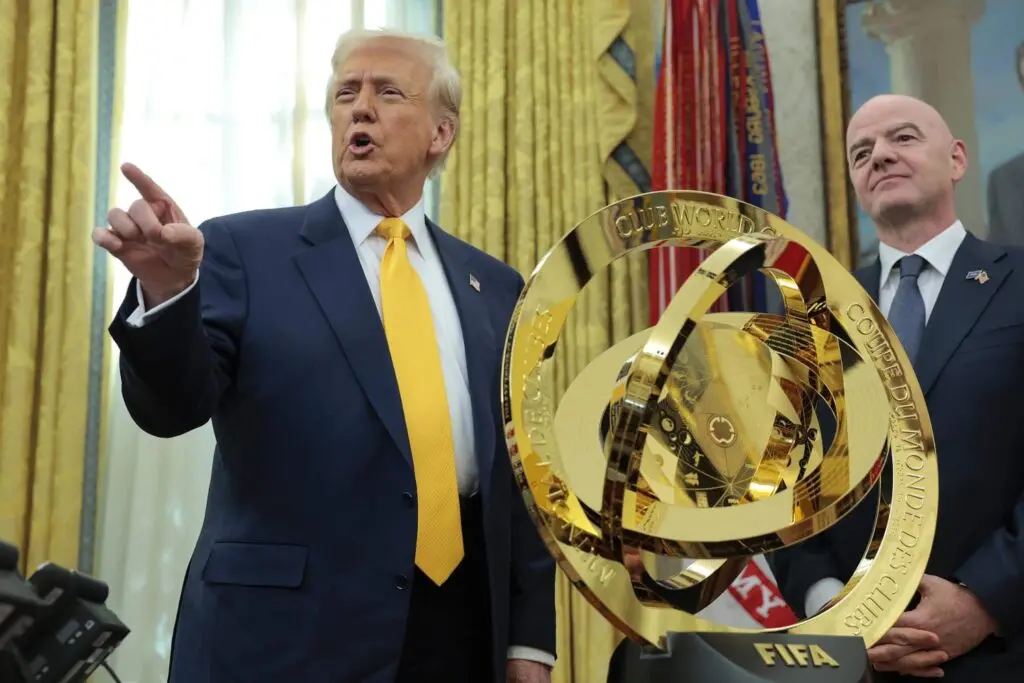
Opinion by Loup Folie–Lançon (Image : NBC / Getty Images)
The 2026 FIFA World Cup: An Event Already Under High Tension
The 2026 FIFA World Cup, scheduled to take place in the United States, Canada, and Mexico starting June 11, is already making headlines. Indeed, for several weeks now, a geopolitical presence has been openly visible—Donald Trump, who was already present during the FIFA Club World Cup trophy presentation to Chelsea Blues last summer. Meanwhile, FIFA President Gianni Infantino continues to appear alongside the former U.S. president. Behind these unexpected appearances, structural issues are gradually emerging that directly question the success of this revamped competition.
Inevitable Fiasco for FIFA 2026?
So, could the 2026 FIFA edition become the Inevitable Fiasco of American-style Soccer? Beyond the curiosity sparked by the 47th President of the United States, some observers are already concerned about how one of the world’s most renowned football competitions will unfold—and Trump is not unrelated to these worries. One recent controversial decision is the planned mass screening of social media accounts of foreign arrivals next summer. This measure is seen as a serious obstacle to the tourism economy and a major violation of individuals’ rights and freedoms, as the five-year review will take place without any search warrant. It also raises concerns about the potential collection of vast amounts of data on young populations, who are extremely active on social networks. Besides being unprecedented, this decision also contradicts the original goal of promoting multiculturalism through hosting a major global sporting event. But that is not all.
Diplomatic Relations and Economic Obstacles
The frosty diplomatic relations between the three host countries can also be viewed as hindering the smooth running of the competition. New customs fees of $250 imposed on immigrants, investors, temporary workers, and accepted immigrants have been criticized as too harsh, particularly in the United States. Furthermore, a June 2025 decision banning nationals from 19 countries raises additional questions since it excludes entrants from Haiti and Iran—both qualified for the World Cup. When asked about this issue, the U.S. leader stated that exemptions would be granted to players, coaches, and certain officials, but this excludes all supporters, journalists, and additional staff members. The introduction of special visas to address this issue—the “FIFA passes”—remains highly selective for now.
Immigration and Supporter Control: A Logistical Challenge
Finally, U.S. immigration enforcement, ICE, is another source of concern. Known for primarily targeting Latino-origin populations, how will it react to the influx of supporters? Their targeted checks could indeed disrupt travel between the 16 different stadiums spread across the three North American countries. This revamped edition, which features 48 teams instead of 36 previously, requires multiple trips to follow the numerous matchups.
A Major Challenge in Diplomacy and Migration
Thus, the 2026 World Cup, held in an expanded format, carries equally significant diplomatic and migration challenges. In many respects, the competition will be decided not only on the fields but also beyond them.