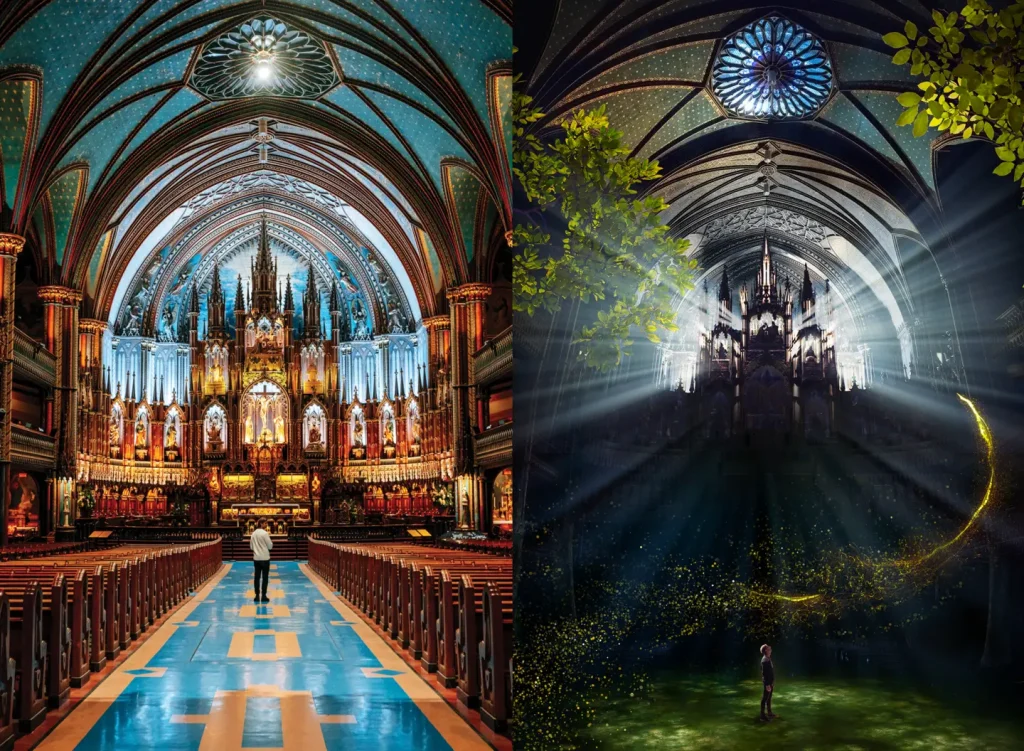
Gérald Henri Vuillien (Image : Basilique Notre-Dame de Montréal)
When Light Dances with Stone
Or how the eternal dialogue between time and the ephemeral is now written in colour and music
There are revolutions so gentle that we only notice them once they are already here, settled into our habits as if they had always been obvious. Such is the case with immersive experiences that, over the past decade, have transformed our cathedrals into theatres of light, our basilicas into living screens, and our monuments into animated picture books. Heritage, that wise old guardian with walls filled with history, suddenly begins to speak, sing, and dance before our astonished eyes. And there we are, dazzled mortals, witnessing the most beautiful of resurrections: that of stones that remember.
The art of making walls speak
For a long time, we looked at historical monuments as one flips through a missal: with respect, sometimes with boredom, often without understanding. Gothic vaults, Baroque domes, and stained-glass windows with shimmering colours loomed over us in centuries of silence. They were beautiful, certainly, but distant, intimidating, almost mute. Then came the day someone gave them a voice.
Video mapping, this modern alchemy that turns stone into canvas and light into brush, changed everything. Suddenly, columns begin to sway like trees in the wind, frescoes come alive as if on the first day, and vaults—those stone skies—become the stage for a narrative where history blends with poetry. At Saint-Eustache in Paris, Luminiscence revives the shadows of the past: vaults glow, music fills the space, and one might almost hear the murmur of forgotten prayers. In Montreal, Aura transforms the Notre-Dame Basilica into a giant illuminated manuscript, where each architectural detail becomes a verse and each stained glass a melody.
These immersive experiences do not merely show: they make us feel. They do not tell history; they make it live. And that is perhaps their greatest magic.
Heritage reinvented
There was a time when churches were places of prayer and monuments guardians of memory. Today, they are also stages, screens, and playgrounds for imagination. Some are offended: how can sacred sanctuaries be turned into spectacle sets? Are we not reducing them to mere tourist attractions?
Yet look at the faces turned upward toward the vaults, the wide-eyed children, the adults suddenly moved by emotion. These light shows take nothing from heritage: they restore its human dimension. They remind us that these places, before becoming museums, were spaces of life, passion, and drama. They give the stones back their soul.
And let us be honest: in a world where we swipe from one image to another, where attention is measured in seconds, these digital immersive experiences may be the only way to capture audiences accustomed to screens. They do not replace guided tours or scholarly study, but they act as a gateway, an entry point. They spark curiosity.
Light as language
There is something deeply moving in the idea that light—this most ephemeral of materials—can bring life back to what seemed frozen for eternity. Cathedrals, those stone books, were once meant to be read by candlelight. Today they shine in a different way, but the effect is the same: they speak to us.
At the Hôtel des Invalides, Aura turns the dome of Louis XIV into a character in its own right. Light caresses the gilding, highlights curves, and makes the space vibrate. Napoleon’s tomb is no longer a simple point of visit: it becomes the heart of a narrative, the centre of emotion. And the visitor, instead of walking in silence, is carried along by a sensory wave.
This is the true achievement of immersive shows: they do not merely present heritage, they make us experience it. They turn the spectator into an actor, the visitor into a participant. They dissolve the distance between past and present.
An economy of wonder
Behind these experiences lies a more pragmatic reality: cultural heritage is expensive to maintain. Churches are emptying, public budgets are shrinking, and monuments—those fragile giants—need resources to survive. Immersive shows offer an elegant solution: they attract crowds, generate income, and give new life to places that might otherwise fall into silence.
Beyond economics, however, there is something deeper: these experiences reshape our relationship with culture. They turn it into a total experience, engaging all the senses. They remind us that art is not only about knowledge, but also about feeling.
The debate: should we fear light?
Of course, none of this comes without debate. Some purists worry: does this spectacularisation of heritage reduce it to mere decoration? Others fear a dilution of the spiritual dimension of sacred spaces.
But can we truly oppose emotion and knowledge? Beauty and rigor? These digital light experiences are not enemies of heritage: they are its new interpreters. They do not replace historians, architects, or guides. They simply offer a new language—more accessible, more immediate.
And let us be realistic: in a world where people spend more time on their phones than in museums, these immersive experiences may be the only way to re-enchant heritage. They do not erase silent contemplation; they prepare it.
Epilogue: stone and dream
There is something almost miraculous in these experiences. They remind us that heritage is not a fixed object, but a living being, capable of transformation across time. They tell us that history is not a lesson, but an adventure.
So yes, perhaps tomorrow our cathedrals will also be screens, our monuments stages, and our churches theatres of light. But is that not another way of honouring them? Of giving them a second youth, a new voice?
Because in the end, these immersive shows do only one thing: they awaken the stones. And we, dazzled mortals, are left simply to be carried by their song.