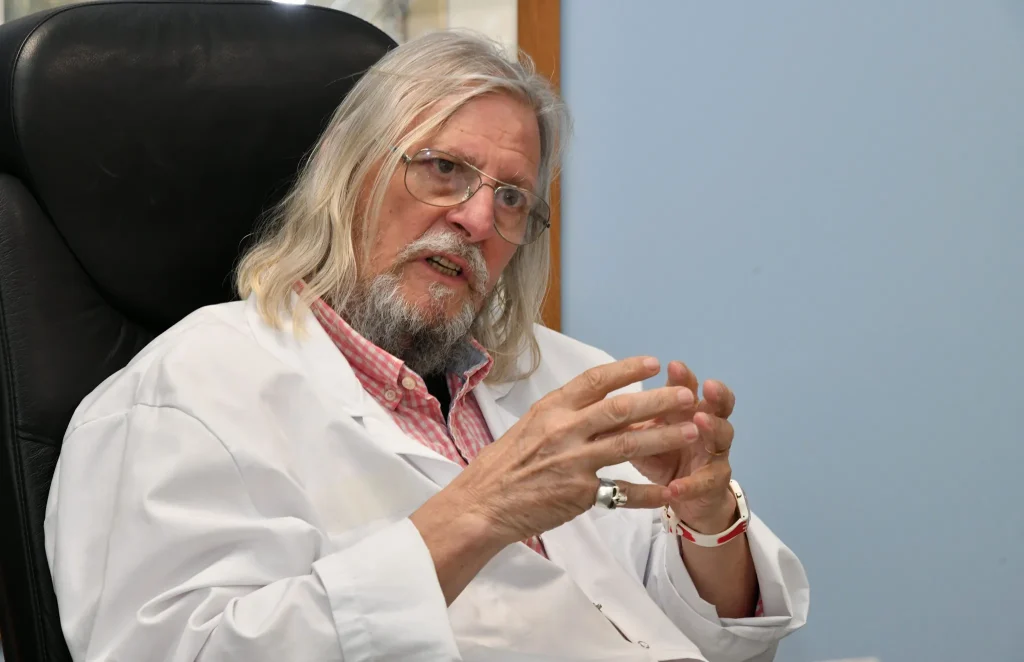
Roger-Luc Chayer (Photo : Maxppp – GEORGES ROBERT)
Viral post about Didier Raoult and cyprine
A surprising new story was once again circulating on social media this week and involved the well-known professor Didier Raoult from Marseille, who had been involved in several controversies and questionable information during the 2020 COVID-19 pandemic.
In this post, accompanied by his photo, one could read: « Drinking large quantities of cyprine would be the ultimate secret to prevent baldness in men. The scientific evidence is conclusive. Stop thinking, just do it! »
It is quite a headline. But since this claim comes from social media, a thorough fact-checking is required.
What is cyprine?
Cyprine is a natural fluid produced by the vagina during sexual arousal in some women. It is essentially a lubrication fluid composed mainly of water, vaginal and cervical secretions, as well as various natural biological substances.
The term is relatively rarely used in common medical language and appears more often in sexual, literary, or social media contexts. It should not be confused with other bodily fluids or with popular terms that are sometimes incorrectly used.
Is cyprine effective against baldness?
There is no credible scientific evidence showing that cyprine has any effect against baldness. This idea appears to stem mainly from rumours, viral jokes, or misinformation circulating on social media.
Some pseudo-scientific posts sometimes try to justify such claims by referring to the presence of hormones, proteins, or minerals in bodily fluids. However, even though cyprine does contain various natural biological substances, nothing demonstrates that it could stimulate hair regrowth or block androgenetic alopecia.
Male pattern baldness is mainly linked to genetic and hormonal factors, particularly the action of dihydrotestosterone (DHT) on hair follicles. Medically recognized treatments include drugs such as Minoxidil or Finasteride, as well as hair transplant procedures.
The message attributed to Didier Raoult likely uses shock and sensationalism to attract attention or generate shares.
Who is Didier Raoult?
Didier Raoult is a French physician, microbiologist, and professor born in 1952, best known for his research on infectious diseases. He long headed the IHU Méditerranée Infection in Marseille and has published a large number of scientific papers throughout his career.
He became a globally visible public figure during the COVID-19 pandemic in 2020, mainly due to his promotion of Hydroxychloroquine as a potential treatment for the virus, often combined with Azithromycin. From the early months of the pandemic, he claimed that this treatment could significantly reduce viral load in infected patients.
Controversies involving Didier Raoult
This position quickly triggered a major scientific and political controversy. Critics notably pointed to:
- very small patient groups;
- lack of rigorous methodology;
- non-randomized trials;
- premature conclusions.
Subsequently, numerous international studies and several health authorities concluded that hydroxychloroquine had not shown clear effectiveness against COVID-19 and could cause cardiac risks in some patients.
The French Medical Council (Ordre des médecins) also reviewed some of his public statements during the pandemic. In 2024, he was temporarily banned from practicing medicine for breaches of the professional code of ethics, particularly related to the insufficiently cautious promotion of COVID-19 treatments.
Other controversies also involved the IHU Méditerranée Infection, including investigations into research practices, internal management, and disputed scientific publications.
Despite this, Didier Raoult still has supporters today (including several denialists and conspiracy theorists, obviously) who believe he was unfairly targeted by health authorities and part of the scientific community.
Why fake news harms the credibility of social media
This type of fake news severely damages the credibility of social media because it deliberately mixes real elements — here the notoriety of Didier Raoult — with an absurd or unverified claim in order to trigger an immediate emotional reaction. The more a post shocks, amuses, or scandalizes, the more likely it is to be shared without verification.
The problem is that this mechanism blurs the line between satire, misinformation, and real information. Many users simply see a well-known photo accompanied by a quote and automatically assume it is authentic. Over time, exposure to this type of content can lead the public to:
- doubt all information circulating online;
- lose trust in media and experts;
- develop information fatigue, where everything seems fake or manipulated.
Platform algorithms also often promote content that generates strong reactions, which can give sensationalist posts more visibility than more nuanced fact-checking.
In some cases, these fake stories may seem harmless or humorous, but they contribute to normalizing an environment where invented quotes, edited images, and pseudo-scientific claims circulate almost on the same level as real information. This gradually undermines public trust in the digital ecosystem as a whole.
Groupe Gay Globe Média is a certified media outlet.
PUBLICITÉ

READ ALSO