Roger-Luc Chayer (Photo : Anonymous / Gay Globe)
Same old story, nothing changes.
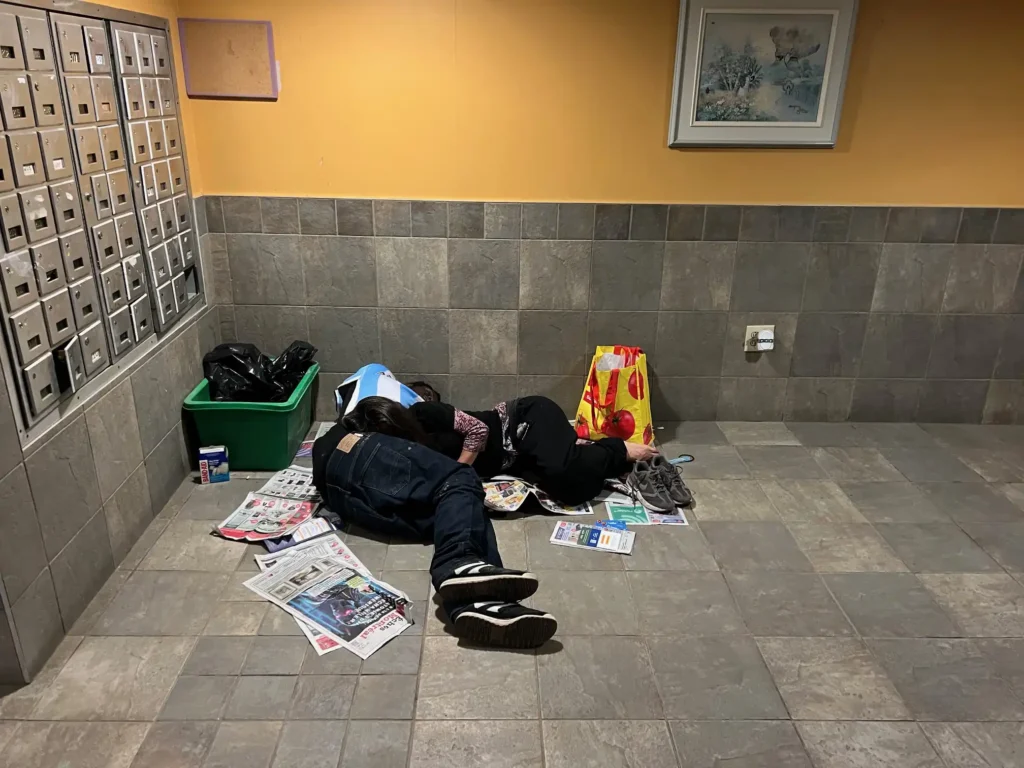
Saturday, May 23, 2025, at 5:45 a.m., as a tenant in an apartment building in the Gay Village of Montreal was returning home after a night out in the neighborhood, passing through the lobby right in front of the mailboxes, two people were lying on the ground — not asleep, but drugged, according to the materials visible on the floor, completely to the right in a blue bag.
Believing the situation had been under control for months, he was confronted with a harsh awakening to a reality affecting most regions of Quebec: nothing is improving when it comes to homelessness in Montreal and drugs in Montreal.
Last winter, in the same building’s indoor parking lot, a vehicle was vandalized four times — yes, the same vehicle — by individuals who roam the hallways and parking area at night with complete impunity. The building’s janitor is not a security guard and is not trained to deal with malicious individuals who have nothing better to do than steal from others in order to survive.
Yet this is still Montreal, Quebec, one of the most socially progressive societies in North America!
The tenant tried in vain to wake the two drugged individuals in the lobby: nothing worked, they appeared completely anesthetized. Call the police? A waste of time, according to him, as such situations have reportedly become increasingly common in Montreal.
Why so much hardship in Quebec’s largest city?
There is no single cause, but rather a combination of factors that have intensified over the past years in Montreal, as in many major North American cities.
First, housing in Montreal plays a central role. Rents have increased far faster than incomes, and the scarcity of affordable housing has pushed already vulnerable people — young adults, precarious workers, individuals facing family breakdown — into the streets or temporary shelters. Once without stable housing, it becomes much harder to keep a job, maintain a routine, or access services, accelerating social precarity.
Next, the drug crisis in Montreal has changed in nature. It is no longer just about “traditional” drugs, but a market dominated by far more toxic and unpredictable substances, often linked to fentanyl and other synthetic opioids. This increases overdoses, loss-of-control episodes, and highly visible street situations.
There is also the issue of mental health in Montreal, often underdiagnosed or insufficiently treated. Untreated anxiety, depression, or psychotic disorders can lead to social breakdown, especially among young adults. Services exist, but they are often overwhelmed, hard to access, or not continuous enough to follow complex cases.
And in the Gay Village of Montreal, the crisis of sexual minorities and youth homelessness is particularly visible. The proportion of young gay and lesbian individuals, including trans people, is estimated at around 35% of the homeless population. A dramatic situation that destroys lives, both for those affected and for residents of the Village who are deeply affected by such widespread hardship.
In Montreal in 2026, there is no single solution, but rather a range of public and community-based measures aimed either at stabilizing people living on the streets or gradually helping them exit homelessness.
The first response is emergency and transitional housing in Montreal. Shelters and community resources provide beds, meals, and a basic level of safety, especially during winter. There are also transitional or supervised housing programs, where people can stay longer while receiving social support. The goal is to move from daily survival toward basic stabilization.
Another key approach is Housing First. The idea is to provide stable housing quickly without requiring prior abstinence, then add support in mental health, addiction services, and social integration. This model is used by several organizations in Montreal, with mixed but generally positive outcomes for the most vulnerable individuals.
For young people, especially those from the LGBTQ+ community, specialized organizations offer tailored resources: safe housing, psychological support, educational guidance, employment assistance, and sometimes inclusive living environments designed to prevent family breakdowns or violence.
The problem with emergency shelters in Montreal’s homelessness system is that young people are placed alongside much older individuals, bringing together a wide range of complex issues. Sleeping indoors in shared dormitories can be perceived as far worse than staying outside alone. The difficult situations occurring in these shelters will be the subject of a future article, based on the testimony of Fabrice, who found himself there unwillingly and says he will never return. For some, the street — even between garbage bins — feels preferable to a bed in what they describe as a human nightmare.
ADVERTISING

READ ALSO