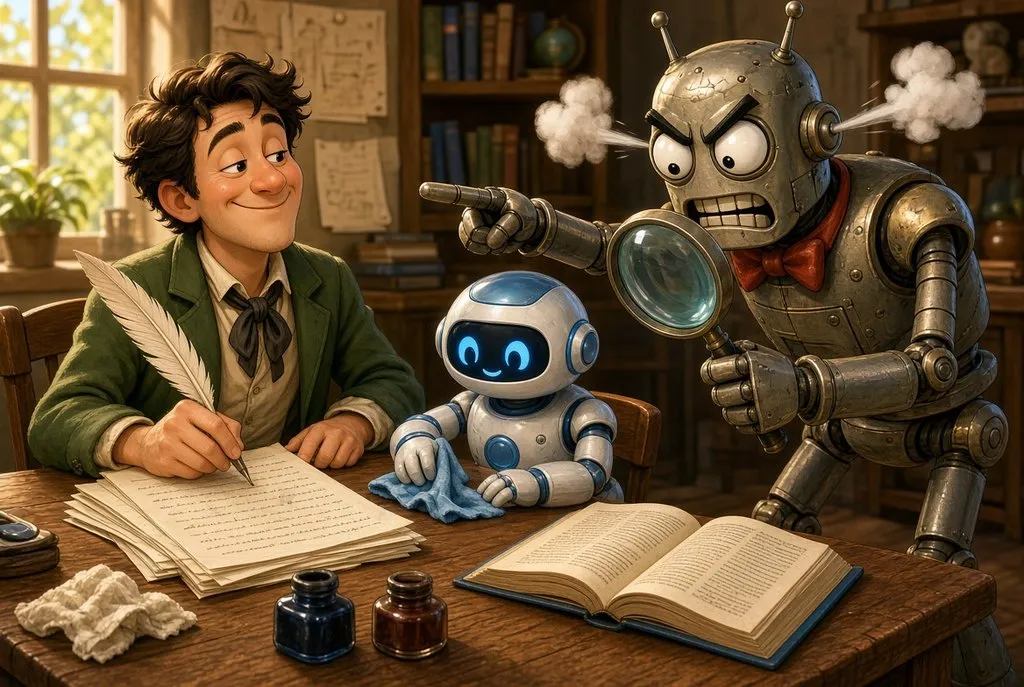
Roger-Luc Chayer (Image : AI / Gay Globe)
The pseudo-scandal involving author and novelist Thélyson Orélien, which has been spreading across social media since yesterday, was caused by the anonymous publication of a message insinuating that the author had used artificial intelligence to write his successful novel. It deserves closer examination, since this situation has occurred within our own media group on more than one occasion.
Since September 21, Quebec writer of Haitian origin Thélyson Orélien has been at the center of a controversy surrounding his novel C’était ça ou mourir, recently awarded the Prix du Roman Fnac and shortlisted for several major literary prizes. An anonymous account on X claims, based on the Pangram artificial intelligence detector, that the novel was largely written by AI. Orélien denies these accusations and says he did not use a machine to write his book. His publisher, Grasset, has also rejected the allegations. The reliability of AI detectors remains disputed.
Disputed because a recent British study compared several verification tools and concluded that most AI writing verification tools never reached the same conclusion, with some claiming that 100% of the content had been generated by AI, while others indicated that the text was 92% human in origin, enough to raise questions about the value of these tools.
I experienced this problem firsthand more than a year ago, when I received an email from a reader accusing me of using artificial intelligence to write Gay Globe articles after running a text through a verification tool. He said he was a regular reader, but that he would no longer read us after discovering that a text had received a score of 90% as having been written by AI.
I was very shocked to receive this message accompanied by such an accusation, since, for the texts that concern me, I only use AI for proofreading and not for writing, and this use has been mentioned in every issue of Gay Globe magazine since the very beginning.
That was all it took for me to investigate the matter. I went to look at the tool he had used and indeed found that my text had been classified as coming from AI at more than 90%. Yet I have been writing my own texts for more than 35 years. I then consulted other verification tools and obtained completely opposite results.
One tool said that my text was 94% human in origin, while another claimed that the same text was 96% AI-generated. I then wondered what could cause such results. I also replied to our reader, who had complained that his email, when subjected to the same inspection, received a score of 45% AI-generated, which seemed absurd to me. He never replied!
Since the arrival of AI in the media landscape, I have made a habit of testing our contributors’ texts in order to avoid what happened to me more than 20 years ago with a journalist who wanted to contribute to the magazine. Graziella, whose last name I will not disclose, wanted to publish a health article in the magazine and, just before publishing it, I copied the text and searched for it on Google to see whether it existed elsewhere. I then discovered that 100% of her article came from a brochure published by the Quebec Ministry of Health and Social Services. Obviously, Graziella’s services were no longer retained following that incident.
Recently, after receiving a text from a contributor who is highly professional in his field, I put it through the test as I normally do and saw that it had received a score of more than 95% as having been written by artificial intelligence. Surprised at first, I once again wondered how it was possible to receive such a score when this Gay Globe journalist had such an easy writing style, and I decided to investigate this phenomenon more thoroughly.
And that is when I understood what was happening with writing verification tools, something the authors of the anonymous message concerning Thélyson Orélien should have known before publishing their accusation: these tools, even though they are presented as reliable, measure not only the appearance of paragraphs or the layout, but also the correctness of texts.
A text revised and corrected 100% by ChatGPT can be considered to have been written 100% by ChatGPT, even though the writing itself has nothing to do with AI. Only its correction was carried out with the help of AI, which can lead to serious accusations capable of destroying careers, as in the case of Thélyson Orélien.
In the box that appears when opening the magazine, it is always stated that… ” Some texts in this magazine have been revised and proofread using online dictionaries and artificial intelligence tools. Some images have been created using artificial intelligence tools and are identified as such when required. In all cases, Groupe Gay Globe does not use AI to write its texts. “
This highlights the weaknesses of tools that are there, it must be remembered, only to generate traffic, meaning clicks, and therefore advertising revenue and circulation revenue.
To date, there is no tool capable of detecting with perfection, with 100% certainty, that a text written by anyone was entirely produced by artificial intelligence. This needs to be understood. Each detection software uses its own criteria, and these criteria are not uniform.
Using AI to correct your texts is equivalent to using a dictionary or an online proofreader and in no way implies a lack of professionalism on the part of the author. On the contrary, publishing a corrected text, regardless of the method used, is entirely to the credit of its author, who thereby demonstrates absolute respect for his readers.
The Dangers of Artificial Intelligence Detectors
Tools that claim to determine whether a text was generated by artificial intelligence should be used with great caution. On their own, they cannot establish the origin of a text with absolute certainty.
The same text can also produce very different results depending on the software used. Grammar correction, sentence structure, vocabulary, writing style, or even the use of an artificial intelligence tool to revise a text written by a human can influence the result.
A result presented as a percentage is therefore not proof. Claiming that a text was entirely generated by AI simply because a detector assigns it a high percentage can lead to a false accusation and, in some cases, seriously damage an author’s reputation.
Before concluding that a text was generated by artificial intelligence, it is therefore necessary to consider its context, its author, its writing history, and the recognized limitations of these tools. A detector may raise a question, but it should never, on its own, be used as evidence to condemn an author.
ADVERTISING
Read also
- Let’s Have a Laugh: Analysis of Gay Globe by Artificial Intelligence — https://gayglobe.net/en/lets-have-a-laugh-analysis-of-gay-globe-by-artificial-intelligence-gemini-chatgpt-grok-claude/
- Dialogues with a Queer Robot? Exploring an Inclusive Artificial Intelligence — https://gayglobe.net/en/dialogues-with-a-queer-robot-exploring-an-inclusive-artificial-intelligence/
- When Artificial Intelligence Imagines the Most Handsome Man — https://gayglobe.net/en/artificial-intelligence-most-handsome-man/
- Ricardo: The Viral Story That Doesn’t Stand Up to Verification — https://gayglobe.net/en/ricardo-viral-story-doesnt-stand-up-to-verification/
- How to Distinguish Fact from Fiction in News and Information — https://gayglobe.net/en/how-to-verify-information-real-journalists/
- Evolution of Gay Globe Magazine: From Activist Beginnings to Digital Inclusion in 2026 — https://gayglobe.net/en/evolution-of-gay-globe-magazine-from-activist-beginnings-to-digital-inclusion-in-2026/