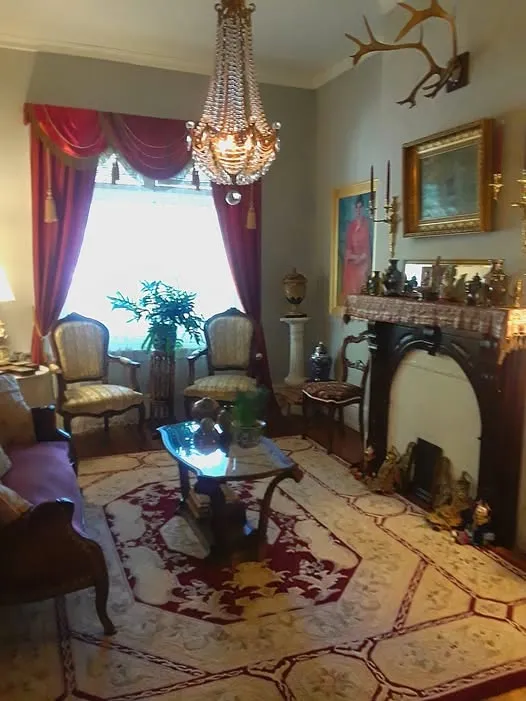
Carle Jasmin (Image : Mark Neil Silber)
I am in my late sixties, single, and I no longer have any close family. I wonder what will happen to my belongings, my photos, my family heirlooms, my books, my collections… after my death. In the photo: the front living room of my 135-year-old Victorian row house in Philadelphia. My house is filled with things!
The message from Mark, posted in a Facebook group for older men, raises a very interesting question about the lives of single people that older gay men often have to face when they have no descendants.
We recently discussed succession in Quebec on Gay Globe, which is an almost unique exception worldwide, but let’s set Quebec aside and examine the question raised by Mark, who wonders what will happen to his assets after his death.
The greatest danger is the possibility that a person who is alone and single, with no heirs, might leave neither a notarized will nor a simple handwritten will. This would open the door to the application of local laws and ensure that his assets would be squandered left and right, sold, and would no longer have any meaning in relation to his personal history.
After Us, the Flood… or the State? When a Gay Man Dies Without Heirs
Mark’s testimony, posted in a Facebook group for older men, raises a question that many would probably prefer to push to the back of a drawer: what happens to our belongings when we die alone, without children, without a legal spouse, and without a will?
For many gay men from older generations, the question is not theoretical. Some never had children. Others never wanted to get married. Some have lost their family, drifted away from them, or simply no longer have anyone close enough to know what to do with their estate.
And in the meantime, the house is there. The furniture is there. The photographs are there. The books, the collections, the memories of travels, and sometimes several decades of life are carefully stored away in cabinets. Then one day, the owner dies. And that is when the law enters the house.
Without a Will, You Are No Longer the One Making the Decisions
Upon his death, Mark leaves behind an estate. His house, bank accounts, vehicles, furniture, and other assets must be dealt with according to the rules applicable in his jurisdiction. The problem is that the law does not know Mark.
It does not know who his best friend was, who accompanied him for twenty years, who came over for coffee every Sunday, or who would have treasured his photographs. It applies rules.
When a person dies without a will, the estate is generally distributed according to an order established by law. Children, a spouse, parents, siblings, and other relatives may successively be called upon to inherit, depending on the jurisdiction.
In England and Wales, for example, the legal order may extend from a spouse or civil partner to descendants, then to parents, siblings and their descendants, before extending to even more distant family members.
In other words, even if Mark had virtually no contact with his family, a distant relative whom he may not have seen for 40 years could, depending on the circumstances, have greater inheritance rights than the friend who shared the last years of his life. This is precisely the kind of situation that many people discover too late.
And the Spouse? Not So Simple
Among gay men, another complication can arise. A man may have lived for 20 or 30 years with his partner and naturally consider that person his family. But depending on the jurisdiction, the legal status of the couple, and how the assets were held, a long-term relationship is not necessarily enough to settle the estate.
Marriage, civil partnership, joint ownership of a property, bank accounts, and beneficiary designations can have completely different consequences. In California, for example, certain assets held jointly with a right of survivorship may pass directly to the surviving co-owner, while certain accounts or contracts have their own beneficiaries.
This is why two men who have lived exactly the same story can face very different estate consequences simply because they did not organize their affairs in the same way.
And What If No One Wants or Can Inherit?
This is where the story becomes almost surreal. When there is no legal heir capable of receiving an estate, several jurisdictions provide for a mechanism known as escheat. The assets may ultimately return to the state or the Crown.
In England and Wales, this is notably referred to as bona vacantia, meaning ownerless property. When a person dies without a will and without any known family, their estate may therefore revert to the Crown. In California, there is also an escheat mechanism when no one can legally receive the estate. Just imagine the scenario.
A man has worked all his life. He has bought a house. He has renovated it. He has accumulated furniture, books, photographs, memories, and perhaps a few objects whose history only he truly knows. He dies. No one knows his wishes. The law knows them even less.
The House Does Not Disappear, but Its Meaning Can
Obviously, we must avoid the image of a government employee arriving with a truck to throw an entire person’s life into the garbage. The estate follows procedures. Debts and obligations must be settled. Potential heirs must be located. Assets are then transferred according to established rights. And if no heir exists, a house may eventually be sold according to the procedures established by the jurisdiction.
But the real question is not simply: how much is the house worth? It is: who will know what it meant? Because a house filled with photographs is not merely a house filled with photographs. A library is not simply a quantity of books. A collection assembled over 40 years is not necessarily a series of objects without importance.
For the person who accumulated them, they are sometimes the material archives of an entire existence. And without a will, the law makes no distinction between the memory of a first love and an old kitchen table.
This may be the most important lesson from Mark’s testimony. Being alone does not necessarily mean being without family. But being alone can mean that the law will not recognize the family you chose. This is a particularly important reality for gay men who have sometimes built, over the decades, networks of friends and loved ones who have played a much more important role than their biological family.
The problem is that inheritance law does not necessarily operate according to this emotional logic. It does not ask: who loved Mark? It asks: who is legally entitled to his assets?
A will allows people to make their wishes known and designate the people, organizations, or institutions to which they wish to transfer their estate. Beneficiary designations can also play a role for certain assets. And above all, this makes it possible to avoid the situation in which, after spending an entire life deciding what to buy, what to keep, and what to pass on, the last decision concerning your belongings is made without you. Because ultimately, Mark’s question may not be: who will inherit my house?
It is much more troubling: Who will remember me when there is no one left to claim the keys?
For Mark, what are the different ways to make a will?
For a single man with no children who owns a home and assets accumulated over decades, the main purpose of a will is to clearly ensure that his wishes are respected after his death.
Notarized will: when this option exists in the country concerned, it provides professional guidance, greater documentary security and, in some legal systems, official registration that makes the will easier to locate after death.
Will prepared by a lawyer: particularly useful when the estate is complex. A lawyer can specify who will receive the house, the money and personal belongings, and who will be responsible for settling the estate.
Witnessed will: a very common form in common-law countries. It allows a person to make a will without necessarily appearing before a notary, but the formal requirements must be strictly followed.
Handwritten will: simple and inexpensive, but much more vulnerable to errors, ambiguities, loss of the document or legal challenges.
Commissioner for oaths: having a document sworn before a commissioner does not automatically turn it into a notarized will or an uncontestable will. The rules of the relevant jurisdiction determine its validity.
For Mark, the essential point is therefore not simply to have a signed document. The will must be valid in his country, it must be capable of being found after his death, and it must clearly state what he wants to happen to his house, his money and his memories. Otherwise, the law may end up making the decisions for him.
ADVERTISING
Read also
- At 62, He Has Never Been More Popular with Younger Men: His Surprising Perspective on Aging
- HIV: The 5 Breakthroughs of 2026 Bringing Researchers Closer to a Cure
- What if the shingles vaccine could also slow down aging?
- After years of silence, a woman living with Alzheimer’s begins speaking again thanks to psilocybin?
- Donanemab and HIV: A New Research Avenue for Cognitive Impairment?
- Thymus: this forgotten organ could extend lifespan and revolutionize treatments against HIV and cancer