Roger-Luc Chayer (Image : AY / Gay Globe)
A small organ once considered useless in adulthood is now revealing a far more powerful role: it may not only help humans live longer and healthier lives, but also transform future HIV treatments and cancer immunotherapy. This organ is the thymus.
The thymus: conductor of the immune system
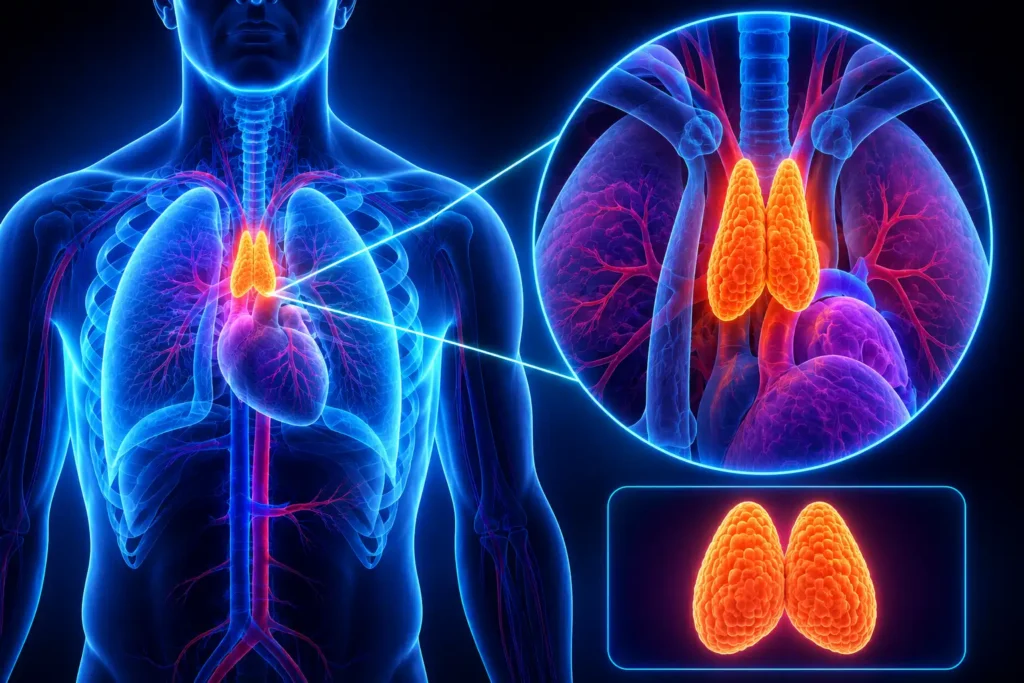
The thymus is a small gland located behind the sternum, between the lungs. For a long time, it was believed to have little importance in adult life. However, it is now recognized as a key organ of the immune system.
It is inside the thymus that T lymphocytes (T cells) are developed and trained. These immune cells are responsible for identifying and destroying infections, viruses, and even abnormal or cancerous cells.
Highly active during childhood and adolescence, the thymus gradually shrinks with age, which led to the assumption that it becomes obsolete in adults. Recent research challenges this view, showing that it continues to influence immune function throughout life.
A healthy thymus is strongly associated with a reduced risk of mortality because it directly supports immune efficiency. It produces T cells, essential for detecting and eliminating viruses, bacteria, precancerous cells, and other threats to the body.
As the thymus involutes with age, T cell production declines, weakening immune defenses and reducing the body’s ability to respond to infections and cancer surveillance. This decline is also linked to chronic low-grade inflammation, a major factor in age-related diseases.
In contrast, when thymus function is preserved, the body continues producing fresh immune cells, maintaining stronger defenses. Individuals with a more active thymus tend to show better resistance to infections, faster recovery from illness, and improved tumor surveillance.
Studies have observed that adults with a functional or less atrophied thymus have a significantly lower risk of death compared to those with severe thymic degradation.
Why an active thymus could extend lifespan
Large-scale analyses of chest scans using artificial intelligence have revealed a clear link between thymus size in adults and overall health status. People with a larger and more functional thymus generally exhibit stronger immune systems and a reduced risk of serious diseases.
This protective effect is explained by the thymus’ central role in producing and maturing T lymphocytes, which recognize and eliminate infectious agents and abnormal cells that may develop into cancer. When the thymus remains active, it continuously supplies new immune cells, strengthening the body’s ability to respond rapidly to threats.
Researchers have also found that a functional thymus is associated with better control of chronic inflammation, a process linked to cardiovascular disease, cancer, and degenerative disorders. By maintaining a more balanced immune response, the thymus may help reduce major causes of mortality.
Thanks to artificial intelligence tools capable of analyzing medical imaging, scientists now have a new biomarker to assess immune health and better understand the role of the thymus in human longevity.
Thymus and cancer immunotherapy
The thymus may also play a crucial role in the effectiveness of cancer immunotherapy, treatments that harness the patient’s immune system to fight tumors.
These therapies rely heavily on T cells, the same immune cells produced and trained by the thymus. When the thymus remains active, it continues generating new T cells capable of recognizing and attacking cancer cells, improving treatment response.
In contrast, when the thymus is severely atrophied, both the number and diversity of T cells decrease, limiting the immune system’s capacity to respond effectively to immunotherapies.
Researchers are increasingly studying the thymus as a key factor influencing cancer treatment outcomes, suggesting that preserving or restoring thymic function could enhance therapeutic success.
Reactivating the thymus: hope for HIV and future therapies
Encouragingly, scientific advances suggest that it may be possible to reactivate the thymus.
Regenerative medicine is now focusing on reversing immune aging by restoring or mimicking thymus function through several innovative approaches:
1. mRNA reprogramming therapies
Researchers at the Broad Institute of MIT and Harvard are developing mRNA-based therapies that temporarily reprogram the liver to act as a surrogate thymus-like system. The liver produces key proteins normally secreted by the thymus, leading to increased T cell production and improved immune responses in animal models.
2. Interleukin-based treatments
Cytokines such as Interleukin-7 (IL-7) and Interleukin-22 (IL-22) are being studied for their ability to stimulate thymic regeneration and boost T cell production, particularly after chemotherapy or immune damage.
3. bioengineered thymus tissues
Using induced pluripotent stem cells (iPSCs), scientists are developing lab-grown thymic tissue. These engineered structures may one day be transplanted to restore immune function.
4. hormonal protocols
The TRIIM protocol (Thymus Regeneration, Immunosenescence, and Insulin Reconstitution) has shown that partial thymic regeneration may be possible in humans, improving immune markers and reversing aspects of biological aging.
The thymus and HIV: rebuilding the immune system
HIV attacks the immune system, particularly CD4 T cells, which are essential for coordinating immune defenses. Over time, the virus weakens the body’s ability to fight infections.
The thymus is central to this process because it produces new T cells. Even in adults, a functional thymus can help replenish immune cells lost due to HIV infection.
Studies suggest that people living with HIV who have better thymic function may recover T cell levels more effectively after starting antiretroviral therapy. In this way, the thymus helps rebuild immune capacity once viral replication is controlled.
This has opened new therapeutic pathways, including thymus stimulation and the use of molecules such as Interleukin-7 (IL-7) to enhance immune recovery.
Regenerative approaches aimed at restoring thymic function could one day improve immune reconstitution in people living with HIV and support long-term disease control strategies.
While the thymus does not cure HIV and does not replace antiretroviral therapy, it could become a key ally in future treatments by strengthening the body’s ability to rebuild its immune system.
ADVERTISING

READ ALSO
HIV: Anti-PD-1 immunotherapy, a promising path toward durable remission
https://gayglobe.net/hiv-anti-pd-1-immunotherapy-a-promising-path-toward-durable-remission/
PrEP Belly: How a False Claim Born on TikTok Is Spreading Panic
https://gayglobe.net/en/prep-belly-rumeur/
HIV: What “Undetectable = Untransmittable” Really Means and the Risks of a Viral Blip
https://gayglobe.net/hiv-what-undetectable-untransmittable-really-means-and-the-risks-of-a-viral-blip/
HIV Misinformation: How False Claims and Miracle Cures Spread Online
https://gayglobe.net/hiv-misinformation-online/
HIV Is No Longer a Death Sentence: End of an Era and Historic Closure in Toronto
https://gayglobe.net/hiv-is-no-longer-a-death-sentence-end-of-an-era-and-historic-closure-in-toronto/
No, dandelion does not cure HIV or cancer
https://gayglobe.net/no-dandelion-does-not-cure-hiv-or-cancer/
The Last Witnesses: What Survivors of the AIDS Epidemic Want to Pass On to Young LGBTQ+ People Before They Are Gone
https://gayglobe.net/en/hiv-lgbt-rights-history/
Evolution of Gay Globe Magazine: From Activist Beginnings to Digital Inclusion in 2026
https://gayglobe.net/evolution-of-gay-globe-magazine-from-activist-beginnings-to-digital-inclusion-in-2026/
HIV and Anti-PD-1 Immunotherapy: A Promising Path Toward Durable Remission
https://gayglobe.net/hiv-anti-pd-1-immunotherapy-durable-remission/
HIV: The future of prevention and long-acting treatments (Lenacapavir coverage article)
https://gayglobe.net/vih-le-lenacapavir/