Roger-Luc Chayer: A Career Spanning Journalism, Music and Creativity
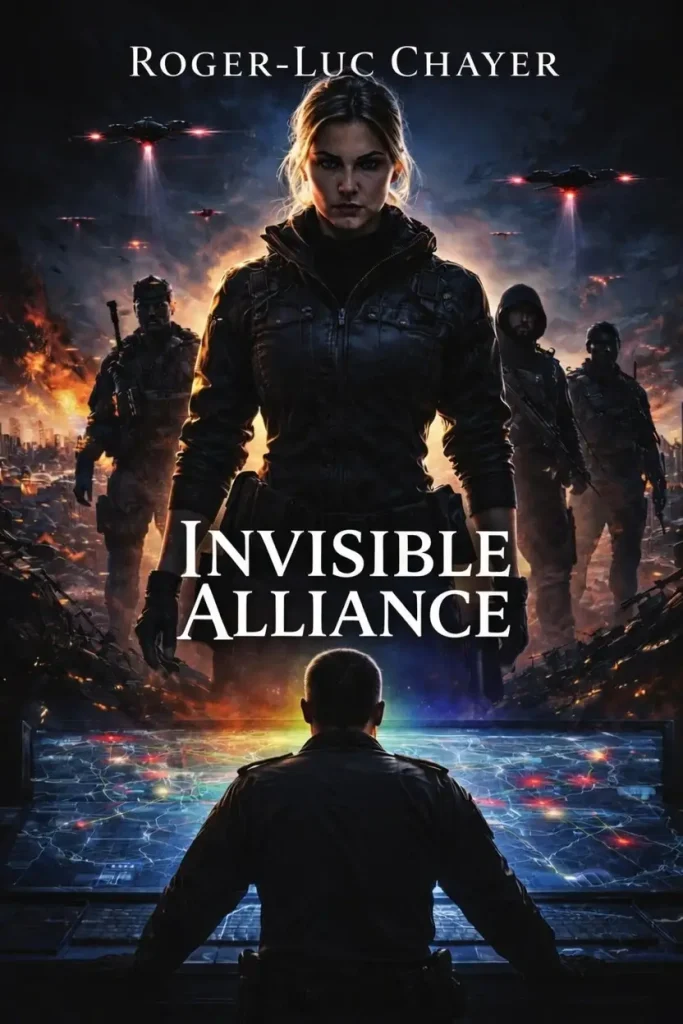
A journalist, publisher and musician, Roger-Luc Chayer has more than 33 years of experience in the media industry. Founder and publisher of Gay Globe, he has devoted his career to journalism, freedom of expression and covering issues often overlooked by mainstream media. A former symphonic horn player and orchestra conductor, he has also built a solid career in music. Driven by curiosity and a spirit of experimentation, he is now exploring the new possibilities offered by artificial intelligence, particularly in literary creation through his novel Invisible Alliance.
Roger-Luc Chayer (Image : AI / Gay Globe)
In the wake of the controversy surrounding Thélyson Orélien and the use of artificial intelligence in writing a novel intended to receive some of the most prestigious literary awards in the world, I felt the need to revisit my own writing experience and the creation of my first novel, Invisible Alliance. This gives me an opportunity to explain how the work took shape, how it came about, and what role human creativity played in its development.
Here is the story behind the novel:
In a near future, the world is shaken by the emergence of a clandestine force: a highly organized LGBT alliance, capable of carrying out coordinated military operations on a global scale. The story explores the cultural and geopolitical shock caused by this force, as well as the fear it inspires among governments and traditional military commanders, while following the personal dilemma of an officer, Colonel Matthias Verhoeven, whose son finds himself at the very heart of the confrontation.
The novel combines psychological tension, military strategy, invisible confrontations and moral negotiations, showing how a force capable of surgical precision can reshape global power without causing civilian casualties.
The novel has received a very positive response and has been downloaded or read online thousands of times, and for good reason. At the heart of the story is a fascinating confrontation between LGBTQ+ military forces and groups committed to a more conservative vision of society and Christian values. It is a unique kind of war, fought intelligently and through coordinated actions, without a single casualty. It challenges traditional power structures and proposes a new way of looking at the place of LGBTQ+ people within institutions and society—not through exclusion, but through recognition and inclusion. You have to admit, it is a fascinating story!
There is broad consensus in the literary world that when artificial intelligence is used to help create the actual content of a work, rather than simply to revise it or correct spelling mistakes, readers should be informed so that they are not misled.
However, I believe it is important to add some nuance to this debate, particularly in light of the Thélyson Orélien controversy. He maintained that he had never used artificial intelligence to write his novel, claiming that he had relied on it solely for spelling corrections, until specialists concluded that its use had been much more extensive.
My own approach was different, and entirely transparent. Invisible Alliance was an experimental work in which I had deliberately incorporated artificial intelligence into the literary creation process. I therefore never tried to conceal its use or give the impression that every stage of the writing had been completed without technological assistance. On the contrary, I chose to explain my approach openly in the novel’s preface, specifying the role artificial intelligence had played in its conception and writing. Readers could find the following statement:
As a journalist by profession, and having never attempted to write a novel—let alone a science-fiction novel—I was assisted by artificial intelligence and several other tools in bringing my original idea to life as faithfully as possible.
Why should we be so afraid of artificial intelligence as a tool to assist in writing a novel? To me, this remains an inexplicable mystery. If you ask ChatGPT to write a 13,000-word novel and give it nothing more than a theme, I guarantee you will end up with a complete mess—a disjointed text that makes very little sense.
I actually put the question to ChatGPT itself. Here is its answer:
Asking ChatGPT to write a 13,000-word novel based solely on a theme, without a structured plot, developed characters or narrative direction, is very likely to produce a disjointed, repetitive text lacking genuine literary coherence. In short, a complete mess!
Creating a novel with the assistance of artificial intelligence nevertheless requires far more creative direction than one might imagine. The creative director must first define the vision for the work, build its narrative architecture, establish the characters’ traits and development, set the timeline and ensure the overall coherence of the story. The director must then guide the AI chapter by chapter, correct deviations, eliminate repetition, identify contradictions and make sure that every element genuinely contributes to the story.
The director must also maintain a literary intention, a tone, a certain sensitivity and a dramatic progression. AI can suggest, develop and rephrase, but it is the director who must constantly evaluate, select, guide and sometimes start the work all over again.
In other words, using artificial intelligence to write a novel does not simply mean giving it an instruction and waiting for the result. It requires genuine literary direction. AI can become a powerful creative tool, but without a human vision, it risks producing a great many words without necessarily telling a good story.
And it was precisely this vision of AI-assisted literary creation that guided the conception and writing of my novel Invisible Alliance. It was a writing experience in which technology did not replace the author, but became an instrument serving his vision, imagination and narrative ambitions.
To better understand this approach, I would like to draw a few parallels with tools that have been around for a long time and which, nevertheless, do not attract the same kind of condemnation that artificial intelligence and conversational agents are facing today.
Surgical robots in operating rooms
In hospitals, surgical robots are increasingly being used to assist surgeons with complex procedures, whether removing a gallbladder, repairing hernias or even performing certain delicate heart and brain operations.
Yet no one accuses doctors of fraud because they use technological tools programmed to assist them in their work. The very purpose of these systems is to improve surgical precision, facilitate certain procedures and, in many cases, achieve better outcomes for patients.
So where is the fraud in using a technological tool to improve one’s work, when responsibility for and direction of the procedure remain in human hands?
The same applies to calculators.
For decades, accountants have moved away from the abacus and embraced electronic calculators and specialized software. These tools, based on mathematical processing technologies, allow them to prepare sales tax and income tax returns, produce financial reports and manage their clients’ accounts more quickly and accurately.
No one cries fraud because an accountant uses a calculator instead of doing every calculation by hand! Why? Because we understand that a technological tool takes nothing away from the competence of the person using it. It helps them work better, faster and with fewer errors. The accountant remains responsible for the figures, analyses and conclusions.
So why shouldn’t the same logic apply to writing? Why should using an artificial intelligence tool to assist an author suddenly become a form of cheating? The real question is not whether a tool is being used, but how it is being used and what creative responsibility the author assumes for the final result.
Now let’s consider the example of symphonic music.
When you attend a symphony orchestra concert featuring more than 120 musicians performing a magnificent work, as I have had the privilege of doing many times, both as a symphonic horn player and as an orchestra conductor, you know that the result depends on rigorous musical direction.
Yet the conductor does not play an instrument during the concert. He does not produce a single one of the notes you hear. The musicians perform them. Nevertheless, he gives meaning to the interpretation, establishes a vision, shapes the nuances, coordinates the musicians’ entrances and transforms dozens of individual talents into one coherent work.
No one in the audience stands up to accuse him of fraud because he did not personally play the violin, oboe or trombone! No one claims that the work does not belong to him in its interpretive dimension simply because he relied on the talent and instruments of others.
Why? Because we understand that directing a creative performance does not necessarily mean personally executing every single element of it.
This is precisely where I see the parallel with artificial intelligence: the tool can produce, execute and develop elements of a work, while the vision, choices, direction and responsibility for that work can remain with the author.
The question, therefore, is not whether the author personally produced every word, any more than the conductor personally played every note. The real question is who conceived the work, who directed its creation and who takes responsibility for the result.
And it was with this vision that I created my novel.
I remember my approach very clearly. I sat down at my keyboard, opened ChatGPT and Grok, and began telling them the story I wanted to bring to life. I knew where I wanted to go, what I wanted to tell and, above all, what I wanted readers to feel. Chapter by chapter, I guided the story, clarified my intentions, corrected directions that did not suit me and imposed my vision on the work. I was not asking a machine to write a novel for me while I simply watched the results unfold. I wanted to experiment with another way of creating, using artificial intelligence as an instrument serving my imagination and literary direction.
This experience allowed me to create a work whose authorship I fully assume, including my decision to use these new technologies. I never felt the need to conceal my method or pretend that I had worked differently. On the contrary, I am openly proud of it because I explored territory that remains relatively unfamiliar in literary creation.
Why should I have been ashamed of using a new creative instrument when my entire approach was based on experimentation?
And that is how the novel Invisible Alliance came into being, just as Ms. X’s tax return was prepared, last week’s symphony concert was performed, or the surgery that removed a brain tumour from Mr. W was carried out.
In each of these examples, technology is put to work in the service of human skill, vision or expertise. Rather than automatically fearing new technologies, we should learn to consider their possibilities, understand their applications and use them intelligently. Humanity has always progressed by developing new tools. Artificial intelligence should be no exception. It is not the tool that should frighten us, but our inability to imagine everything we can accomplish by learning how to use it properly.
ADVERTISING
READ ALSO
1. Can AI Detectors Really Prove That a Text Was Written by Artificial Intelligence?
3. Dialogues with a Queer Robot? Exploring an Inclusive Artificial Intelligence
4. Artificial Intelligence in Images: A Major Technological Advancement
5. When Artificial Intelligence Imagines the Most Handsome Man
6. Contest: Which Artificial Intelligence Model Generates the Most Attractive Male Portraits?