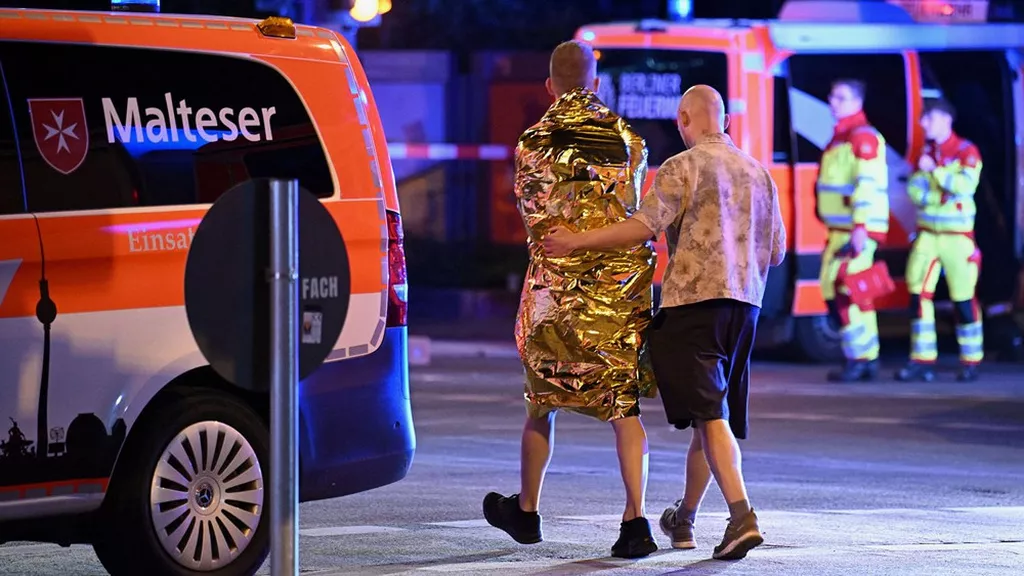
Opinion by Roger-Luc Chayer (Photo Annegret Hilse/Reuters)
Whenever the media suggests that Pride and the growing visibility and emancipation of LGBTQ+ communities are somehow responsible for the rise in homophobic violence around the world, it overlooks a far more troubling reality. Hatred does not emerge from equality—it is fueled by political leaders, extremist movements, and ideologues who deliberately encourage fear and division, often to distract from their own failures or misconduct. Yesterday’s attack during Berlin’s Christopher Street Day Pride March is yet another tragic reminder of that reality.
Even more alarming is the role that religion can play when it becomes intertwined with political extremism. In those circumstances, hatred can become extraordinarily powerful. This is one of the reasons why Gay Globe regularly publishes articles that critically examine religious institutions. Our position is that, throughout history, many religious organizations have too often served as instruments of hatred, domination, and the exclusion of LGBTQ+ people. They have also survived because they benefit from structures of power—and, quite frankly, because religion has become a highly profitable enterprise.
Yesterday, during Berlin’s Pride march, the suspect—a 21-year-old man whom authorities suspect was radicalized by Islamist ideology—allegedly drove a truck into the crowd. The victims included LGBTQ+ people, allies, children, and ordinary spectators, without any distinction based on sexual orientation or gender identity. One person was killed, and sixteen others were seriously injured.
How does a human being come to hate complete strangers enough to want them dead? How can a political, religious, or extremist ideology persuade someone that innocent people deserve to be massacred simply because they represent a reality that the attacker refuses to accept? These are questions our societies must continue to confront if they genuinely wish to combat hatred and violence.
There is never a single explanation for an act like this, and it would be irresponsible to draw firm conclusions about an individual’s motives before investigators complete their work. Nevertheless, research in psychology, criminology, and radicalization consistently shows that several factors often converge in young adults who commit acts of mass violence.
The first is ideological radicalization. When a young person is repeatedly exposed to extremist narratives—whether religious, political, or otherwise—they may gradually begin to view entire groups of people as enemies or legitimate targets. This process of dehumanization is one of the defining characteristics of many acts of ideological violence.
Another factor is the search for identity and belonging. At the age of 21, many young adults are still trying to find meaning and purpose in their lives. Extremist organizations are highly effective at exploiting this vulnerability by offering simple answers to complex problems, a strong sense of identity, and the promise of belonging.
Social media also plays a significant role. Recommendation algorithms can trap vulnerable individuals inside echo chambers where hateful messages are constantly reinforced, making violence appear justified—or even heroic.
Psychological factors may also contribute, including profound frustration, humiliation, social isolation, or anger. However, it is important to emphasize that the overwhelming majority of people living with mental health conditions never become violent. Mental illness alone is rarely sufficient to explain an act of terrorism or mass violence.
Finally, some perpetrators seek notoriety. They want to leave their mark on history, even through horrific crimes, believing that widespread media attention will immortalize them.
If investigators ultimately determine that yesterday’s attack specifically targeted the LGBTQ+ community, it would reflect a disturbing trend observed over the past several years. Pride celebrations and LGBTQ+ communities have increasingly become symbolic targets for extremist groups that portray diversity and equality as threats to their worldview.
Who Is Fueling Anti-LGBTQ+ Hostility?
There is no official ranking of individuals who “express the most hatred” toward LGBTQ+ people. However, numerous politicians, religious leaders, and public figures have been criticized by international human rights organizations for statements or policies widely viewed as hostile to LGBTQ+ rights.
Among the political leaders most frequently cited are Viktor Orbán, whose government has adopted laws restricting LGBTQ+ visibility in Hungary and has repeatedly portrayed LGBTQ+ issues as a threat to children; Vladimir Putin, whose administration expanded laws banning so-called “LGBTQ+ propaganda” while severely restricting LGBTQ+ rights in Russia; Yoweri Museveni, who signed one of the world’s harshest anti-LGBTQ+ laws in Uganda; and Ron DeSantis, whose education-related policies have been strongly criticized by LGBTQ+ advocacy organizations in the United States.
Among religious figures, Pat Robertson, who died in 2023, spent decades making hostile statements about gay people, while Franklin Graham remains a vocal opponent of same-sex marriage. In addition, leaders of the Islamic Republic of Iran and the Taliban regime in Afghanistan continue to defend religious interpretations that justify severe criminal penalties against LGBTQ+ people.
Public commentators, influencers, and media personalities also contribute to anti-LGBTQ+ rhetoric in various countries, although their influence differs depending on the political and cultural context.
At the same time, it is essential to distinguish between criticizing public policies and promoting hatred. Human rights organizations generally consider rhetoric especially dangerous when it dehumanizes LGBTQ+ people, falsely portrays them as threats to society or children, encourages their exclusion from public life, or legitimizes discrimination and violence against them.
History repeatedly demonstrates that when these narratives are embraced by influential political leaders, religious authorities, or media personalities, they can create a social climate in which discrimination—and sometimes violent attacks against sexual minorities—becomes more likely.
Keeping Pride Safe Without Losing Its Spirit
We are in the middle of Pride season, and major cities around the world are preparing to host their celebrations. Yet it is impossible to station police officers—or even military personnel—along every meter of every parade route or at every related event.
That raises an unavoidable question: How can Pride events be better protected from individuals determined to attack LGBTQ+ people and their allies?
The answer almost certainly lies in a combination of measures: stronger intelligence gathering, closer monitoring of individuals who have become radicalized, enhanced cooperation between event organizers and law enforcement agencies, and increased public awareness and vigilance.
Protecting the open, festive, and inclusive spirit of Pride while ensuring the safety of participants has become one of the greatest challenges facing Pride organizers across the globe. Freedom, visibility, and equality should never require extraordinary courage—but in today’s climate, safeguarding those values demands vigilance from governments, communities, organizers, and citizens alike.
ADVERTISING

READ ALSO
- After Noahm’s Murder in Metz, Can Anyone Still Claim That Homophobia No Longer Exists?
https://gayglobe.net/en/homophobic-murder-metz-noahm-2026/ - When Homophobia Decides Lives
https://gayglobe.net/en/hatred-homophobia-lgbt-testimony-gay-globe/ - Hunted on Grindr: The Tool That Exposes GBT Communities to Danger
https://gayglobe.net/hunted-on-grindr-the-tool-that-exposes-gbt-communities-to-danger/ - The True Face of the Pope Revealed: We Are Sissies! And Homophobic Attack Against Gay Globe From an Individual From Longueuil, Quebec!
https://gayglobe.net/the-true-face-of-the-pope-revealed-we-are-sissies-and-homophobic-attack-against-gay-globe/ - Kai Schwemmer: Anti-Gay Statements and Major Controversy
https://gayglobe.net/kai-schwemmer-propos-anti-gays-controverse-kai-schwemmer-anti-gay-statements-controversy/