Roger-Luc Chayer (Photo : Roger-Luc Chayer / Gay Globe)
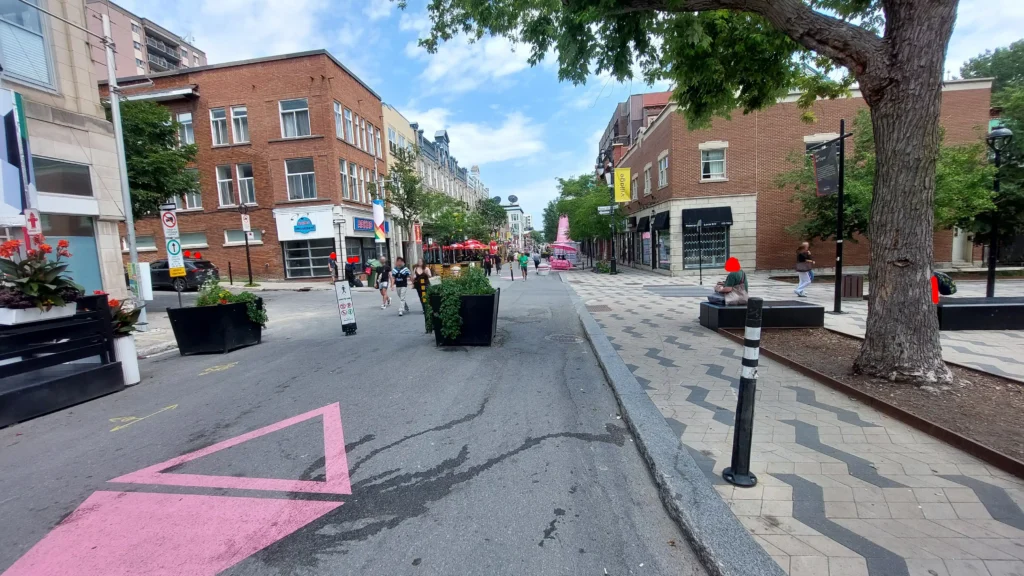
Okay, that’s enough! Every red dot on the photo represents a homeless person, someone struggling with addiction, or someone causing public disorder during my visit. No police officers or cadets were on site or nearby.
We’re going to stop telling ourselves fairy tales, as if this were a movie where everything is perfect in a world populated only by unicorns. Montreal has lost control of the Gay Village, a historic neighbourhood of Montreal’s LGBTQ+ community, and it must be talked about — because just days before Montreal Pride, we can no longer accept watching the situation deteriorate like this.
On Saturday, July 25, around 4:30 p.m., between Papineau and Saint-Hubert streets, including several side streets in Montreal’s Gay Village, there were more people visibly struggling with substance use, homelessness, or mental-health issues than ordinary citizens and visitors simply trying to enjoy the area. That was practically all you could see.
For the first time in my life, for no apparent reason, while I was sitting on one of the pink benches in the Gay Village chatting with my 82-year-old friend Normand, a group of idle young people — three men and one woman — started staring at me as if I had drawn their attention. One of the men, accompanied by the young woman, approached me in an intimidating manner, as if looking for confrontation. I then went into a shop right in front of me. Normand, for his part, headed to the convenience store to buy a drink, and fortunately the incident stopped there.
But why do we have to put up with this?
At the corner of Papineau, a homeless man in Montreal’s Gay Village was bent double on the street corner, almost unable to stand, clearly under the influence of substances that had robbed him of all awareness of his surroundings and of any human dignity.
I also saw a tent set up on Panet Street, two others in the small park in front of the Radio-Canada entrance, another in Parc des Faubourgs, and yet another on the private property of a residential building.
But this situation can no longer continue. Nothing is working anymore. Montreal’s municipal authorities and police services appear overwhelmed by a form of laissez-faire that is becoming deeply concerning.
Montreal’s Gay Village is a historic LGBTQ+ symbol in Quebec. It deserves better. The vulnerable people living there deserve better. Residents of the Gay Village, merchants of the Gay Village, and visitors deserve better. Montreal Pride 2026 is approaching, but celebrating our achievements must not mean closing our eyes to a reality that threatens the safety of the neighbourhood, the dignity, and the vitality of this historic sector.
Because it was never the plan of residents, merchants, or visitors to see the fabulous Gay Village of Montreal turn into an open-air care unit.
The other day I met a 20-year-old Belgian and asked him whether he had expected to find the Village in the state it is in today. His answer was scathing and broke my heart: “I’m finishing my stay here and I will never come back!”
When Montreal’s Gay Village was at its most flourishing, it was not merely a lively commercial district of the metropolis. For the residents, merchants, activists, and LGBTQ+ community organizations that helped build it, the neighbourhood embodied a much broader collective project: the creation of a space where LGBTQ+ people could finally live, express themselves, and gather in an environment marked by safety, dignity, LGBTQ+ pride, and a sense of belonging.
Originally, Montreal’s Gay Village was born out of a fundamental need: to offer a social refuge to a community that had long been marginalized. After decades of discrimination, clandestinity, and repression directed at LGBTQ+ people — particularly at LGBTQ+ establishments and meeting places — the development of the neighbourhood allowed several generations to find a place where they could exist openly, without having to hide their identity.
For residents of the Gay Village, the goal was clear: to build a living environment in which LGBTQ+ community solidarity could flourish. The Village was meant to be a lived-in, vibrant, and welcoming neighbourhood where neighbours, families, merchants, and visitors could share the same space with mutual respect.
On the merchants’ side, the vision was also one of sustainable development. The bars, restaurants, shops, galleries, and businesses that set up in the area helped create a destination recognized far beyond Montreal’s borders. Their ambition was not only to attract transient customers, but to take part in building a genuine economic, tourist, and cultural neighbourhood.
The Gay Village had also become a symbol of visibility for LGBTQ+ rights in Quebec and around the world. Every terrace, every business, every event, and every public demonstration represented an affirmation of the existence and rights of LGBTQ+ communities. The neighbourhood reminded everyone that LGBTQ+ presence in public space was a legitimate reality that deserved to be celebrated and protected.
Yet behind the festivities and energy of Montreal’s Gay Village, there was also a desire to preserve balance. Residents wanted a clean, safe, and pleasant living environment. Merchants needed a dynamic sector where visitors felt welcome. Nightlife, LGBTQ+ culture, and tourism had to be able to coexist with the daily lives of those who had chosen to live there.
Montreal’s Gay Village was therefore never imagined as a simple entertainment venue or just another commercial zone. It was the result of decades of struggles, investments, and civic commitment. It represented a true LGBTQ+ social conquest — a space where a community could finally recognize itself, gather, and celebrate its history.
It is precisely for this reason that the current transformations of the neighbourhood are causing so much concern among many historic residents of the Gay Village, merchants, and community stakeholders. Beyond the issues of public safety, homelessness, the addiction crisis, and mental health, the question of preserving a collective LGBTQ+ symbol is what is at stake today.
Who broke Montreal’s Gay Village?
Blaming a single person or a single institution for having “broken” Montreal’s Gay Village would be too simplistic. The reality is more complex: this historic LGBTQ+ neighbourhood of Montreal has been weakened by a succession of decisions, absences of decisions, and social transformations that, taken together, have profoundly changed its face.
For decades, Montreal’s Gay Village was a model of resilience. Born of the necessity to create a safe space for a long-marginalized community, it became an international symbol of LGBTQ+ pride, freedom, and solidarity. But over time, several factors contributed to its weakening.
First, the transformation of social and technological habits had a major impact. The arrival of dating apps, the multiplication of social networks, and greater social acceptance of LGBTQ+ people reduced the central role that the Village’s bars and businesses once played as primary meeting places.
Next, the economic evolution of the sector created new challenges. Rising commercial rents, competition from other Montreal neighbourhoods, and changing consumer habits contributed to the closure of several emblematic establishments. The Village lost part of the concentration of LGBTQ+ businesses that once constituted its strength and identity.
But another important factor concerns the management of public space. Many residents and merchants criticize municipal authorities for failing to sufficiently anticipate the deterioration of certain parts of the neighbourhood, particularly regarding homelessness in Ville-Marie, drug consumption, and mental-health problems. For many local stakeholders, public intervention came too late or was not adapted to the scale of the crisis.
The question therefore remains: how can we preserve the future of Montreal’s Gay Village and its historic LGBTQ+ heritage?
Who will have the collective will to rebuild Montreal’s Gay Village?
Rebuilding Montreal’s Gay Village cannot be the work of a single actor. This historic neighbourhood of Quebec’s LGBTQ+ community is the result of decades of civic, commercial, community, and political commitment; its rebirth will therefore also have to be collective.
The primary responsibility lies with Montreal’s public authorities. The City of Montreal, the borough of Ville-Marie, and the various services concerned must recognize that Montreal’s Gay Village is not a neighbourhood like any other. It is a historic site of LGBTQ+ culture in Quebec, a symbol of social struggles, visibility, and progress that deserves particular attention.
Safety in the Gay Village, cleanliness, occupation of public space, and support for vulnerable people must be addressed with concrete actions rather than temporary measures. The crises of homelessness, addiction, and mental health require coordinated, humane, and effective interventions that protect both people in vulnerable situations and the quality of life of residents.
Merchants of the Gay Village will also have an essential role to play. The vitality of the neighbourhood has always rested on a balance between community life, culture, dining, entertainment, and commerce. Reinventing the commercial offering, attracting new generations, supporting local businesses, and recreating a sense of belonging will be major challenges in revitalizing Montreal’s Gay Village.
Montreal’s LGBTQ+ organizations will also need to take part in this reflection. The Village was built by activists, entrepreneurs, and citizens who believed that a community needed a visible and unifying space. That same collective energy will be necessary to imagine its future.
But we must not forget the residents of the Gay Village themselves. A neighbourhood cannot survive without those who live there, work there, and choose to defend it. Their voices must be heard, for they are the daily witnesses of the changes affecting the sector.
The Montreal LGBTQ+ community as a whole may have to ask itself a difficult question: is the Village still considered a collective heritage worth protecting? For a long time, several generations dreamed of having a place where they could be visible and free. Today, that hard-won freedom must not lead to the abandonment of the place that symbolized it.
Rebuilding Montreal’s Gay Village does not mean returning to the past. It is not about recreating exactly the neighbourhood of the 1980s or 1990s, but about recovering what made it strong: LGBTQ+ pride, safety, creativity, solidarity, and the feeling of belonging to something greater than oneself.
We must especially not forget that in other Montreal boroughs, similar urban crises have been managed in completely different ways, and that some sectors have succeeded in regaining their vitality.
I am thinking in particular of the Promenade Masson in Rosemont–La Petite-Patrie, or Wellington Street in Verdun — two examples often cited to show that a neighbourhood can transform positively when local stakeholders work together.
The difference is not magic, but a question of political will, leadership, collaboration among local actors, and on-the-ground commitment. What is needed is a constant presence, concrete actions, perseverance, and a great deal of hard work.
Montreal’s Gay Village has already demonstrated its capacity to be reborn. It survived marginalization, discrimination, and major social crises. It possesses a history, an identity, and immense symbolic value.
The question, therefore, is perhaps not whether the Village can be rebuilt, but rather whether Montreal will have the collective will to restore it to the place it deserves: that of a proud, safe, vibrant, and unifying LGBTQ+ neighbourhood, worthy of its history.
ADVERTISING
READ ALSO