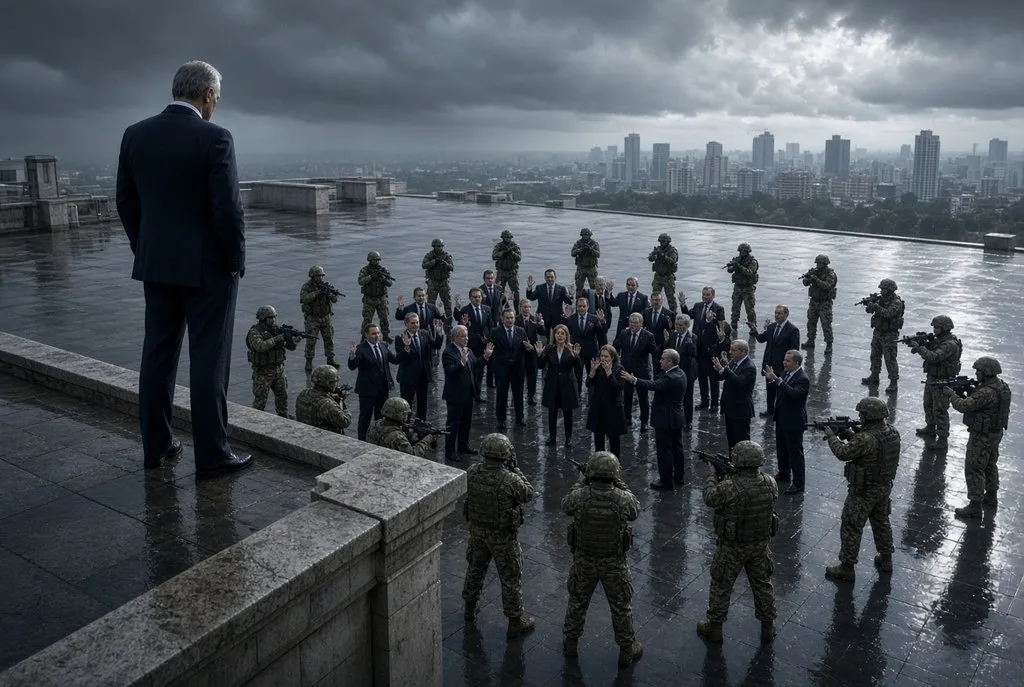
Roger-Luc Chayer (Image : AI / Gay Globe)
We live in such an era that one wonders whether Donald Trump is merely acting out the result of inner troubles that he has never taken the time to address, or whether his overall policy toward his friends, his allies and his alliances is instead inspired by reading Star Wars, as he seems to be applying Order 66 « by the book » in an attempt to transform the United States into an entirely artificial planetary empire.
What is Order 66 in Star Wars?
In Star Wars, Order 66 is one of the most important moments in the political transformation of the Republic into the Empire. It is not simply a military order targeting the Jedi: it is the mechanism that allows Palpatine to destroy, almost instantaneously, those who were nevertheless the defenders of the regime he was leading.
For years, the Jedi served the Galactic Republic as peacekeepers. They fought alongside the clone army during the Clone Wars and were officially regarded as allies of the government. But Palpatine, who was secretly the Sith Lord Darth Sidious, gradually manipulated the war and the institutions in order to increase his own power.
When his plan reached maturity, Palpatine issued Order 66. Through programming implanted in the clone soldiers, they were instructed to consider the Jedi traitors and eliminate them. Soldiers who, only moments earlier, had been fighting alongside the Jedi therefore turned against them.
It is this dimension that makes Order 66 particularly symbolic: the institutions and armed forces of a regime are used to destroy those who had nevertheless been its servants and protectors.
The consequence is immediate. The Jedi are decimated throughout the galaxy. Their ability to oppose the authorities practically disappears overnight. Palpatine can then present the situation as a political and security necessity: he claims that the Jedi have betrayed the Republic and that the regime must be reorganized to ensure peace and stability.
This is how the Galactic Republic becomes the Galactic Empire. Palpatine gradually concentrates all power in his hands and transforms a regime presented as democratic into a dictatorship.
Trump and “Order 66”: a metaphor taking on an astonishing resonance
At first glance, comparing Donald Trump’s foreign policy to “Order 66” in Star Wars may seem more like popular culture than political analysis. Yet when one observes the way the American president is redefining relations between the United States and its traditional allies, the metaphor becomes surprisingly relevant.
In the universe of Star Wars, Order 66 is the moment when clone soldiers, who had until then been fighting alongside the Jedi to defend the Republic, suddenly receive orders to turn against them. The Jedi, once considered allies and protectors of the regime, officially become enemies. Their elimination then allows Palpatine to concentrate power and transform the Galactic Republic into an Empire.
Obviously, nothing in reality allows us to say that Donald Trump is literally implementing some kind of “Order 66.” But the reference can serve as a metaphor to describe a profound transformation in American international relations: traditional alliances increasingly appear to be subject to a logic of power struggles rather than one of lasting strategic solidarity.
For decades, the United States built an international system based largely on a vast network of alliances. NATO, Canada, the European Union, Japan, South Korea and Australia are among the pillars of this international order. Washington was generally regarded as the principal guarantor of this architecture.
Under Donald Trump, this relationship appears to have changed in nature. Alliances are much more often assessed according to what they directly bring to the United States. The military spending of partners, trade deficits, tariffs, access to markets and American strategic interests now occupy a central place in diplomatic relations.
NATO is probably one of the best examples of this transformation. Trump has long demanded that European members of the Alliance substantially increase their military spending. This pressure is not necessarily aimed at destroying NATO. On the contrary, Washington continues to regard the Alliance as a major strategic instrument. But the message is different: belonging to an alliance no longer automatically guarantees a relationship based on traditional political reciprocity.
The relationship with Canada illustrates this new approach even more dramatically. Washington and Ottawa officially remain historic partners and allies. Yet trade disputes can now quickly give rise to tariff threats and particularly aggressive rhetoric. The historic partner can therefore find itself, on certain issues, being treated as an economic adversary.
This is precisely where the Order 66 metaphor becomes interesting.
In Star Wars, the change does not simply consist of declaring war on an outside enemy. It consists of turning the instruments of a system against those who were part of it. The clone soldiers are not replaced. They remain the same soldiers, but their mission changes. The Jedi do not suddenly become different: it is the authorities that now designate them as enemies.
Trump’s foreign policy obviously does not operate in such a radical manner. But a comparable logic can be observed in certain diplomatic relationships: a country can be considered an ally militarily while becoming an adversary commercially or politically.
The Greenland issue is also a particularly revealing case. Trump has publicly expressed interest in taking control of the autonomous Danish territory, even going so far as to raise the possibility of using force before backing away from that option. Yet Denmark itself is an ally of the United States and a member of NATO.
The question, therefore, is no longer simply who is a “friend” or an “enemy.” It becomes much more complex: can an ally continue to be considered a genuine partner when it refuses Washington’s strategic objectives?
It is probably this evolution that gives the reference to Star Wars its journalistic force.
“Order 66” can thus symbolize the transition from a system based on relatively predictable alliances to a system in which international relations are increasingly determined by power, economic pressure and each state’s ability to negotiate.
Nevertheless, we must be careful not to take the comparison too far. Trump does not necessarily seek to destroy American alliances. Rather, he seeks to renegotiate them according to a much more transactional conception of American interests. The distinction is important.
But for Washington’s traditional allies, the result can be destabilizing. For decades, they could regard the American alliance as a strategic constant. They must now consider the possibility that this relationship is conditional, negotiable and subject to being called into question.
This is where the image of Order 66 takes on its full meaning.
In Star Wars, Order 66 marks the end of an old political order and the rise of a new Empire. In reality, Trump obviously has no secret button capable of transforming the United States into a planetary empire. But his foreign policy appears to be contributing to a much deeper transformation: that of a world in which Washington no longer simply asks its allies to be partners, but demands that they demonstrate their concrete usefulness to American interests.
And if this transformation were to continue, the real question might not be whether Trump is implementing Order 66.
The question would rather be whether the international order built around American power since 1945 is itself experiencing its own “Order 66.”
In Star Wars, Order 66 almost annihilated the Jedi, but it did not succeed in making their ideals disappear. History even demonstrates that a system can survive the destruction of its institutions and be reborn in another form. A similar question could be asked today about the international order: even if traditional alliances were deeply weakened by Donald Trump’s policies, could they eventually be reborn in another form after his time in power?
This is what Canada’s Prime Minister, Mark Carney, suggests: if the United States no longer wants to assume its role as a leader, Canada will! And it has already begun!
PUBLICITÉ

READ ALSO
Trump Wants to Punish Canada. America Will Pay!
https://gayglobe.net/en/trump-wants-to-punish-canada-america-will-pay/
Trump in Davos, or the Art of Contradicting Yourself in Front of the World
https://gayglobe.net/en/trump-in-davos-or-the-art-of-contradicting-yourself-in-front-of-the-world/
“Gays for Trump”: The Perfect Alibi for a Regime That Dreams of Silencing Them
https://gayglobe.net/gays-for-trump-the-perfect-alibi-for-a-regime-that-dreams-of-silencing-them/
The Pink Triangle and Trump: A Troubling Journey Towards Totalitarianism
https://gayglobe.net/the-pink-triangle-and-trump-a-troubling-journey-towards-totalitarianism/
King Charles III and Trump: Humor, FIFA, World War II and the French Legacy at the British Court
https://gayglobe.net/en/king-charles-iii-trump-fifa-world-war-french-british-court/
Village People: The Betrayal of a Disco Icon
https://gayglobe.net/village-people-the-betrayal-of-a-disco-icon/