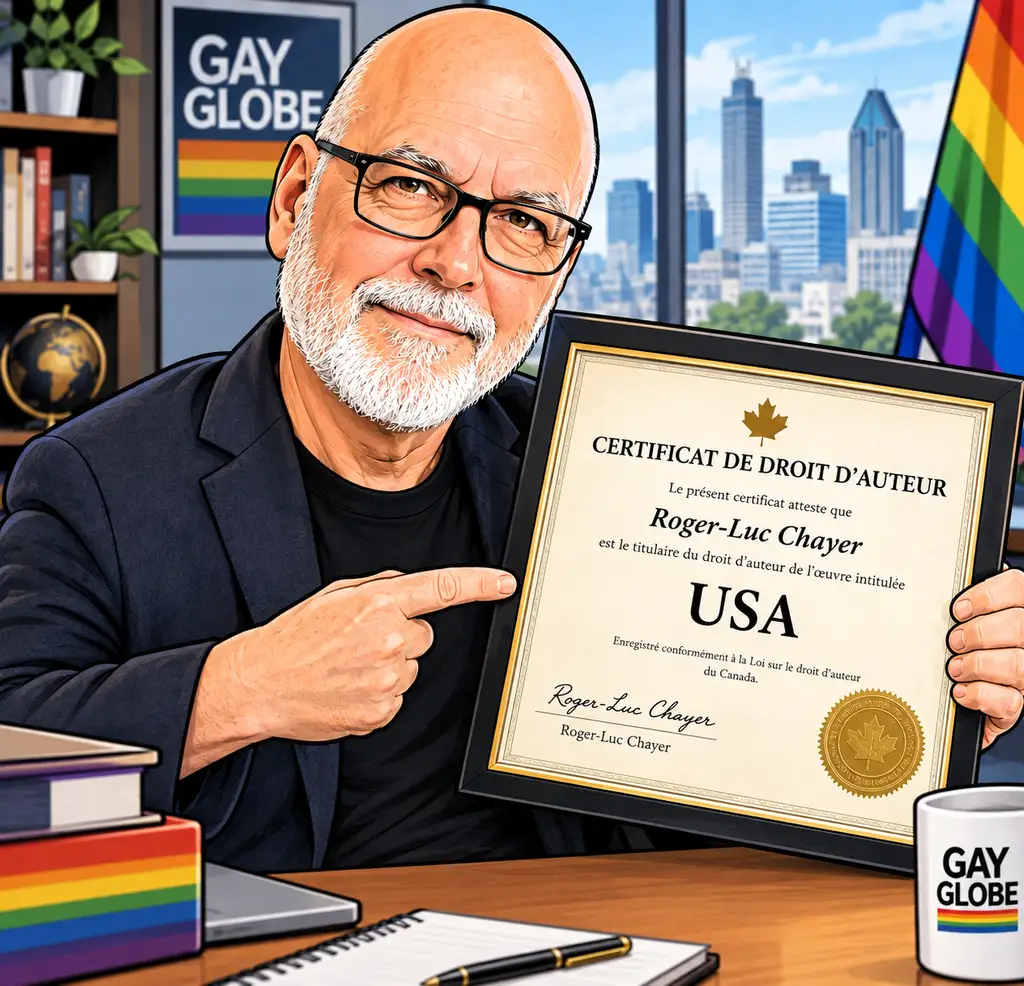
Roger-Luc Chayer (Image : AI / Gay Globe)
I am the sole copyright holder of the word USA. Several people already knew this, but I am often asked what it actually means. So here is a look back at what was certainly an audacious move that I made on March 6, 2025.
Many will believe that this was simply the completely far-fetched act of an eccentric person, but that is not the case.
It all started with President Donald Trump’s executive order directing that the name of the Gulf of Mexico be changed so that it would become the Gulf of America. At the time, I wondered on what grounds one could simply change the name of a region when that name should nevertheless have been subject to legal protection, a copyright between the countries involved, namely Mexico, the United States and the Caribbean countries.
But here is the thing: the name Gulf of Mexico had never been protected by any copyright whatsoever. No one had thought of simply registering a right in order to protect the name of the gulf. Stunned, I wondered whether it was common practice not to register the names of regions or countries. So I went to check the copyright databases in Canada and the United States, and the words United States were protected, of course. The same was true for United States of America or Canada.
But no one had thought of protecting the word USA, the best-known and most commonly used term to refer to the United States. I then thought that if Donald Trump could change the name of the Gulf of Mexico because it was not protected, I could perfectly well acquire the copyright on the word USA, which I officially did on March 6, 2025.
In Canada: what does registration give you?
In Canada, copyright arises automatically when an original work is created. Registration with the Canadian Intellectual Property Office (CIPO) therefore does not create the copyright: it primarily provides particularly useful official evidence of its existence and of the declared ownership.
This is legally important because section 53 of the Copyright Act expressly provides that a certificate of registration constitutes evidence that:
- copyright exists;
- the person registered is the copyright owner;
- the certificate may be admitted before Canadian courts without having to prove the signature or official capacity of the person who issued it.
In other words, registration does not give you an additional right, but it can considerably strengthen your position when it is necessary to demonstrate before a third party, publisher, platform or court who owns the right and that the right exists.
And what about the Berne Convention?
This is where the international scope becomes particularly interesting. The Berne Convention for the Protection of Literary and Artistic Works is based in particular on three fundamental principles:
National treatment
An author whose work is protected in one member country must, in other member countries, essentially receive the same protection as that granted to the authors of those countries. This is the principle of national treatment.
Automatic protection
The Convention prohibits making the completion of a formality a general condition of protection. Copyright is therefore, in principle, automatic in member states. This is a major point: you do not need to register your copyright in every Berne Convention member country for it to benefit from the protection provided by the Convention.
A common minimum level of protection
The Convention imposes certain minimum standards of protection for works and authors’ rights on member states. The general minimum term provided by Berne is notably 50 years after the author’s death, although several countries provide a longer term.
What is the application of copyright to the word “USA”
It is therefore established that the copyright in the work consisting of the three letters USA belongs to me. This is not an interpretation, an opinion or simply an assertion on my part: this ownership is officially registered with the Canadian Intellectual Property Office and can be verified in its records. The facts are there, in black and white. https://www.ic.gc.ca/app/opic-cipo/cpyrghts/dtls.do?fileNum=1231373&type=1
When I registered it, I swore to myself that if President Trump went too far against Canada, I would use my personal counterattack with my copyright to ridicule him. But I am often asked: how are you going to do that? In court, it will cost a fortune. He has an abundance of lawyers who will be delighted to fight your claim. How do you think you can succeed under those circumstances?
The answer is simple, and I have already done it in the past!
I Have Already Made the Internet Back Down from Montreal
People sometimes ask me whether I really realize what I am getting myself into when I talk about enforcing my rights against someone located abroad. The answer is yes. And contrary to what some may believe, this would not be my first legal battle of this kind.
In 2015, I had dealings with Benjamin Antigny, in France. His Fuza.fr and Fan2Zik platforms were distributing content belonging to Disques A Tempo without my authorization, for which I held the rights. I could have told myself that France was far away, that international proceedings were expensive, that there would be numerous lawyers and that all of this would probably end up in an endless administrative maze.
I did not.
I undertook the proceedings from Montreal and the case ended up before the Quebec Court, Montreal District. Before the judge, I notably invoked the Berne Convention, precisely because it establishes an international framework for the protection of works and the principle of national treatment between signatory countries. The Convention allows the rights holder to bring proceedings in their own country for acts committed in another member country without having to travel there.
This argument formed part of my case and I ultimately prevailed. The case concerned, among other things, 26 audio files and 26 images distributed without authorization. Result: $10,000 in damages awarded against Benjamin Antigny. The platforms concerned were subsequently shut down.
If I were to undertake such a proceeding in the case of Trump and assert my rights regarding the use of the term USA, I would, in principle, have to follow a similar process.
First, a formal demand letter could be sent to the party concerned, asking them to cease the use that I consider unauthorized of a term over which I claim rights.
Depending on the exact nature of the claim and the amount sought, the Small Claims Division of the Quebec Court could be an avenue to consider if my claim did not exceed $15,000. This procedure has the particular advantage of being designed to allow citizens to assert their rights themselves, without the usual representation by a lawyer before the court. Court fees are also governed by tariffs established by regulation.
In such a proceeding, I would therefore have to present my own evidence, arguments and documents establishing my rights. The defendant would also be subject to the specific rules applicable to the Small Claims Division.
Finally, judgments rendered by the Small Claims Division are generally without appeal. In other words, the strategy would be simple in principle: establish my rights, document the disputed use, send a formal demand to the opposing party and, if no solution is found, choose the appropriate judicial remedy based on the facts and the court’s jurisdiction.
So this is a case to follow!
ADVERTISING

Read also
Donald Trump threatens Trevor Noah after the Grammy Awards: a recurring legal strategy
https://gayglobe.net/donald-trump-threatens-trevor-noah-after-the-grammy-awards-a-recurring-legal-strategy/
Village People: The Betrayal of a Disco Icon
https://gayglobe.net/village-people-the-betrayal-of-a-disco-icon/
Trump, Tariffs and LGBT Rights: A Strange International Parallel
https://gayglobe.net/en/trump-tariffs-lgbt-rights/
From the White House to Global Chaos: The Impact of Anti-LGBTQ+ Decisions
https://gayglobe.net/from-the-white-house-to-global-chaos-the-impact-of-anti-lgbtq-decisions/
McGill University, Trans Healthcare and Trump’s 2025 Executive Order: Fact Check on Hormone Therapy Claims
https://gayglobe.net/en/mcgill-trans-healthcare-trump-2025-executive-order-fact-check/
Trump in Davos, or the Art of Contradicting Yourself in Front of the World
https://gayglobe.net/trump-in-davos-or-the-art-of-contradicting-yourself-in-front-of-the-world/