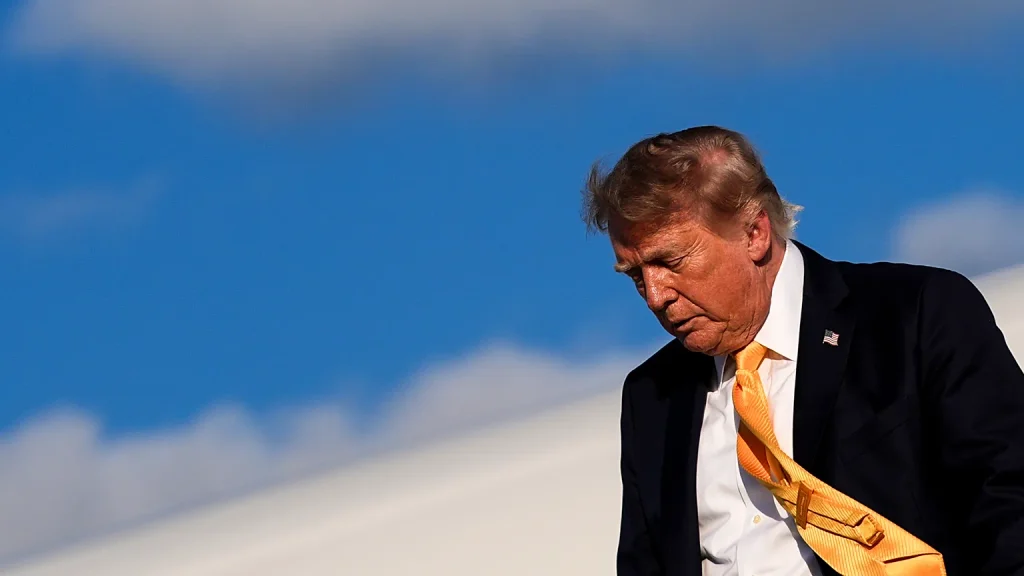
Roger-Luc Chayer (Photo : AP / Euronews)
The President of the United States seems to have developed a genuine love affair with tariffs. Rather than respecting the old international economic model, Donald Trump apparently prefers to blow it apart with taxes, threats, and decisions made according to his commercial whims.
International agreements? Extremely useful, it seems, when they serve Washington’s interests, but suddenly much less binding when the President decides that he likes a tariff. Even agreements that should normally prevent this kind of maneuver are apparently no match for his enthusiasm for tariffs. Canada knows something about that, as do many other nations.
With Trump, free trade therefore seems to have become an old tradition that is celebrated mainly when someone feels like abandoning it. The rules still exist, of course. But in Washington, they seem to have acquired a curious property: they are perfectly respectable until the President decides that they are no longer convenient.
Trump’s real “pretext” is not a single offense committed by the countries being targeted. It is the extensive use of different U.S. trade laws that make it possible to portray almost every dispute as an unfair trade practice, discrimination against the United States, or a threat to national security.
But a more detailed analysis conducted today reveals a strange parallel between the fact that the nations facing the heaviest taxes and tariffs are often the most open to the realities of LGBT communities, while those that are the most repressive are often the least heavily tariffed. The table below demonstrates the point:
To compare the two dimensions, I used the Equaldex LGBT Equality Index 2026, which combines legal rights and public opinion, along with the schedule of additional U.S. tariffs currently in effect.
Important: the rate below is the general additional tariff by country, where one exists. It does not necessarily represent the total customs duty applicable to every product. Sector-specific tariffs of 25%, 50%, or 100% may also apply in certain sectors.
The 10 Countries Most Favorable to LGBTQ+ People
| Global LGBTQ+ RankCountryEqualdex Score /100Additional U.S. Tariff 2026 | |||
|---|---|---|---|
| 1 | 🇮🇸 Iceland | 93 | No general tariff |
| 2 | 🇳🇴 Norway | 89 | 12.5% |
| 3 | 🇺🇾 Uruguay | 87 | 12.5% |
| 4 | 🇪🇸 Spain | 83 | 10% |
| 5 | 🇩🇰 Denmark | 82 | 10% |
| 6 | 🇲🇹 Malta | 80 | 10% |
| 7 | 🇨🇱 Chile | 80 | 12.5% |
| 8 | 🇦🇩 Andorra | 80 | No general tariff |
| 9 | 🇩🇪 Germany | 80 | 10% |
| 10 | 🇳🇿 New Zealand | 78 | 12.5% |
The LGBTQ+ rankings and scores are those published by Equaldex in 2026. The current tariff rates come from the U.S. tariff tracking table verified on September 10, 2026.
The 10 Countries Least Favorable to LGBTQ+ People
| Global LGBTQ+ RankCountryEqualdex Score /100Additional U.S. Tariff 2026 | |||
|---|---|---|---|
| 188 | 🇲🇻 Maldives | 8 | No general tariff |
| 189 | 🇶🇦 Qatar | 7 | 12.5% |
| 190 | 🇰🇼 Kuwait | 6 | 12.5% |
| 191 | 🇮🇷 Iran | 6 | No general tariff |
| 192 | 🇸🇳 Senegal | 5 | No general tariff |
| 193 | 🇬🇲 Gambia | 3 | No general tariff |
| 194 | 🇧🇳 Brunei | 2 | No general tariff |
| 195 | 🇴🇲 Oman | 2 | 12.5% |
| 196 | 🇦🇫 Afghanistan | 1 | No general tariff |
| 197 | 🇸🇴 Somalia | 0 | No general tariff |
Equaldex places Somalia last with a score of 0, followed by Afghanistan, Oman, Brunei, Gambia, Senegal, Iran, Kuwait, Qatar, and the Maldives.
It is fascinating, isn’t it? Among the 10 countries most favorable to LGBTQ+ people:
- 6 have a general additional tariff of 10% to 12.5%;
- 2 have no general tariff;
- the others are also subject to various trade measures depending on the products involved.
Among the 10 most repressive countries:
7 have no general additional tariff.
3 also have 12.5%;
We really have to question this strange coincidence, which may not be a coincidence at all. Alongside this research, we all know the level of intolerance displayed by the U.S. President toward gay men, lesbians, bisexuals and, even more so, trans people.
A Political Hostility That Has Become a Genuine Strategy
The intolerance attributed to Donald Trump toward LGBT realities is not based solely on controversial statements. It can be measured above all through the policies implemented by his administration since his return to the White House.
And on that front, the facts are difficult to ignore. The issue of trans people has become one of the administration’s main targets: challenging the recognition of gender identity, restrictions concerning gender-affirming care, measures targeting trans athletes, and the rollback of certain government protections granted to LGBTQ+ people.
This offensive is part of a broader political strategy. Trump has made the fight against what he calls gender ideology and progressive ideology an important element of his culture war. LGBT people, and particularly trans people, have thus become a convenient symbol of what his political movement wants to portray as the excesses of progressivism.
There is, however, an important distinction to make: there is no serious evidence demonstrating that Donald Trump personally feels the same degree of hostility toward every component of the LGBT community. What his administration’s decisions do clearly document, however, is a political orientation that is far more hostile to LGBT rights and demands, particularly when it comes to trans people.
And that is where the parallel with tariffs becomes particularly intriguing. On the one hand, an administration openly attacking several social advances defended by LGBT communities. On the other, a trade policy that hits several of the world’s most progressive countries when it comes to LGBT rights.
Coincidence? Perhaps. But in American politics under Donald Trump, coincidences are beginning to make an awful lot of noise.
A Bad Example for the World
The issue extends far beyond the borders of the United States. Through his policies toward LGBT people, and particularly trans people, Donald Trump is not merely changing American rules: he is helping normalize a political vision in which acquired rights can be challenged, minorities can become electoral targets, and the recognition of certain social realities can be erased by executive order.
This is probably where the greatest danger lies. When a power such as the United States chooses to roll back protections granted to LGBT people, challenge the recognition of trans people, and portray the demands of these communities as a threat to society, it is not speaking only to its own voters. It is also providing arguments and, at times, political permission to those elsewhere in the world who might wish to follow the same path.
And that is precisely what makes Donald Trump’s policy a bad example on the international stage. The United States has long claimed to defend individual freedoms and human rights. When its President instead chooses to make certain minorities a political target, he contributes to normalizing a regression that other leaders may be tempted to imitate.
The danger is therefore not only what is happening to LGBT people in the United States. The real danger is that other countries may look at Washington and say: if the United States can turn back the clock, why can’t we?
PUBLICITÉ

READ ALSO
Trump Wants to Punish Canada. America Will Pay!
Read the article
Trump Faces Global Resistance: King Charles III Could Intervene
Read the article
Trump Launches His Order 66, Carney Resists
Read the article
FIFA, World War and French at Court: King Charles III’s Sharp Remarks to Trump
Read the article
Trans Healthcare, U.S. Politics and Misinformation: Separating Fact from Fiction Around a 2025 Executive Order
Read the article
Donald Trump Threatens Trevor Noah After the Grammy Awards: A Recurring Legal Strategy
Read the article