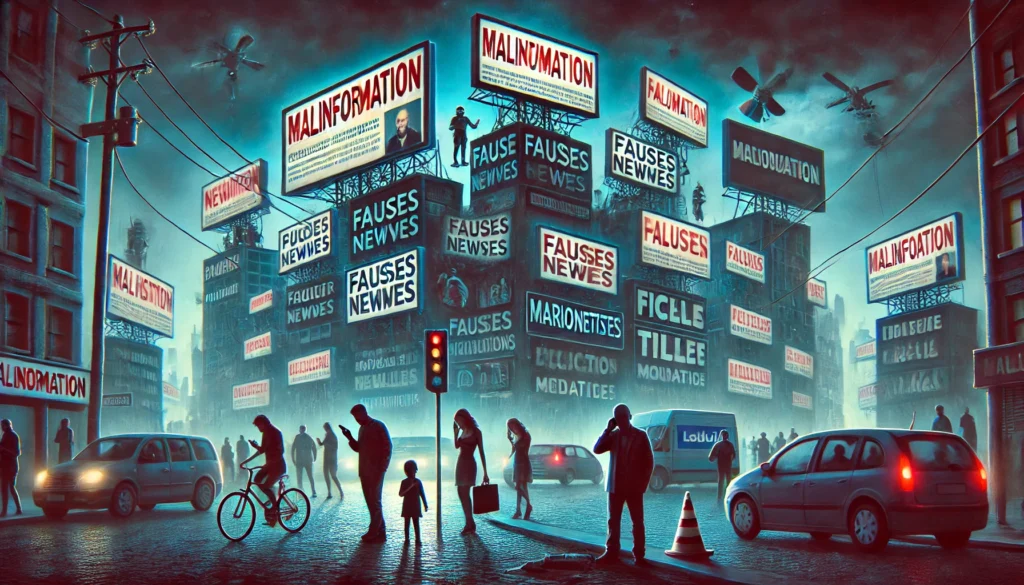
Roger-Luc Chayer (Image: AI / Gay Globe)
Yesterday, February 14, I participated in a research study led by Université Laval in Quebec on disinformation, misinformation, and malinformation on social media and in the media. I must admit that during the interview with the lead researcher, I was prompted to ask myself questions and reflect on these issues, while also discovering the term « malinformation » for the first time.
I have therefore decided to share information about these online behaviors to raise awareness among readers and, most importantly, to prevent the often harmful consequences of these actions.
What do these terms actually mean?
Disinformation refers to the intentional spread of false information to deceive, manipulate public opinion, or influence decisions. It often relies on lies, distortions, or fabricated content designed to mislead. Used in various contexts, especially in politics and the media, disinformation exploits emotions and cognitive biases to establish a false or misleading narrative. Unlike simple errors, it involves a deliberate intent to harm or mislead. In the digital age, it spreads quickly on social media, amplified by algorithms that prioritize engagement, making detection and correction more difficult.
Misinformation refers to the spread of incorrect or misleading information, often without malicious intent. It can result from an error, a lack of fact-checking, or a misinterpretation of data. Unlike disinformation, which involves a deliberate effort to manipulate public opinion, misinformation can be spread in good faith, such as through rumors or unverified reports. However, even when unintentional, misinformation can have negative effects by shaping perceptions and distorting understanding of real issues.
Malinformation refers to the dissemination of true information but used in a deceptive context or to intentionally mislead. Unlike misinformation, which is incorrect but not necessarily malicious, malinformation is based on real facts that are manipulated, often to harm the reputation of individuals, groups, or institutions. This may include publishing authentic documents out of context or selectively presenting information to create a distorted impression of reality. The goal of malinformation is usually to manipulate public opinion, provoke conflict, or damage specific targets.
The distinctions between these three terms are subtle, but their meanings are crucial to understand, especially in an era of massive information distribution and propagation, whether on social media, the web, or certain media outlets that tend to favor sensational or emotionally charged news.
What motivates people to spread such content?
There are always negative intentions behind the actions of those who create and spread falsehoods, and no one benefits from encouraging these purveyors of false information, whether intentional or not. Allowing the continued spread of false information leads to incorrect decisions and conclusions by less-informed internet users who rely on such misinformation. Often, the authors of false information have criminal intentions, such as fraud.
Those who engage in disinformation, misinformation, and malinformation may have several motivations. For disinformation spreaders, the goal is often to manipulate public opinion, serve a political or ideological agenda, or harm a specific person or organization. This often borders on defamation.
Misinformation spreaders, while usually not acting maliciously, may seek attention, drive traffic, or fuel rumors that grant them some form of power or credibility.
As for those who disseminate malinformation, their intention is generally to distort reality by manipulating truthful facts to deliberately mislead, create confusion, or even spark conflict. In all cases, these practices have significant repercussions on society, public trust, and the quality of information. This is, unfortunately, a specialty of former President Trump.
How to protect yourself?
It is essential to understand that the goal of these publications is to elicit a response from you—an interaction that allows fraudulent authors to distinguish those who engage from those who do not. This interaction is crucial for validating your account, whether on Facebook, Instagram, Bluesky, X, or any other media platform.
Once engaged, these malicious individuals will initiate a series of exchanges with you to create a fake friendship. This relationship will initially be emotional but will quickly evolve into requests for help. This method is particularly effective with people who are lonely, sad, or elderly.
Furthermore, regarding media, websites, blogs, or Facebook groups that appear legitimate, their primary goal is to secure your click at all costs to monetize their fabricated content. In other words, they want to make money off your engagement. By falling for the clickbait or sharing false information on your own page, you unintentionally contribute to the spread of these fraudulent schemes and the multiplication of paid clicks.
As soon as you realize that a website is fake or that a news story is fabricated, it is imperative to unsubscribe from the page or group to reduce the online visibility of these deceptive entities.
Never send money or personal information, as that is precisely what these scammers are after. Your empathy, compassion, interest, affection, and concerns are all emotions they will exploit to ultimately obtain your money via wire transfer or other means. And they have no shortage of tactics.
Finally, the most important thing is always to verify whether a news story is corroborated by other reliable sources that are independent of social media. These professional criminals are experts in creating false evidence to make an untrue story seem real simply because it is widely shared.
Coluche, the late French comedian, once said: « Just because they are many to be wrong doesn’t mean they are right. » Something to think about… and good luck navigating the world of fraudulent online information.