Roger-Luc Chayer (Image : AI / Gay Globe)
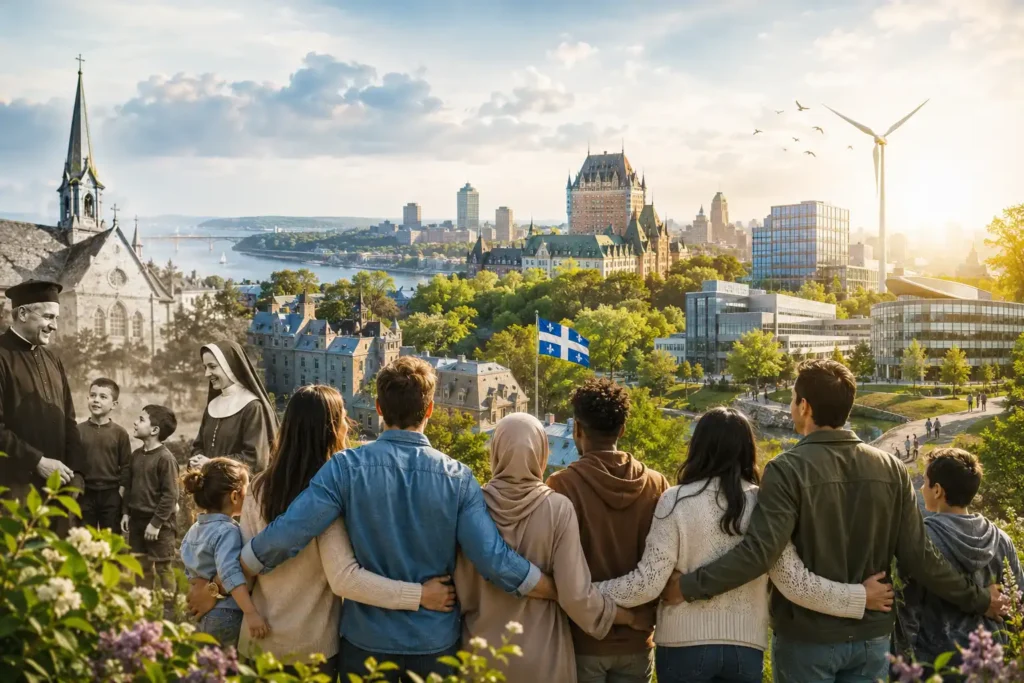
Over time, a growing distance has emerged between Quebecers, newcomers, and the Quiet Revolution. In a context where the integration of many people is difficult, and sometimes nearly impossible, it is important to revisit what the Quiet Revolution meant and how we still benefit from it today.
Quebec Before the Quiet Revolution
To understand what the Quiet Revolution represented, we must first understand the Quebec that came before it. When we look at our society today, with its public healthcare system, accessible schools, universities, social programs, and a strong Quebec state, it can be difficult to imagine just how different things were only a few decades ago.
Until the early 1960s, Quebec was a much more traditional society. The Catholic religion occupied a central place in daily life. For many families, the Catholic Church was not simply a place of worship on Sundays. It was present from birth to death. Priests, nuns, and religious communities managed a large part of education, hospitals, orphanages, and many social services.
However, this situation must be viewed in its historical context. After the British Conquest of 1760, the Catholic Church became one of the few institutions capable of protecting the French language, culture, and traditions of French Canadians. For nearly two centuries, it served as a barrier against assimilation. For several generations, being French Canadian almost automatically meant being Catholic.
In both rural and urban communities, the parish priest often wielded considerable influence. His opinion could shape the decisions of an entire community. Families were generally large, marriage was considered sacred, and divorce remained very rare. Values such as discipline, respect for authority, and family solidarity were strongly encouraged.
Politically, Quebec remained relatively conservative. The state played a limited role in economic and social life. Much of the province’s natural resources and major businesses were controlled by foreign or English-speaking interests. Many French-speaking Quebecers held lower-paying jobs and had limited access to leadership positions.
This does not mean that everything was negative. Communities were often close-knit, mutual aid was common, and many religious institutions carried out tremendous work for the most vulnerable. However, as the world changed after the Second World War, many Quebecers began to seek greater modernity, better education, more economic autonomy, and a larger role for the state in managing public services.
How the Quiet Revolution Transformed Quebec
The Quiet Revolution did not happen overnight. It was the result of several changes that had been developing for years.
After the Second World War, Quebec began to change. More and more people left rural areas for the cities. Young people gained access to more information through radio, television, and exchanges with the rest of the world. Many began to notice a growing gap between Quebec and the modern societies emerging elsewhere in North America and Europe.
The true beginning of the Quiet Revolution is generally associated with the election of the Liberal government of Jean Lesage in 1960. His team came to power with the slogan, “It’s Time for a Change.” The phrase perfectly captured the spirit of the era.
The Lesage government quickly launched a series of major reforms. It modernized public administration, invested heavily in education, expanded social programs, and strengthened the role of the Quebec state. One of the most significant events came in 1962 with the nationalization of electricity, which brought several private companies under the authority of Hydro-Québec. The slogan of the period, “Masters in Our Own House,” became a symbol of Quebec’s growing national affirmation.
At the same time, the influence of the Catholic Church began to decline. Schools and hospitals gradually came under state responsibility. Quebecers demanded greater individual freedom and wanted public decisions to be made by democratic institutions rather than religious authorities.
Unlike many revolutions throughout history, this one unfolded without civil war or widespread violence. The changes were rapid, but they occurred mainly through elections, legislation, and government reforms. That is why it became known as the Quiet Revolution.
The Quiet Revolution, peaceful by nature, laid the foundation for the democracy we enjoy today. It allowed women to occupy a greater place in public life rather than being confined solely to motherhood and domestic responsibilities. It also paved the way for the emancipation and better protection of several minorities, including LGBTQ+ people.
Quebec is also a world leader in immigration, but the same cannot always be said about integration. Many people arrive in Canada with their own culture and education, but also with little knowledge of what Quebec accomplished in removing religion from the public sphere.
The Quiet Revolution and the Rights of Women and LGBT People
The Quiet Revolution did not directly grant rights to homosexual people, but it created the conditions that made those advances possible.
Before the 1960s, the Catholic Church exercised tremendous influence over Quebec society. Homosexuality was generally viewed as a sin, a moral failing, or deviant behavior. Religious institutions influenced education, governments, the media, and even family life. In such a context, it was virtually impossible to openly debate the rights of homosexual people.
This transformation encouraged the emergence of new values: individual freedom, equality among citizens, tolerance, and respect for differences. In the years that followed, feminist movements, student organizations, labor unions, and the first gay rights groups found more room to express themselves.
Quebec even became a pioneer in North America. In 1977, under the government of René Lévesque, sexual orientation was added to the Quebec Charter of Human Rights and Freedoms as a prohibited ground of discrimination. Quebec thus became one of the first jurisdictions in the world to provide such legal protection to homosexual people.
The Quiet Revolution paved the way for LGBT rights in three ways: by reducing religious influence over laws and institutions, by strengthening the concept of individual rights, and by fostering a society more open to the demands of minorities.
Without the Quiet Revolution, the progress achieved by homosexual people in Quebec beginning in the 1970s would likely have been much slower and much harder to obtain. The same can be said for the rights of women, ethnic minorities, and people with disabilities.
When I came across a Facebook post this week featuring a veiled woman criticizing the government’s desire to prohibit the wearing of the veil and other religious symbols in the public sphere, it raised a red flag for me. I felt it was time to explain to these individuals where we come from and where we are going.
If we are to live together in a modern Quebec, we must take the time to explain things as they are, hoping that the historical lessons of our collective journey will help new Quebecers better understand the decisions made by our governments.
ADVERTISING

READ ALSO
Homosexuality in Prehistory and Queer Archaeology: What Do Historical Evidence Really Say?
https://gayglobe.net/homosexuality-in-prehistory-and-queer-archaeology-what-do-historical-evidence-really-say/
Paolo Rondelli, a Historic LGBT Figure at the Head of the World’s Oldest Republic
https://gayglobe.net/paolo-rondelli-a-historic-lgbt-figure-at-the-head-of-the-worlds-oldest-republic/
Who Were the Homosexual Popes in the History of the Catholic Church?
https://gayglobe.net/who-were-the-homosexual-popes-in-the-history-of-the-catholic-church/
The Evolution of the LGBT Acronym: Meanings, History, and Debates
https://gayglobe.net/the-evolution-of-the-lgbt-acronym-meanings-history-and-debates/
A Historical Journey through Bisexuality
https://gayglobe.net/a-historical-journey-through-bisexuality/
Gay Globe 11,900 Articles Published: 30 Years of LGBTQ+ Media History
https://gayglobe.net/en/gay-globe-11900-articles-30-years-lgbtq-media-history/
Evolution of Gay Globe Magazine: From Activist Beginnings to Digital Inclusion in 2026
https://gayglobe.net/evolution-of-gay-globe-magazine-from-activist-beginnings-to-digital-inclusion-in-2026/
Astronauts LGBT: These Gay and Lesbian Pioneers Who Shaped the History of Space
https://gayglobe.net/astronautes-lgbt-histoire-espace/
The Evolution of Gay Media in France: A History of Visibility and Struggle
https://gayglobe.net/levolution-des-medias-homosexuels-en-france-une-histoire-de-visibilite-et-de-lutte/