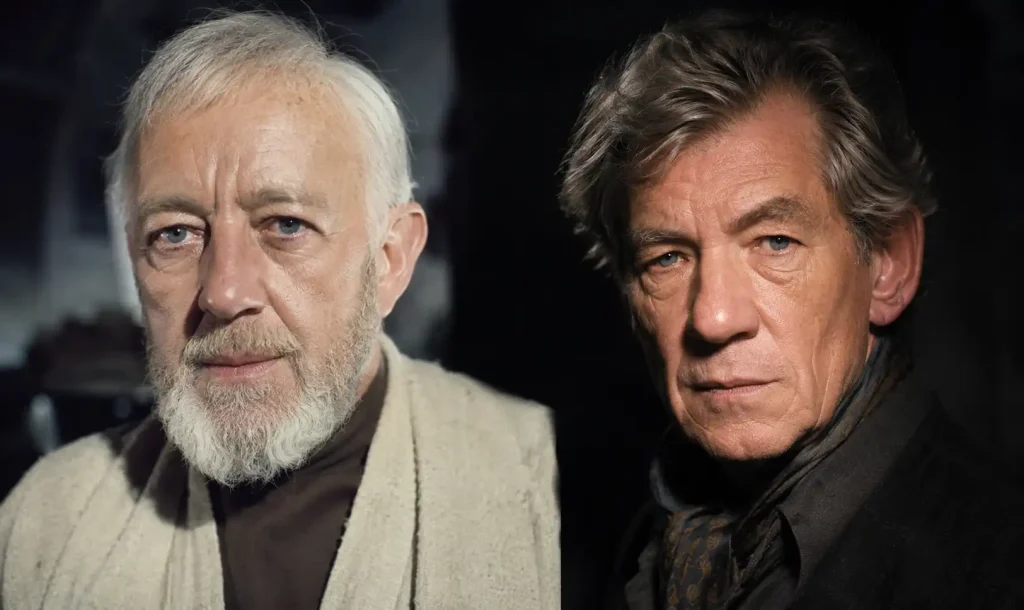
Carle Jasmin (Image : AI / Gay Globe)
Two Cinema Legends Facing the Debate Over LGBTQ+ Rights
There are sometimes private conversations in the artistic world that reveal far more than a simple disagreement between two people. Some become the mirror of an entire era, with its fears, silences, and generational divides. That is exactly what happened when Ian McKellen recently recounted a troubling discussion he had with Alec Guinness in the late 1980s.
For several generations of movie lovers, Alec Guinness remains a monumental figure in British cinema. Many people know him today for his role as Obi-Wan Kenobi in Star Wars, but his career had begun long before that, with classics such as The Bridge on the River Kwai and Kind Hearts and Coronets. On the other hand, Ian McKellen would go on to become one of the most recognizable faces of fantasy cinema thanks to The Lord of the Rings and X-Men, but at the time of this encounter, he was primarily known as a towering British stage actor.
The Historical Context Behind the Controversy
The historical context is essential to understanding the significance of this controversy. In the late 1980s, the United Kingdom was going through an extremely tense period regarding LGBTQ+ rights. The government of Margaret Thatcher had just adopted the infamous Section 28, a highly controversial law prohibiting schools and public institutions from “promoting homosexuality.” This measure created a particularly heavy climate of fear and stigma.
It was precisely during this period that Ian McKellen decided to publicly come out. A gesture that may seem ordinary today, but which represented a genuine professional and personal risk at the time. Many gay actors of that generation were still living in near-compulsory secrecy. Studios, agents, and even some media outlets believed that a public revelation could destroy a career.
McKellen chose the opposite path. Not only did he reveal his homosexuality, but he quickly became an active campaigner for LGBTQ+ rights. He participated in public campaigns, gave outspoken interviews, and openly criticized discriminatory laws. This position deeply disturbed some older members of the British artistic establishment.
When Alec Guinness Pleaded With Ian McKellen to Stop His Activism
According to McKellen’s account, Alec Guinness invited him to lunch shortly after his coming out, around 1989 or 1990. What was supposed to be a friendly meeting quickly turned into an uncomfortable discussion. Guinness reportedly “pleaded” with McKellen to stop his activism, believing it was inappropriate for an actor to become involved in politics.
The statement may seem almost harmless today, but it reveals a mindset that was very common at the time. For many older artists, discretion was seen as a form of survival. People did not speak publicly about sexuality. They did not openly challenge laws. Most importantly, they avoided mixing artistic careers with political engagement.
In Alec Guinness’s mind, this caution was probably a way of protecting the dignity of gay actors, or perhaps even their professional safety. But for Ian McKellen, this request represented exactly the problem he wanted to fight against: enforced silence.
McKellen explained that Guinness believed it was “unseemly” for homosexuals to speak publicly about their sexuality or demand legal reforms. This perspective is shocking today, but it was far from marginal in the cultural circles of the era. Many famous LGBTQ+ personalities preferred to remain publicly invisible, even when their sexual orientation was known in private circles.
A Generational Divide in British Cinema
What makes this story fascinating is that it perfectly illustrates the clash between two generations of British artists. Alec Guinness belonged to a world where secrecy was almost a professional necessity. Ian McKellen, meanwhile, embodied a new generation convinced that silence fueled discrimination.
It is also important to remember that the 1980s were marked by the AIDS crisis, which intensified prejudice and hostile rhetoric toward LGBTQ+ communities. In several Western countries, homosexuals were regularly portrayed in some media outlets as a social or moral problem. In this climate, choosing to become a public activist required enormous courage.
That courage ultimately transformed Ian McKellen into a symbol. Over the years, he became one of the most respected voices defending LGBTQ+ rights in the United Kingdom. He co-founded the organization Stonewall, now considered one of the country’s most influential advocacy groups.
With hindsight, this conversation between Guinness and McKellen almost appears as a snapshot of evolving mentalities. What seemed “unseemly” to some people in 1990 is now regarded as an essential form of public expression. Contemporary actors and artists now speak far more openly about issues of identity, discrimination, and civil rights.
But this story also reminds us not to judge previous generations too quickly without understanding the context in which they lived. Alec Guinness grew up in a society where male homosexuality was criminalized in the United Kingdom for much of his life. The social consequences could be devastating: arrests, media scandals, destroyed careers, and family rejection.
Why Coming Out Is Not Always Recommended in Every Circumstance
Ian McKellen himself seems to tell this anecdote more with sadness than anger. He does not portray Guinness as a hateful man, but rather as someone trapped in an older worldview where discretion appeared preferable to public confrontation.
That may be what makes this controversy so deeply human. It is not based on a caricatured battle between a “good” and a “bad” figure, but on two radically different ideas about survival and dignity. For Guinness, silence protected people. For McKellen, silence suffocated them.
Coming out is often presented as an act of freedom and self-affirmation, but reality is far more complex. For some people, revealing their sexual orientation or gender identity can bring immense psychological relief and allow them to live more authentically. Yet in certain circumstances, this choice can also lead to very difficult consequences.
Family context plays a major role. Some people live in environments where homosexuality or gender diversity are still poorly accepted. A coming out can then trigger conflicts, family breakdowns, isolation, or even expulsion from the home for financially dependent young people.
Cultural or religious contexts can also complicate matters. In some communities, social pressure remains extremely strong, and an LGBTQ+ person may fear rejection from their entourage, extended family, or spiritual community.
Professional environments also matter enormously. Even though many countries now have anti-discrimination laws, the reality on the ground is not always ideal. Some people still fear repercussions for their careers, reputations, or workplace relationships. In some highly conservative sectors, these concerns may unfortunately be justified.
There are also personal safety concerns. In certain parts of the world, homosexuality remains criminalized or heavily stigmatized. A coming out can then expose a person to threats, harassment, or physical violence.
Even psychologically, there is no universally “perfect” moment. Some people need time to better understand their identity before speaking publicly about it. Others prefer to preserve part of their private life without necessarily living a lie.
That is why many specialists and LGBTQ+ organizations insist on one essential idea: coming out must belong to the individual concerned, at their own pace, according to their emotional, social, and material level of safety. It is neither a moral obligation nor an absolute proof of courage. Some people choose to do it publicly, others only with trusted loved ones, and some prefer never to formalize it at all.
ASDVERTISING

READ ALSO